

HR Recruiting Process KPI Dashboard




Try Before you Buy Download Free Sample Product
 Impress Your
 Audience
 100%
100% Editable
 Save Hours
 of Time


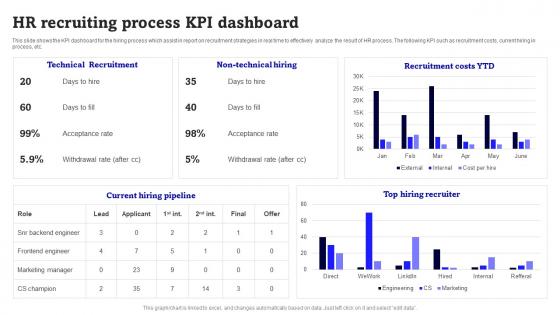
This slide shows the KPI dashboard for the hiring process which assist in report on recruitment strategies in real time to effectively analyze the result of HR process. The following KPI such as recruitment costs, current hiring in process, etc.
People who downloaded this PowerPoint presentation also viewed the following :
HR Recruiting Process KPI Dashboard with all 7 slides:
Use our HR Recruiting Process KPI Dashboard to effectively help you save your valuable time. They are readymade to fit into any presentation structure.






FAQs for HR Recruiting
Critical HR recruiting KPIs include time-to-fill, cost-per-hire, quality of hire, source effectiveness, and candidate satisfaction scores. These metrics enable organizations to streamline recruitment processes, optimize resource allocation, and enhance candidate experiences, with many companies finding that tracking these KPIs ultimately delivers faster hiring cycles and improved talent acquisition outcomes.
Organizations align recruiting KPIs with business objectives by mapping talent metrics to strategic goals, establishing quality-over-quantity measures, and tracking long-term performance indicators like retention and productivity. Through integrated dashboards and regular stakeholder collaboration, companies ensure recruiting efforts directly support growth targets, operational efficiency, and competitive positioning, ultimately delivering sustainable workforce capabilities that drive business success.
Time-to-fill and time-to-hire metrics serve as critical benchmarks for recruitment efficiency, measuring the speed from job posting to offer acceptance and from candidate application to hiring decision respectively. These metrics enable HR teams to identify bottlenecks, streamline hiring processes, and reduce vacancy costs, with many organizations finding that faster, more efficient recruitment delivers competitive advantage in securing top talent.
Candidate quality can be quantified through performance ratings, retention rates, time-to-productivity metrics, cultural fit assessments, and hiring manager satisfaction scores. These measurements enable HR teams to track long-term recruiting success by evaluating how new hires perform in their roles, with many organizations finding that tracking post-hire performance ultimately delivers better talent acquisition strategies and reduced turnover costs.
**INPUT**: What techniques can be used to measure the candidate experience as a recruiting KPI? **OUTPUT**: Candidate experience measurement techniques include post-interview surveys, application completion rates, candidate net promoter scores, feedback response rates, and time-to-feedback metrics. These approaches enable HR teams to identify friction points, streamline communication processes, and enhance touchpoint quality, with many organizations finding that improved candidate experiences significantly boost employer brand reputation and attract top talent.
Hiring manager satisfaction scores provide crucial insights into recruitment quality by measuring whether new hires meet role expectations, integrate effectively, and deliver anticipated performance outcomes. These scores help HR teams refine sourcing strategies, improve candidate screening processes, and enhance hiring manager collaboration, ultimately reducing turnover costs while ensuring recruitment efforts align with organizational needs and long-term talent retention goals.
Diversity hiring metrics can be incorporated through tracking representation percentages across demographics, measuring diverse candidate pipeline ratios, monitoring interview-to-hire conversion rates by group, and evaluating sourcing channel effectiveness for underrepresented talent. These metrics enable organizations to identify recruitment gaps, enhance employer branding, and build more inclusive teams, with many companies finding that strategic diversity tracking ultimately delivers broader talent pools and improved organizational performance.
Cost-per-hire is calculated by dividing total recruitment expenses (advertising, recruiter salaries, technology costs, interview expenses) by the number of hires made within a specific period. Organizations optimize this metric by leveraging digital recruitment platforms, streamlining interview processes, and enhancing employee referral programs, with many companies finding that strategic automation and targeted sourcing ultimately reduce costs while improving candidate quality and hiring speed.
Recruiting KPI automation tools include applicant tracking systems (ATS), HR analytics platforms, CRM integrations, dashboard software, and AI-powered recruitment analytics. These technologies streamline data collection, real-time reporting, and predictive analysis by eliminating manual tracking, centralizing candidate information, and generating automated insights, ultimately delivering faster hiring decisions and enhanced recruitment efficiency.
Employee retention rate serves as an indirect recruitment KPI by reflecting how well recruiting processes identify candidates who align with company culture, role requirements, and long-term organizational goals. High retention rates indicate effective screening, assessment, and candidate matching strategies, while low retention suggests recruitment processes may prioritize speed over quality, ultimately delivering insights into hiring effectiveness and helping organizations refine their talent acquisition approaches for sustainable workforce stability.
Recruitment KPI measurement challenges include inconsistent data collection, subjective quality assessments, attribution complexities across multiple touchpoints, and difficulty tracking long-term employee success metrics. These obstacles can be overcome by implementing standardized tracking systems, establishing clear quality criteria, using integrated analytics platforms, and combining quantitative metrics with qualitative feedback, ultimately delivering more accurate insights that enhance hiring decisions and organizational performance.
Social media engagement metrics inform recruiting strategies by revealing candidate preferences, content performance, and brand perception across platforms like LinkedIn, Twitter, and Instagram. These insights enable HR teams to optimize job postings, refine employer branding messaging, and target high-engagement demographics more effectively, ultimately reducing time-to-hire while attracting quality candidates through data-driven content strategies.
Referral program metrics significantly influence recruitment effectiveness by reducing time-to-hire, lowering cost-per-hire, and improving candidate quality through employee networks and trusted recommendations. Organizations with strong referral programs find that referred candidates demonstrate higher retention rates, faster onboarding, and better cultural fit, ultimately delivering enhanced recruitment ROI and stronger talent pipelines.
Recruitment KPIs should shift focus from growth-oriented metrics like hiring velocity during expansion to quality-focused measures like cost-per-hire and retention rates during downturns, while emphasizing skills adaptability and internal mobility. Economic uncertainty requires balancing candidate experience scores with budget efficiency metrics, with many organizations finding that flexible KPI frameworks enable strategic pivots while maintaining talent pipeline strength across market cycles.
Onboarding success serves as a critical validation metric for recruitment KPIs, measuring how well new hires integrate, perform, and remain with the organization during their first 90-180 days. Strong onboarding completion rates and early performance indicators reflect effective recruitment processes, with many companies finding that seamless onboarding directly correlates with long-term retention and productivity outcomes.
-
Excellent design and quick turnaround.
-
I have been using SlideTeam for the past six months. Very happy and satisfied!