


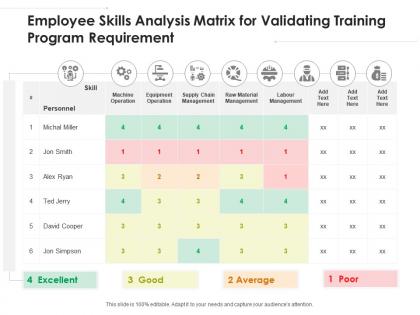
Employee skills analysis matrix for validating training program requirement




Try Before you Buy Download Free Sample Product
 Impress Your
 Audience
 100%
100% Editable
 Save Hours
 of Time


Our Employee Skills Analysis Matrix For Validating Training Program Requirement are topically designed to provide an attractive backdrop to any subject. Use them to look like a presentation pro.
People who downloaded this PowerPoint presentation also viewed the following :
Employee skills analysis matrix for validating training program requirement with all 2 slides:
Use our Employee Skills Analysis Matrix For Validating Training Program Requirement to effectively help you save your valuable time. They are readymade to fit into any presentation structure.
FAQs for Employee skills analysis matrix for validating
So a skills matrix is like a spreadsheet where you list everyone's names on one side and all your team's key skills across the top. Then you rate each person's level for each skill - super straightforward. The cool thing is you can instantly see who's good at what and where you're totally screwed if someone leaves. Makes assigning projects way easier too. Plus you'll spot training needs before they become problems. Honestly, I've seen teams wing it without one and it always bites them later. Just start basic - pick your most important skills and rate everyone 1-5 or whatever works.
First thing - grab your job descriptions but don't trust them completely since they're usually garbage or written years ago. Chat with your best people about what actually makes them good at their jobs day-to-day. That's where the gold is. Cross-check this against any gaps you've spotted during reviews or when projects went sideways. I'd also sneak a peek at similar roles at competitor companies. Focus on skills that directly help your team crush their goals. Skip the fancy stuff that just looks good on paper but doesn't move the needle.
First thing - figure out what skills you actually need, including the weird specific ones nobody talks about. Rate everyone 1-5 and don't sugarcoat it. I've watched people create these fantasy matrices where everyone's magically proficient at everything. Get your team involved or they'll think it's BS. Skills change so fast these days, so update it regularly. Here's the thing though - only focus on gaps that genuinely impact what you're trying to accomplish. Otherwise you're just making spreadsheets for fun. Then actually use the thing for training decisions and who gets assigned to what projects.
So basically, you map out what skills each role needs, then see where everyone actually stands right now. Way more useful than just sending people to random training sessions that may or may not help. I'd start small - pick like 5-8 key skills for one position and rate your team on those. Then you can see exactly what gaps need filling and who's maybe ready to level up. It's honestly pretty eye-opening once you get it set up. Think of it like a GPS for career development instead of just wandering around hoping you'll stumble onto the right path.
So basically, map out what skills your team has now versus what you actually need. Then when you're interviewing people, you can see if they fill real gaps or just add more of the same stuff. I swear this saves you from hiring someone amazing who doesn't actually solve your problems - been there, done that. You'll write way better job postings too since you know exactly what matters. Oh, and do the team audit first before posting anything new. Makes such a difference in finding the right person instead of just any person.
Honestly, quarterly check-ins work best for this stuff. Have your team self-assess first using like a 1-5 scale, then you add your take. Three months hits the sweet spot - any longer and you'll miss how fast people actually improve. Focus on real examples from recent work, not vague feedback. Also track what new skills they're hungry to learn, not just rating what they already do. The whole thing should feel like a normal conversation, definitely not some formal review process (ugh). Oh, and update your matrix right after - trust me, you'll forget the details otherwise!
Yeah, totally! Skills matrices are great for this. Map out what skills you need vs what people actually have - the gaps become pretty obvious. I'd start with your most critical stuff first though. What's really eye-opening is seeing when one person knows everything about something important. That's honestly terrifying if they quit or get hit by a bus or whatever. The visual layout makes it way easier to spot these issues than just thinking about it in your head. Works for technical skills, people skills, all of it really. You'll probably find gaps you didn't even realize existed.
So basically, a skills matrix shows you exactly what everyone on your team can do - no more guessing if Sarah knows Python or wondering about Mike's UX background. Super helpful for project planning honestly. You'll spot skill gaps before they bite you, and it prevents you from always dumping everything on your best people (we've all been there). Just pick 5-10 skills that matter most and have everyone rate themselves. Don't overthink it - even a simple spreadsheet works. Game changer for workload balancing.
Honestly just use Excel or Google Sheets - everyone's got access and there are free templates everywhere. Super easy to share too. Airtable's pretty cool if you want something more visual, or Monday.com works. But here's the thing - I've watched teams spend forever picking the "perfect" tool when a basic spreadsheet would've worked fine. My old manager did this exact thing lol. Start with whatever you've already got on your computer. Short sentences work. You can always switch later if it's not cutting it. The real trick isn't the fancy platform, it's actually keeping the thing updated consistently.
So here's what worked for me - figure out what skills you actually need for your big goals first. Like if you're going digital, you need data people and cloud experts, right? Next step is auditing your current team to see where the holes are. Skills matrices used to annoy me (felt like busywork) but honestly they're gold for planning ahead. Connect each big project to the competencies it needs. Then your matrix becomes this roadmap for who to hire and what training to invest in. Best part? You can finally show the executives exactly how spending on skills will move the needle on business goals.
Honestly, the hardest part is getting people to rate themselves accurately. Some folks undersell everything they know, others think they're experts when they're not. It's kinda crazy how all over the place it gets. Defining the skill levels so everyone's on the same page? That's another nightmare. Oh, and once you actually build the thing, updating it constantly is such a drag because skills shift all the time. Start with just the must-have skills for one team first. Get that working smooth, then grow from there. Trust me, don't go overboard right away.
Dude, try adding some color coding or icons to your skills matrix - it's a game changer. Heat maps work really well for this stuff. You'll spot skill gaps instantly instead of squinting at boring spreadsheets forever. When I present these to my boss, the visual stuff keeps people actually paying attention (nobody wants to stare at endless data tables, let's be honest). Charts help too if you're feeling fancy. Just start with basic colors and watch how much quicker everyone gets it. Makes the whole thing way less painful to use.
Honestly, skills matrices are pretty brilliant for this. They make hidden talent way more visible - you know how certain people always get noticed while others don't? This fixes that. You'll spot high-potential folks from underrepresented groups who usually get passed over for promotions. Data beats gut feelings every time, especially when it comes to who talks the loudest in meetings (we all know that person). Map out skills across different groups first. The patterns that show up might actually shock you. Plus you can target development opportunities better once you see the real gaps.
For performance metrics, I'd throw in proficiency ratings on a 1-5 scale, competency assessments, and goal achievement percentages. Peer feedback scores are solid too. Some teams I know track certification status and training completion rates - honestly depends what matters for your specific work. Project success metrics can be good if you can actually tie them to individual skills (which isn't always easy). The big thing is making sure you're measuring real capability, not just who's good at taking tests. Track current levels plus how people progress over time. Start with maybe 3-4 metrics that actually matter to your team, then build from there.
A skills matrix shows who's got what abilities and where you're missing stuff - makes succession planning so much cleaner. You'll spot people ready for bigger roles fast, plus see exactly what they need to work on still. Think of it like a career GPS for your whole team. Honestly saves you from making those "hmm, who should we promote?" guesses that usually go sideways. Keep updating it though - stale data is useless. During reviews, you can point to specific skills someone should focus on next. Way better than vague "develop leadership" feedback.
-
Very unique, user-friendly presentation interface.
-
Top Quality presentations that are easily editable.
-
Very unique and reliable designs.
-
Easily Editable.