

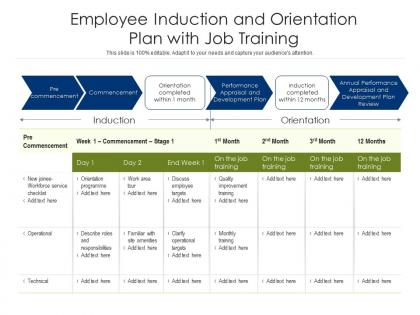
Employee induction and orientation plan with job training




Try Before you Buy Download Free Sample Product
 Impress Your
 Audience
 100%
100% Editable
 Save Hours
 of Time


Our Employee Induction And Orientation Plan With Job Training are topically designed to provide an attractive backdrop to any subject. Use them to look like a presentation pro.
People who downloaded this PowerPoint presentation also viewed the following :
Employee induction and orientation plan with job training with all 2 slides:
Use our Employee Induction And Orientation Plan With Job Training to effectively help you save your valuable time. They are readymade to fit into any presentation structure.
FAQs for Employee induction and orientation plan
So basically you want to get them set up before they even start - ship their laptop and handle paperwork early. First week should cover introductions and company culture stuff. Yeah, the IT setup and compliance training is tedious but you gotta do it. Make sure they know exactly what their role involves and who their main contacts are. I always think those first few weeks are make-or-break for retention. Check in with them at 30, 60, and 90 days to see how things are going. People pretty much decide if they're staying within the first month, so those early conversations really matter.
Track the obvious stuff first - how long it takes new hires to actually hit their targets, retention at 90 days and one year, plus onboarding completion rates. Numbers don't tell the whole story though. Survey people about confidence levels and get manager feedback on readiness. I'd also watch how fast they jump into meetings or start contributing to projects - that's usually a good sign. Oh, and set up check-ins at 30, 60, 90 days because catching problems early saves everyone headaches later.
Honestly, culture can make or break your whole onboarding game. Don't just dump values in a welcome packet and call it done - that's what everyone does and it's useless. You've got to actually show new people how decisions happen, what the real (unwritten) rules are. Pair them with someone who gets it, not just whoever's available that week. They need to see your culture in action, not just read about it. It's the difference between having someone who's genuinely part of the team versus someone who's still trying to decode how things actually work around there.
Honestly, tech can be a game-changer for onboarding if you don't go overboard with it. Digital platforms handle all that boring paperwork automatically. Interactive training modules are way better than those awful PDF packets everyone used to get. Chatbots answer the random HR stuff that comes up at 2am (because someone always has questions at weird times). Mobile apps give people everything they need from day one. My advice? Start by automating whatever takes you the longest right now - probably the manual stuff. Progress tracking shows you where people get confused too. Just don't digitize everything for the sake of it.
Honestly, just keep it simple and don't dump everything on them at once. Focus on the must-haves first - their role, who to contact, what happens next. Skip the policy manual on day one (they won't read it anyway). Interactive stuff beats long documents every time. Use examples when you can and break things into smaller pieces. Oh, and definitely test it with someone fresh to the role first - you'll catch stuff you missed. New people are already overwhelmed, so make it easy to scan through quickly. They can learn the company history later.
Honestly, just ditch the one-size-fits-all approach and make different tracks for each role. Sales people need CRM stuff and territory details. Developers want code access and tech docs right away. That generic company history presentation? Pretty much nobody cares about it on day one. Pair each new hire with someone from their actual team instead. Marketing needs brand guidelines, IT needs security protocols - totally different stuff. Map out what each role actually needs to know, then build separate paths for each. Oh, and definitely ask your recent hires what would've helped most. They'll tell you.
Honestly, aim for 3-6 months minimum. Anything shorter is setting people up to fail - they get overwhelmed and bounce within the year. I've watched this train wreck happen too many times! Companies with 90+ day programs see like 50% better retention, which makes total sense. New hires need time to actually build relationships and figure out the culture, not just survive week one. Don't cram everything into those first few days. Spread the learning out over at least three months. Your brain can only absorb so much before it shuts down anyway. Map out what they really need to know and pace it properly.
Dude, peer mentorship is a game changer for onboarding. New people get the real deal from someone who actually remembers what it's like being confused about everything. They learn where the decent bathroom is, which meetings actually matter, all that stuff managers forget to tell you. Way less awkward than pestering your boss constantly. Also helps with retention since people feel connected right away instead of floating around lost for weeks. Oh, and pair them with someone who's been there like 6-18 months - not the old-timers who've forgotten what it's like to be new.
Oh man, the worst thing is when new people get that deer-in-headlights look because you've dumped everything on them day one. Information overload kills morale fast. Honestly, most companies are terrible at this - they'll hand someone a 50-page manual and wonder why they seem lost. Spread the orientation over a few weeks instead. Give them a buddy to ask stupid questions to (we all have them). Be super clear about what their actual job is and who they'll work with. I'd do weekly check-ins the first month too. Way better than having someone quietly struggle for weeks before speaking up.
Set up check-ins at the one week, one month, and three-month marks - that timing usually works best. Send short surveys asking what's clicking and what isn't. Honestly, the 30-day point is golden because that's when people stop being polite and actually tell you what sucks. Make it easy for new hires to ask questions too, maybe through Slack or weekly office hours. But here's the thing - you've got to actually fix what they're complaining about. If multiple people are struggling with the same training module, don't just shrug it off.
Honestly, good onboarding makes such a huge difference. New people get up to speed way faster when they actually know what's expected and have proper training. Otherwise they're just wandering around asking everyone basic stuff - which is annoying for the whole team, let's be real. You want them doing actual work within weeks, not months. Plus people stick around longer when they don't feel completely lost those first few days. The trick is having an actual plan with checklists and everything. System logins, meeting the team, all that. Don't just hand them a laptop and peace out.
Honestly, your first week pretty much determines everything. Bad onboarding and people mentally check out - I've watched it happen so many times. You want new hires feeling welcome and actually prepared, not just thrown to the wolves. Clear expectations help a ton. So does connecting them with teammates who don't suck. Give them real tools they need, not outdated equipment from 2015 or whatever. Most companies mess this up badly, which is crazy because it's such low-hanging fruit. Get someone excited from day one and they'll stick around way longer.
Yeah, remote onboarding is tricky because you lose all that casual face-time. I'd map out their whole first week with specific check-ins so nothing gets forgotten. Tech setup is actually the biggest pain - get them laptops and system access sorted before they even start. Schedule some one-on-ones for intros, plus maybe virtual coffee breaks? Sounds cheesy but it works. You can't rely on hallway conversations anymore, so everything needs to be way more planned out. Takes double the prep time honestly, but I've seen it work really well when companies actually put in the effort.
Start with the boring but necessary stuff - I-9 forms, W-4s, emergency contacts, all that. Your employee handbook needs signatures, plus anti-harassment and confidentiality agreements. Honestly, make a checklist because you'll definitely forget something otherwise. Industry matters too - healthcare and finance have extra hoops like background checks and certifications to track. Don't skip documenting wage/benefit disclosures either. I learned this the hard way during an HR audit last year. Total nightmare when half your paperwork's missing.
Start with a solid checklist that everyone has to follow - day 1 basics, week 1 targets, month 1 checkpoints. Digital tools work great because nobody can skip steps or claim they "forgot" something. Monthly manager calls are honestly where you'll catch most problems. People will actually tell you what's broken if you ask regularly. Allow some wiggle room for location-specific stuff while keeping your core process non-negotiable. I'd audit what you're doing now first - probably way more inconsistent than you think. You'll want to fix the biggest gaps before rolling out anything new.
-
Best Representation of topics, really appreciable.
-
Enough space for editing and adding your own content.
-
Attractive design and informative presentation.
-
Excellent design and quick turnaround.