


Employee Hiring Plan At Workplace Powerpoint Presentation Slides





Try Before you Buy Download Free Sample Product
 Impress Your
 Audience
 100%
100% Editable
 Save Hours
 of Time


Improving the recruitment process helps in finding candidates quickly and effectively. Finding and retaining talented employees plays a vital role in any business growth. Replacing an existing salaried employee costs an average of 7 to 9 months salary to the firm. The purpose of the deck is to demonstrate the staff recruitment and selection process as an essential HRM operation to enhance employee strength. Here is a professionally designed Employee Hiring Plan at Workplace template that addresses various factors affecting staff recruitment, recruitment methods, recruitment interviews, and selection process. Firms can reduce employee turnover and the cost of replacing an employee through an effective recruitment process. The effective recruitment process involves consistent planning and evaluation. The deck covers details about enhancing the recruitment process with efficient recruitment planning to attract potential candidates, internal external recruitment process, applicants resume screening, etc. It caters to slides about reducing recruitment cycle time through various initiatives, visual techniques in handling recruitment challenges, etc. Customize this 100 percent editable template based on your needs now.
People who downloaded this PowerPoint presentation also viewed the following :
Content of this Powerpoint Presentation
Slide 1: This slide introduces Employee Hiring Plan at Workplace. State Your Company Name and begin.
Slide 2: This slide states Agenda of the presentation.
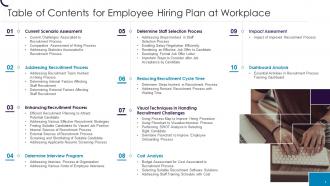
Slide 3: This slide presents Table of Content for the presentation.
Slide 4: This slide highlights title for topics that are to be covered next in the template.
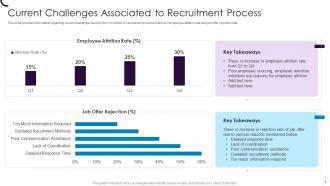
Slide 5: This slide shows Current Challenges Associated to Recruitment Process.
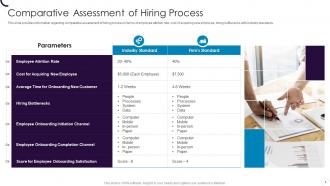
Slide 6: This slide presents Comparative Assessment of Hiring Process.
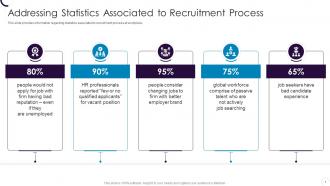
Slide 7: This slide displays Addressing Statistics Associated to Recruitment Process.
Slide 8: This slide represents title for topics that are to be covered next in the template.
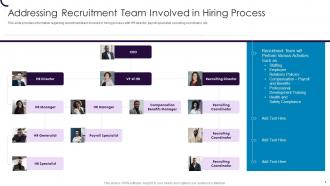
Slide 9: This slide showcases Addressing Recruitment Team Involved in Hiring Process.
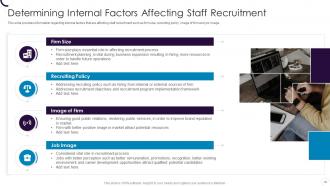
Slide 10: This slide shows Determining Internal Factors Affecting Staff Recruitment.
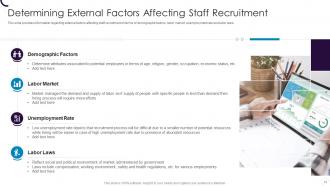
Slide 11: This slide presents Determining External Factors Affecting Staff Recruitment.
Slide 12: This slide displays title for topics that are to be covered next in the template.
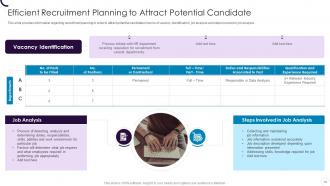
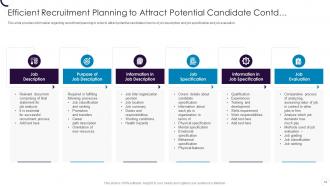
Slide 13: This slide represents Efficient Recruitment Planning to Attract Potential Candidate.
Slide 14: This slide showcases recruitment planning in order to attract potential candidate in terms of job description.
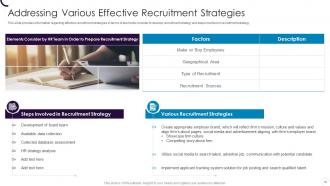
Slide 15: This slide shows Addressing Various Effective Recruitment Strategies.
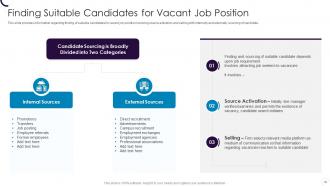
Slide 16: This slide presents Finding Suitable Candidates for Vacant Job Position.
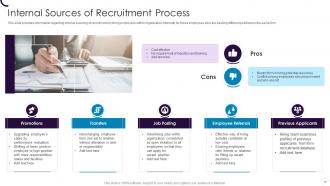
Slide 17: This slide displays Internal Sources of Recruitment Process.
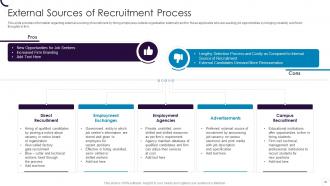
Slide 18: This slide represents External Sources of Recruitment Process.
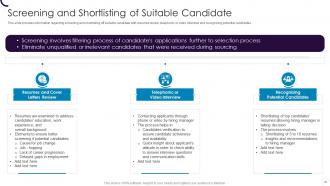
Slide 19: This slide showcases Screening and Shortlisting of Suitable Candidate.
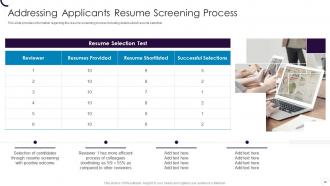
Slide 20: This slide shows Addressing Applicants Resume Screening Process.
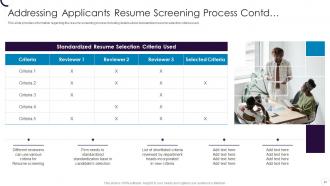
Slide 21: This slide presents Addressing Applicants Resume Screening Process.
Slide 22: This slide displays title for topics that are to be covered next in the template.
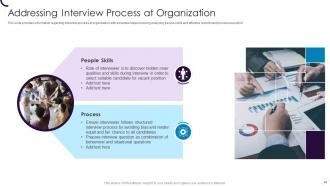
Slide 23: This slide represents Addressing Interview Process at Organization.
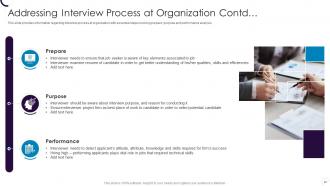
Slide 24: This slide showcases interview process at organization with essential steps.
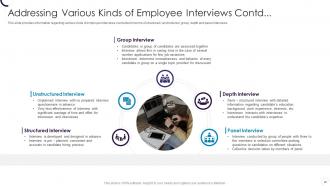
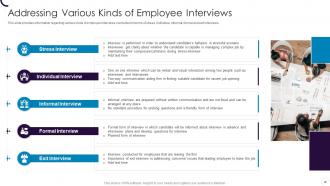
Slide 25: This slide shows Addressing Various Kinds of Employee Interviews.
Slide 26: This slide presents various kinds of employee interviews conducted in terms of stress, individual, etc.
Slide 27: This slide displays title for topics that are to be covered next in the template.
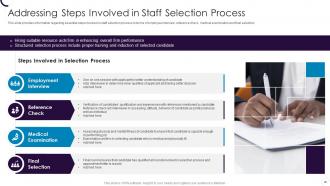
Slide 28: This slide represents Addressing Steps Involved in Staff Selection Process.
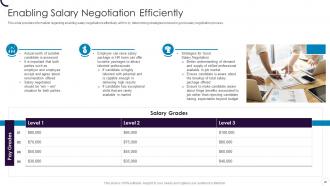
Slide 29: This slide showcases enabling salary negotiations effectively at firm by determining strategies involved in good salary negotiation.
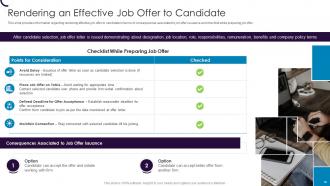
Slide 30: This slide shows rendering effective job offer to candidate in terms of consequences associated.
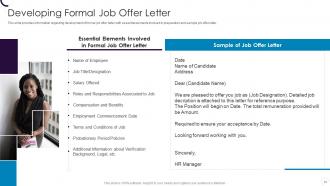
Slide 31: This slide presents development of formal job offer letter with essential elements involved.
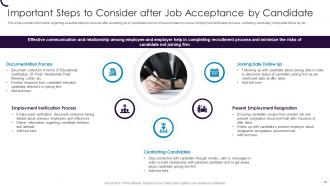
Slide 32: This slide displays Important Steps to Consider after Job Acceptance by Candidate.
Slide 33: This slide represents title for topics that are to be covered next in the template.
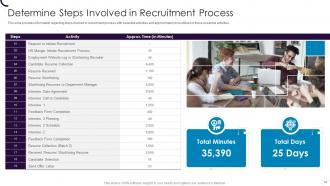
Slide 34: This slide showcases steps involved in recruitment process with essential activities.
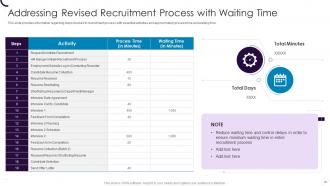
Slide 35: This slide shows Addressing Revised Recruitment Process with Waiting Time.
Slide 36: This slide presents title for topics that are to be covered next in the template.
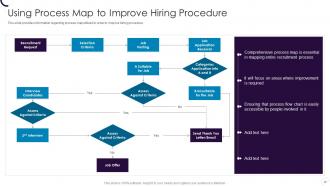
Slide 37: This slide displays Using Process Map to Improve Hiring Procedure.
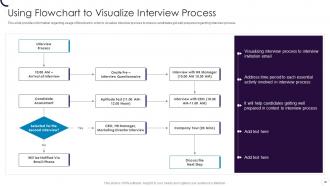
Slide 38: This slide represents Using Flowchart to Visualize Interview Process.
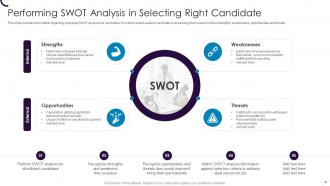
Slide 39: This slide showcases SWOT analysis for candidates in order to select suitable candidate by assessing them.
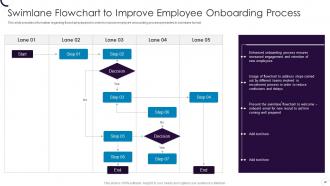
Slide 40: This slide shows Swimlane Flowchart to Improve Employee Onboarding Process.
Slide 41: This slide presents title for topics that are to be covered next in the template.
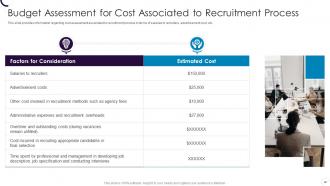
Slide 42: This slide displays Budget Assessment for Cost Associated to Recruitment Process.
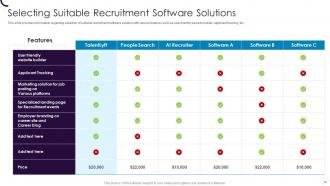
Slide 43: This slide represents Selecting Suitable Recruitment Software Solutions.
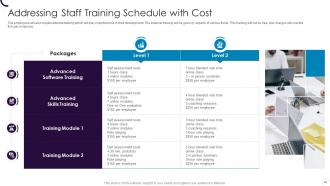
Slide 44: This slide showcases Addressing Staff Training Schedule with Cost.
Slide 45: This slide shows title for topics that are to be covered next in the template.
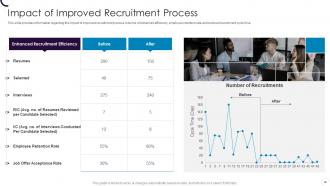
Slide 46: This slide presents Impact of Improved Recruitment Process.
Slide 47: This slide displays title for topics that are to be covered next in the template.
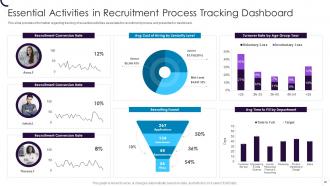
Slide 48: This slide represents Essential Activities in Recruitment Process Tracking Dashboard.
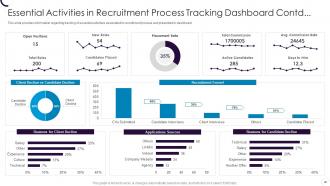
Slide 49: This slide showcases tracking of essential activities associated to recruitment process.
Slide 50: This slide displays Icons for Employee Hiring Plan at Workplace.
Slide 51: This slide is titled as Additional Slides for moving forward.
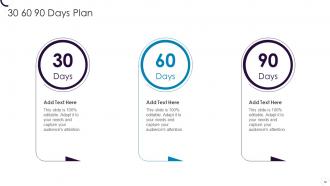
Slide 52: This slide provides 30 60 90 Days Plan with text boxes.
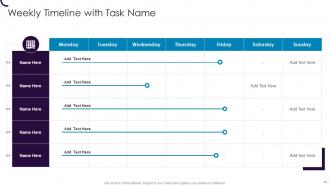
Slide 53: This slide shows Weekly Timeline with Task Name.
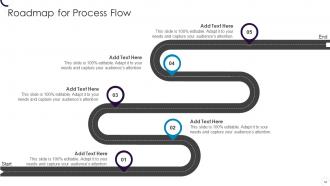
Slide 54: This slide presents Roadmap for Process Flow.
Slide 55: This is About Us slide to show company specifications etc.
Slide 56: This is Our Mission slide with related imagery and text.
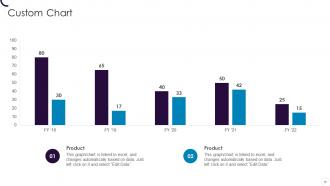
Slide 57: This slide displays Custom chart with two products comparison.
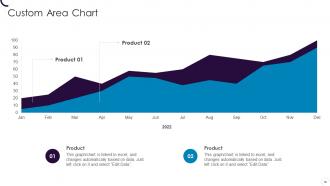
Slide 58: This slide depicts Custom Area chart with two products comparison.
Slide 59: This slide shows Post It Notes. Post your important notes here.
Slide 60: This slide showcases Magnifying Glass to highlight information, specifications, etc.
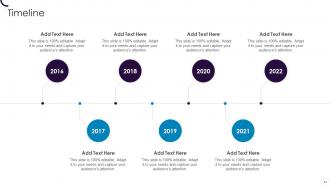
Slide 61: This is a Timeline slide. Show data related to time intervals here.
Slide 62: This slide displays Mind Map with related imagery.
Slide 63: This is a Thank You slide with address, contact numbers and email address.
Employee Hiring Plan At Workplace Powerpoint Presentation Slides with all 68 slides:
Use our Employee Hiring Plan At Workplace Powerpoint Presentation Slides to effectively help you save your valuable time. They are readymade to fit into any presentation structure.







FAQs for Employee Hiring Plan At Workplace
Start with figuring out which roles you actually need versus the ones that would just be nice to have. Your budget and timeline are gonna drive most of these decisions anyway. Market's pretty brutal for certain positions right now, so that'll affect your strategy too. I'd audit your current team first - see where the real gaps are. Company culture fit matters more than people think, honestly. Then work backwards from your business goals to prioritize who you hire first. Oh, and focus on the skills you're genuinely missing, not just what sounds good on paper.
Look, having a real hiring plan stops you from just throwing random people at problems - which honestly happens way too often. First thing? Figure out what skills your team actually lacks compared to where you want to go. Then hire specifically for those gaps. Your current people won't waste time training terrible fits or covering for weak spots. They can actually focus on what they're good at instead of scrambling around all the time. Way less chaos, way better results. Oh and productivity goes up because everyone's playing to their strengths finally.
Your company's workplace reputation is everything when hiring good people. Candidates will stalk your Glassdoor reviews and check out what employees post on social media - trust me, they're doing their homework. The cool thing about solid employer branding? Top talent actually wants to join you rather than just settling for whatever. Makes interviews way less painful when people are genuinely excited. Plus you can compete with companies throwing around bigger salaries. Get your happy employees sharing stuff on LinkedIn and fix your careers page so it doesn't suck. Show what working there actually feels like.
Track where your best hires actually come from first - that alone will help tons next time you're recruiting. Look at resume keywords from your top performers and see what patterns pop up. The fancy predictive modeling thing? Honestly it's usually overhyped, but basic metrics like time-to-hire and retention rates by source are gold. Set up something simple to see which interview questions actually matter for job performance (spoiler: probably fewer than you think). Oh, and definitely measure quality of hire scores across different strategies. Even just knowing LinkedIn vs referrals vs job boards will give you a huge head start.
Okay so first thing - post jobs on diverse boards and partner with orgs that help underrepresented folks. Your job descriptions matter too - ditch the "nice-to-haves" and stick to what's actually needed. I swear half these job posts are ridiculous anyway. For interviews, keep them structured and get diverse panels involved. Train everyone on unconscious bias (yeah, we all have it). Oh and track your metrics by demographics - that's how you'll spot where you're losing people. Honestly the biggest thing is just being deliberate about it from the start.
Work backwards from when you need them to start. Recruitment usually takes 2-3 weeks, then interviews are another 2-3 weeks. Don't forget offer negotiations and notice periods - that's typically 2-4 weeks right there. Background checks always take longer than you think, easily another week. I learned this the hard way last year. Build in buffer time for each phase because something will definitely go wrong. Look at your last few hires and see how long they actually took - not what you hoped they'd take. Your company's decision-making speed matters way more than you'd expect.
Focus on the basics first: time-to-hire, cost-per-hire, and offer acceptance rates. Also track where your best hires come from - LinkedIn vs referrals vs whatever else you're spending money on. Quality of hire matters way more than most people think, so check how new employees are doing at 6 and 12 months. Oh, and candidate experience scores are pretty crucial since people talk. If diversity's a thing for your company, obviously include those numbers too. Once you've got solid data on these, then you can mess around with the fancier predictive stuff.
Your team knows way more about what actually works than you think they do. They see who struggles and who kills it every day. Exit interviews are gold, but don't wait - just ask them regularly what's missing skill-wise and what kind of person fits your culture. They'll catch candidate red flags you'd totally miss. Plus they can help you write better job posts and interview questions. Oh, and definitely ask what they wish someone had told them when they were interviewing. That stuff's honestly more useful than most HR playbooks.
Honestly, start with what you'd actually want to read if you were job hunting - that's your north star. Make the job title crystal clear (none of that "rockstar ninja" nonsense). Break down the day-to-day stuff they'll actually be doing, not just vague responsibilities. Separate must-haves from nice-to-haves for skills. Don't copy-paste from other postings either - candidates can tell immediately. Talk up your company culture and perks. Growth opportunities matter too. Oh, and if you can swing it, include salary range upfront. Saves everyone time. The whole point is giving people enough info to know if they're a fit while still getting them excited about the role.
Honestly, ATS systems are a lifesaver for hiring. They'll automatically sort through all those resumes and rank candidates based on whatever keywords you set up - way better than crying over 300 applications manually. The system kicks out unqualified people and shows you the good matches first. You can track everyone through your pipeline, auto-schedule interviews, send rejection emails. Most integrate with job boards too, so you're posting everywhere at once. Oh, and definitely spend time upfront getting your filters right - like really think through those must-have skills because garbage in, garbage out, you know?
Focus on three main things: bias training, proper interview skills, and basic legal stuff. Honestly, the bias part is huge - managers don't realize how much they rely on random gut feelings that have nothing to do with the job. Teach them behavioral questions and consistent scoring so they're not all over the place with evaluations. Legal training's pretty straightforward - just what questions are off-limits to avoid discrimination problems. Do it as a half-day workshop with role-playing. Trust me, they'll retain way more from practice than sitting through slides.
Honestly, the biggest thing is making sure your onboarding actually backs up what you sold them on during interviews. Like if you talked up growth opportunities, then week one better include actual development paths and training schedules. Don't just mention company culture - show them how it really works day-to-day. I've watched so many places crush the interview game then completely fumble the first week (it's painful to see). Map out the whole journey from application through their first 90 days. Ask your recent hires directly where things felt off or disconnected. That'll tell you everything.
Honestly, salaries are just the tip of the iceberg when you're hiring. Benefits alone will hit you hard - health insurance, 401k matching, all that stuff. Then there's payroll taxes, laptops, training costs. Oh, and recruiting fees if you use agencies (those are brutal). Rule of thumb? Budget about 1.3x whatever the salary is for the real cost. So a $60k hire actually costs you like $78k. Also leave room for negotiations because everyone tries to bump up the offer. The first few months they're basically useless while learning everything, so factor that in too. Work backwards from your total budget to see how many people you can actually afford.
Honestly, the best hires happen when HR and department heads actually team up instead of working in silos. Your HR team knows how to source and screen, but department leaders know the technical stuff and culture fit they're looking for. Get them collaborating on job descriptions from the start. Have department heads jump in on initial phone screens - don't wait until final interviews. That "throw it over the fence" approach never works. I'd probably set up weekly check-ins between HR and hiring managers for each role. Makes such a difference when everyone's on the same page throughout the whole process.
Honestly, the data doesn't lie - track your time-to-fill, candidate quality, and retention rates religiously. I do quarterly reviews because hiring moves so damn fast these days. Get feedback from new hires AND your hiring managers monthly instead of waiting for some big review. Your recruiting team sees the trenches daily, so stay tight with them and department heads. Benchmark against industry standards, sure, but don't get too caught up in that - your company's different. Small tweaks beat major overhauls every time. Oh, and market changes will mess with everything, so build in flexibility from the start.
-
Great designs, Easily Editable.
-
I didn’t expect such a good service for the money I am paying. But, they exceed my expectations. Great work SlideTeam.