


Supplier Evaluation Form With Evaluation Criteria




Try Before you Buy Download Free Sample Product
 Impress Your
 Audience
 100%
100% Editable
 Save Hours
 of Time


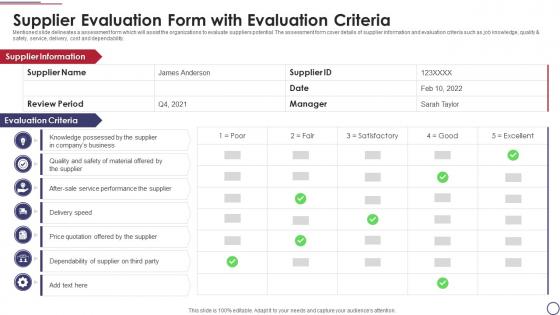
Mentioned slide delineates a assessment form which will assist the organizations to evaluate suppliers potential. The assessment form cover details of supplier information and evaluation criteria such as job knowledge, quality and safety, service, delivery, cost and dependability.
People who downloaded this PowerPoint presentation also viewed the following :
Content of this Powerpoint Presentation
Businesses need suppliers, and the best way to invite and select them is through a supplier evaluation form. Whether in online or physical format, the supplier evaluation form with evaluation criteria will always remain a piece of gold for top management.
A good, business-solution-oriented form features many of the usual requirements that companies need. What is important is the evaluation criteria that you subject your suppliers to and the level of technology integration you demand. In today’s tech-driven and digital transformation-led world, it is not unusual to find suppliers equipped with the capability for blockchain monitoring. Yet, for the end-business consumer, apart from speed and easy traceability, the basics are the most important.
Now, as businesses get around to evaluating suppliers, creating a form is the first step. A pain point in doing this well is the tedium, work, and effort involved in choosing the appropriate medium and channel with which all stakeholders are comfortable. The idea is to ensure that the presentation and the broad contours are explained clearly to all in the company.
A vendor management strategy is important; get it here.
SlideTeam resolves these issues well with its focus on templates that are clutter-free but expert-curated and provide ready-to-use content for presentations. Each of the templates is 100% editable and customizable, providing a starting point, the structure for the presentation, and the capability to customize to the audience profile.
Let’s explore.
Template 1 Supplier Evaluation Form with Evaluation Criteria PPT Template
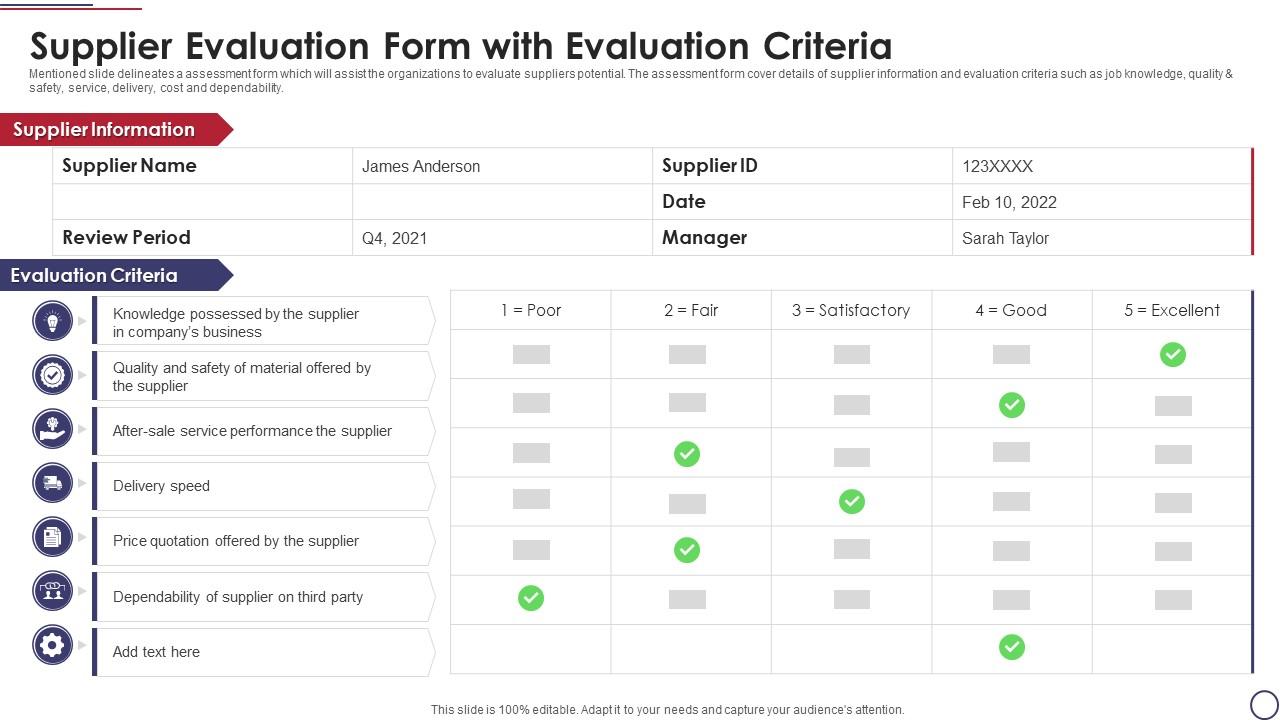
Use this PPT Template to delineate an assessment form, which will assist organizations in evaluating suppliers’ potential. It clearly identifies the name of the reviewing person and the name of the manager responsible for the ratings and the review. The assessment form covers details of supplier information and evaluation criteria such as job knowledge, quality & safety, service, delivery, cost, and dependability. The rating scale ranges from 1-5, with one denoting poor and five meaning excellent. In between are the three ratings of fair, satisfactory, and sound. The slide already lists seven evaluation criteria, each somewhat relevant across any business. You can customize and replace these with your own set of evaluation variables within less than five minutes, and the presentation will be ready to go. In essence, the supplier is expected to rank well on all parameters, such as knowledge about the company’s business, delivery time and margins, and ability to take pains despite the quality of the business environment.
The icons used add to the understanding of the criteria, instinctively and are a valuable addition to this slide that most prominent global businesses, part of Fortune 500, are using. The idea is to ensure the manager really understands what the parameters are intending to measure and then provide this world-class tool as the ablest of assistance possible.
BE SURE OF SUPPLY
Simply put, all big brands are built on the strength of their suppliers delivering quality material on time at reasonable cost. Apple, for instance, spends a major part of its time on supplier relationships. Hence, a supplier evaluation form with criteria is the real kick-point for any company. Our slides are the best place to ensure your business gets it right.
PS This Supplier Evaluation PPT Template, a complete deck, is the best way to sort out your suppliers and seal the deal.
Supplier Evaluation Form With Evaluation Criteria with all 6 slides:
Use our Supplier Evaluation Form With Evaluation Criteria to effectively help you save your valuable time. They are readymade to fit into any presentation structure.





FAQs for Supplier Evaluation Form
Check their quality standards first, then dig into pricing and payment terms. Delivery reliability is huge - I've been burned by vendors who promise the moon but can't deliver on time. Financial stability matters too, especially if you're planning a long-term partnership. Communication is honestly make-or-break for me. If they're slow to respond during the courtship phase, imagine how bad it'll get later! Don't forget to verify they can scale with you and meet any industry certifications you need. Reference checks are clutch - past clients spill the real tea.
Get their financial statements first - revenue growth, cash flow, debt levels, the usual stuff. Dun & Bradstreet credit reports are clutch for this, saves you digging around forever. Try to find out how they pay other vendors too. I always google them to see if there's drama - layoffs, lawsuits, whatever. How long have they been around? If they're riding on one huge client, that's sketchy. You don't want them going under if that client bails. Oh, and set up regular check-ins with your critical suppliers.
Look at their track record over the past 2-3 years - delivery times, quality, how they handled problems when stuff hit the fan. Because trust me, something always goes wrong eventually. Don't just listen to their sales pitch promises. Dig into actual data on contract compliance and performance metrics. Honestly, this is probably your best predictor of future performance. Past behavior shows you patterns you can't ignore. Short version: their history tells you way more than their PowerPoint deck ever will. Weight it heavily when deciding.
Dude, those supplier management platforms are seriously worth looking into - they'll pull financial data, track performance, even scan news for sketchy stuff automatically. Way better than drowning in spreadsheets. Set up digital portals so suppliers can just upload their certs and docs themselves (saves you so much back-and-forth). The dashboards make comparing suppliers super easy too. Oh, and definitely figure out what's driving you crazy about your current process first. That'll help you pick the right tools instead of getting distracted by all the fancy features you probably won't use.
Track defect rates and on-time delivery first - those are your bread and butter metrics. Defect rates show what percentage doesn't meet specs. Delivery performance tells you if they're actually hitting deadlines (spoiler: many don't). Compliance scores matter too for certifications and audits, though honestly that's where most people drop the ball. Oh, and customer complaints by supplier - that's where you'll spot quality issues before they blow up. Monthly reports on these four should catch most headaches early. Trust me, way better than scrambling when things go sideways.
Oh man, this bit me hard once with a supplier in Thailand! Different cultures communicate totally differently - some are blunt, others drop subtle hints about issues. Your usual evaluation methods might not work since business practices and quality expectations vary by region. Time's a big thing too. What looks like delays to us could be their normal pace. Honestly, the best move is getting local contacts who understand the culture and can translate the real meaning behind conversations. Otherwise you'll miss red flags or misread perfectly fine suppliers.
Build a solid audit plan covering quality, compliance, and ops stuff. Do them yearly minimum - more often if suppliers are sketchy or mission-critical. Always visit in person when you can, trust me, their PowerPoints never tell the whole story. Bring people from quality, procurement, and operations so you're not flying blind. Document the hell out of everything and create action plans for problems. Here's the thing though - most companies drop the ball on follow-up. Circle back in 30-60 days to check they actually fixed what they said they'd fix, otherwise you're just wasting everyone's time.
Build those compliance checks right into your evaluation from the start. Create a checklist covering all the regs that hit your industry - safety, environmental, data protection, whatever. Before you even look at a supplier seriously, make them show certifications and audit reports proving they're legit. Trust me, almost got screwed by a vendor who seemed perfect but had zero compliance docs! Also set up regular reviews, not just one-time checks. Oh and honestly? Some companies get lazy about this stuff, but you can't treat compliance like it's optional. It's as crucial as their pricing.
Honestly, there's a bunch of solid options depending on your budget. Ariba and Coupa are the fancy dedicated platforms - they'll handle scorecards, risk assessments, the whole nine yards. But if money's tight (and let's be real, when isn't it?), Excel or Google Sheets work fine for custom scoring matrices. Way less flashy but gets the job done. For financial health checks specifically, tools like RapidRatings or Dun & Bradstreet are pretty solid. My advice? Figure out your key criteria first, then just pick whatever fits your complexity and wallet.
Oh man, this is huge - communication can make or break everything. I've watched suppliers with amazing tech completely screw up relationships because they disappeared when problems hit. You want people who actually talk to you, not just send invoices. Quick responses matter. So does flagging issues early instead of letting you find out the hard way. During evaluations, pay attention to how they engage - do they ask good questions or suggest improvements? The ones who just nod along are red flags honestly. Make responsiveness part of your scoring criteria. Trust me, when things get messy (and they will), you'll be so glad you picked the communicators.
Oh man, definitely avoid suppliers who dodge questions or take forever to respond - communication issues will drive you insane later. Look out for missing certifications, sketchy quality records, or companies that seem financially unstable. Super low pricing is tempting but usually means they'll cut corners somewhere. I got burned once by a vendor who kept making excuses, so trust me on this one! Check their references and see if their production capacity actually matches what they're promising. Site visits are clutch if you can swing it - you'll learn way more than any email chain could tell you.
So basically you want to bake sustainability right into your scoring system - carbon footprint, waste practices, labor standards, that whole deal. Make suppliers actually show you their sustainability reports and audit their facilities if you can. Weight it maybe 20-30% of your total score depending on what matters to your company. Here's the thing though - don't just check boxes. Set real targets they need to hit, like specific renewable energy percentages or whatever. I've been seeing more companies do this lately and honestly it's about time. The key is making it measurable so you can actually compare apples to apples.
Send surveys to the departments actually working with suppliers - procurement, operations, finance. Focus groups are solid since people talk more openly in groups than filling out forms alone. One-on-ones with key people work well too, honestly some of the best feedback happens during random coffee chats. Set up regular cross-team supplier reviews where everyone can voice concerns. Maybe create a simple feedback portal or just use whatever collaboration tools you already have. The main thing is making it stupid easy for people to share experiences as they happen, not waiting for some annual review cycle that nobody remembers anyway.
Honestly, quarterly check-ins saved my butt when one of our "reliable" suppliers started slipping. Track the basics - delivery times, quality, costs, how fast they respond when stuff goes wrong. I wish I'd caught the red flags sooner! Build simple scorecards so you can actually see the trends at a glance. Here's the thing though - don't just call them out for problems. Give props to the ones crushing it too. The real trick? Set those calendar reminders right now or you'll keep putting it off like I did.
Don't get sucked into just comparing prices - that's how you end up with a supplier who looked great on paper but can't deliver. Take time to actually check their references (seriously, call those past clients). I'd make a scorecard first with your non-negotiables weighted by importance. Otherwise you'll be stuck comparing totally different things later. Also dig into their financials - last thing you want is them going under mid-project. Teams always fall for the slickest presentation, but that PowerPoint probably won't save your project when things go sideways.
-
Thank you SlideTeam for such an excellent service.
-
They had the topic I was looking for in a readymade presentation…helped me meet my deadline.