

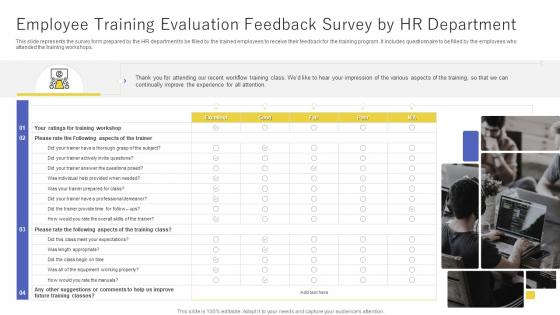
Employee Training Evaluation Feedback Survey By HR Department




Try Before you Buy Download Free Sample Product
 Impress Your
 Audience
 100%
100% Editable
 Save Hours
 of Time


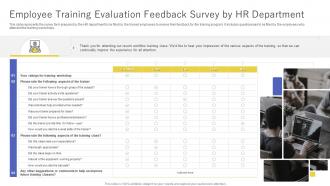
This slide represents the survey form prepared by the HR department to be filled by the trained employees to receive their feedback for the training program. It includes questionnaire to be filled by the employees who attended the training workshops.
People who downloaded this PowerPoint presentation also viewed the following :
Employee Training Evaluation Feedback Survey By HR Department with all 6 slides:
Use our Employee Training Evaluation Feedback Survey By HR Department to effectively help you save your valuable time. They are readymade to fit into any presentation structure.





FAQs for Employee Training Evaluation Feedback Survey
Key metrics include knowledge retention rates, skill application assessments, performance improvements, employee engagement scores, and ROI calculations through productivity gains. These measurements work together by tracking learning outcomes, behavioral changes, and business impact, with many organizations finding that combining quantitative performance data with qualitative feedback delivers comprehensive insights into training effectiveness and competitive advantage.
Organizations can assess training impact through performance metrics analysis, productivity measurements, skill assessments, employee feedback surveys, and ROI calculations. These evaluation methods enable companies to track improvements in efficiency, quality, and output, while identifying knowledge gaps and measuring behavioral changes, ultimately delivering enhanced operational performance and strategic workforce development across departments.
Employee feedback plays a crucial role in training evaluation by providing direct insights into program effectiveness, engagement levels, content relevance, and learning outcomes from participants' perspectives. This feedback enables organizations to identify knowledge gaps, adjust training methods, and enhance future program design, with many companies finding that regular feedback collection significantly improves training ROI and employee satisfaction.
Companies ensure training alignment by conducting strategic needs assessments, mapping learning objectives to business outcomes, and establishing clear performance metrics that connect to organizational priorities. Through regular stakeholder consultations and data-driven evaluation processes, organizations can continuously adjust their training programs, ultimately delivering improved employee capabilities and measurable contributions to strategic objectives.
Training evaluation methods include pre/post assessments, performance metrics analysis, 360-degree feedback, behavioral observations, and return-on-investment calculations for both structured programs and informal learning initiatives. These approaches enable organizations to measure knowledge retention, skill application, and productivity improvements across departments like sales, manufacturing, and customer service, ultimately delivering enhanced performance and competitive advantage.
Different learning styles significantly impact training evaluation by requiring diverse assessment methods that match how individuals process information, with visual learners responding better to infographic assessments, auditory learners excelling in verbal evaluations, and kinesthetic learners performing best through hands-on demonstrations. Organizations increasingly find that incorporating multiple evaluation formats, such as interactive simulations for retail training or visual dashboards for technical skills assessment, ultimately delivers more accurate performance insights and enhanced employee development outcomes.
Learning management systems (LMS), AI-powered analytics platforms, mobile assessment apps, virtual reality simulations, and automated survey tools can significantly enhance training program evaluation. These technologies streamline data collection, provide real-time performance insights, and enable personalized feedback delivery, with many organizations finding that integrated assessment platforms reduce evaluation time while delivering more comprehensive training effectiveness measurements.
Training evaluations should be conducted at multiple intervals: immediately after training, 3-6 months post-training, and annually for long-term impact assessment. This multi-phase approach enables organizations to measure knowledge retention, behavioral changes, and business impact, with many companies finding that regular evaluation cycles enhance training ROI, identify skill gaps, and ultimately deliver more targeted professional development programs.
Pre-training assessments improve post-training evaluations by establishing baseline knowledge levels, identifying specific skill gaps, and creating personalized learning pathways for participants. These assessments enable organizations to measure actual skill acquisition, demonstrate concrete ROI through before-and-after comparisons, and customize evaluation metrics, with many companies finding that targeted pre-assessments ultimately deliver more accurate training outcomes and enhanced employee development strategies.
Common pitfalls include measuring only participant satisfaction rather than learning outcomes, collecting feedback too late after training completion, focusing solely on short-term results, and failing to establish baseline performance metrics. Organizations often overlook linking training objectives to business goals, neglecting follow-up assessments, and insufficient stakeholder involvement, ultimately missing opportunities to demonstrate training ROI and strategic value.
Training evaluations inform future needs by identifying skill gaps, measuring knowledge retention, assessing behavioral changes, and analyzing performance improvements across departments. Through comprehensive feedback analysis, organizations can refine curriculum design, adjust delivery methods, and prioritize resource allocation, with many companies finding that data-driven training strategies deliver enhanced employee engagement and measurable business outcomes.
Organizations can use benchmarks including training ROI percentages, skill proficiency improvement rates, employee satisfaction scores, knowledge retention metrics, and performance enhancement measurements. Through industry reports from ASTD and corporate learning associations, companies compare their results with sector-specific standards, enabling them to identify gaps, optimize programs, and ultimately deliver more effective training investments.
Cultural factors significantly influence training evaluation through varying communication styles, feedback preferences, learning approaches, and performance measurement expectations across different regions. Organizations with global workforces find that standardized evaluation methods often miss cultural nuances, leading many to adopt culturally adaptive assessment frameworks that account for local business practices, ultimately delivering more accurate effectiveness measurements and enhanced employee engagement.
Best practices for documenting training evaluation outcomes include standardized metrics tracking, comprehensive data collection across multiple levels, stakeholder-specific reporting formats, and regular performance benchmarking. These approaches streamline assessment processes by establishing clear measurement frameworks, capturing both quantitative and qualitative insights, and enabling organizations to demonstrate ROI while identifying improvement opportunities that enhance future training effectiveness.
Organizations can involve employees through pre-training surveys, peer feedback sessions, self-assessment tools, focus groups, and collaborative goal-setting activities. These engagement strategies enable companies to gather real-time insights, enhance program relevance, and increase participation rates, with many organizations finding that employee-driven evaluation ultimately delivers higher retention rates and more effective skill development outcomes.
-
Amazing variety of PowerPoint slides. Really helpful in designing professional presentations.
-
They helped us design the pamphlets for our church’s food drive! The people loved the design, and I’m happy to say it was successful. Thank you, SlideTeam!