


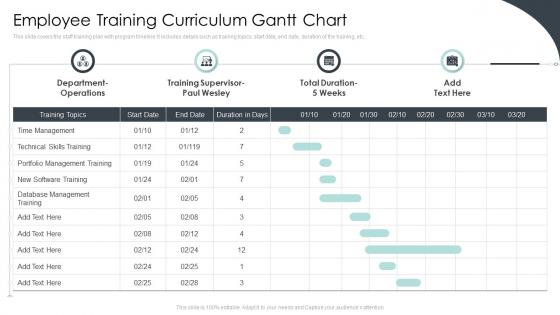
Employee Training Curriculum Gantt Chart




Try Before you Buy Download Free Sample Product
 Impress Your
 Audience
 100%
100% Editable
 Save Hours
 of Time


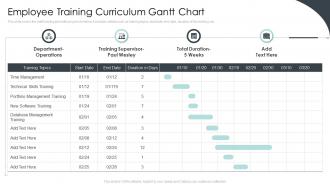
This slide covers the staff training plan with program timeline. It includes details such as training topics, start date, end date, duration of the training, etc.
People who downloaded this PowerPoint presentation also viewed the following :
Employee Training Curriculum Gantt Chart with all 6 slides:
Use our Employee Training Curriculum Gantt Chart to effectively help you save your valuable time. They are readymade to fit into any presentation structure.





FAQs for Employee Training
You need clear goals first, then pick delivery methods that won't put people to sleep. Hands-on practice is huge - way better than just lectures. Make sure it connects to what they actually do at work, not some random generic stuff nobody cares about. Regular feedback keeps people on track. Oh, and definitely assess if it worked afterward - otherwise you're just throwing money at training that might be useless. Get their input too so you can fix what sucked. I'd start with your biggest problem areas and tackle those first instead of trying to boil the ocean.
Performance reviews are your best starting point - managers usually know where the gaps are. Survey your people too since they'll tell you what they actually want to learn (sometimes totally different from what you think). Skills testing helps figure out who's at what level, then map that against where they need to be. Business goals matter here - work backwards from what you're trying to achieve. Industry trends and compliance stuff can't be ignored either, obviously. Honestly, the biggest mistake is relying on just one method. You need multiple angles to really understand what's missing. It's like... you wouldn't diagnose a problem with just one symptom, right?
Dude, tech has completely taken over training - and honestly, it's pretty amazing. LMS platforms handle course delivery while VR gives people actual hands-on practice without the risk. Analytics dashboards track who's learning what (super helpful for managers). Your team can literally train from their phones during commutes or lunch breaks. AI even customizes content for different learning styles, which blows my mind. Best part? You can train tons of people at once without dealing with room bookings or travel costs. I'd say look at what tech you're already using first, then figure out where you can level up your current programs.
Honestly, completion rates and feedback scores are pretty surface-level - they don't really show if people actually learned anything. What you want to watch is job performance after training. Are they making fewer mistakes? Getting more productive? That's the real stuff that matters. Employee surveys help too since good training usually makes people happier at work (shocking, I know). Calculate your ROI by comparing training costs to actual results - like higher sales or whatever your goal was. Pick maybe 2-3 metrics that match what you're trying to achieve and track them for a few months. Don't overthink it.
Honestly, ditch the lectures if you can. People actually remember stuff when they're doing role-plays or group activities instead of just sitting there. I mean, we've all zoned out during those endless PowerPoint sessions, right? Your team will participate way more, and you can spot problems immediately rather than finding out later that half of them didn't get it. Sure, lectures are quicker to throw together and cheaper, but the results are pretty meh. Try swapping out just one boring session with something interactive first - you'll probably be surprised how much better it works.
Honestly, just ask them! Post-training surveys work great, or grab people for quick one-on-ones. Focus groups too if you're feeling fancy. Ask what actually worked, what sucked, and what they wanted more of. People will tell you the truth if you give them the chance - I was shocked how blunt my team got once they realized I actually cared about their opinions. Then you gotta actually use that feedback though. Boring lectures? Add hands-on stuff next time. Felt rushed? Make those sections longer. Don't be one of those managers who asks for input then ignores it completely.
Don't cram it all into one day - that's your first mistake. Space things out over weeks, maybe months. Have them teach it back to you or someone else (this actually works way better than you'd expect). Give them real situations to mess around with, not boring theoretical crap. Make little cheat sheets they can keep at their desk. The best part? Get them using it right away while it's fresh. Oh, and do quick check-ins later to see what stuck. Practice immediately after training is where you'll see the real difference.
Dude, training makes such a difference for keeping people happy at work. Like, when companies actually invest in helping you grow, you feel way less disposable, you know? Nobody wants to be that person who's clueless about their job forever. Skills training builds confidence, which honestly just makes everything better. I read somewhere that good training programs can boost retention by like 40-60% - pretty solid numbers. Oh, and people definitely stay longer when they see actual career growth happening. If your company's struggling with turnover, this is probably the easiest fix that actually works.
Start sending stuff before their first day - schedule, materials, whatever they need so they don't walk in confused. Break training into chunks over a few weeks instead of info-dumping everything at once (seriously, that's torture). Get them a buddy for random questions and cover the basics: their role, company culture, key people to know. I'd personally skip the endless presentations - get them doing real work early so they actually feel productive. Oh, and check in regularly to see how they're handling it all. Way better than leaving them to figure things out alone.
So cross-training is like having backup players for every spot on your team. When someone calls out sick or you need to pivot fast, you're not totally screwed. People can actually jump between departments instead of the whole "that's not my job" thing. Honestly, it keeps everyone way more interested too since they're picking up new skills and seeing how everything connects. You won't be panicking every time someone goes on vacation - which is honestly the worst. Just start simple though. Maybe have two people trade roles for a week and see what happens?
Ugh, remote training is tricky. Biggest pain points? People zone out way easier, and coordinating across time zones is a nightmare. Plus you lose that natural team bonding that just happens in person. Don't even get me started on trying to teach hands-on technical stuff through a screen - it's basically impossible. Break everything into shorter chunks so people don't get overwhelmed. Interactive stuff helps too - polls, breakout rooms, whatever keeps them awake. Record sessions for people in weird time zones. If you need hands-on practice, ship them materials beforehand. Way more work upfront but it actually works.
Oh dude, this is huge. Like seriously, don't skip this step. Map out your business goals first, then build training around those. Otherwise you're just throwing money at random courses nobody cares about. When people actually understand how their new skills help the company (and them), they'll engage instead of zoning out. Your culture gets reinforced naturally too, which is honestly pretty cool. I've watched companies waste so much cash on misaligned programs - it's painful. The ROI difference is night and day when you get this right.
Dude, learning opportunities are a game-changer for keeping people around. Shows you actually care about where they're headed, not just what they can do for you right now. Nobody wants to feel trapped doing the exact same stuff forever - that's soul-crushing. Skills development keeps things fresh and gives them actual goals beyond just surviving Monday through Friday. Oh, and here's the thing people mess up: make sure the training connects to what they actually want next in their career. Random workshops nobody asked for? Total waste. When it's relevant to their goals, they'll be way more invested and stick around longer.
honestly, give people actual time to learn - like Friday afternoons or flexible "learning hours." too many companies just talk about supporting development but never create space for it. Show off when someone uses new skills on real projects and celebrate that stuff publicly. lunch-and-learns work great too, people love sharing what they've discovered. The trick is connecting learning to career growth and cool projects, not just boring compliance stuff. oh and definitely don't make it feel like another task on their endless to-do list.
Honestly, you gotta track both the hard numbers and the fuzzy stuff. Start with baselines before anything kicks off - otherwise you're just guessing later. I'd focus on productivity gains, how many fewer mistakes people make, and retention rates (replacing someone is ridiculously expensive btw). Then look at engagement scores and whether people are actually getting promoted internally. Don't go crazy measuring everything though. Pick like 2-3 things that actually matter for your goals. Oh, and definitely do some follow-up tests to see if people retained what they learned - that's where a lot of training programs fall apart.
-
Been using SlideTeam for some time now…can’t imagine why I wasted all that time in front of the screen trying to make the perfect presentation.
-
I want to thank SlideTeam for the work that they do, especially their customer service.