


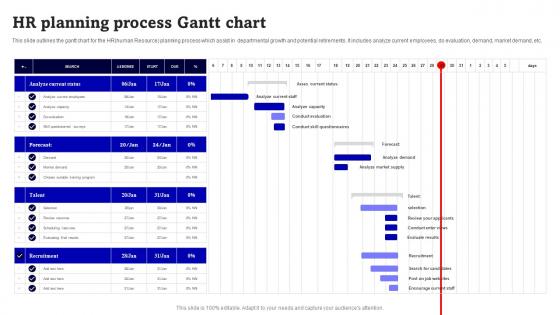
HR Planning Process Gantt Chart




Try Before you Buy Download Free Sample Product
 Impress Your
 Audience
 100%
100% Editable
 Save Hours
 of Time


This slide outlines the gantt chart for the HR human Resource planning process which assist in departmental growth and potential retirements. It includes analyze current employees, do evaluation, demand, market demand, etc.
People who downloaded this PowerPoint presentation also viewed the following :
HR Planning Process Gantt Chart with all 6 slides:
Use our HR Planning Process Gantt Chart to effectively help you save your valuable time. They are readymade to fit into any presentation structure.






FAQs for HR Planning
So you need three main things: figure out what skills your team has now, predict what you'll need later, then spot the gaps. Start by auditing everyone's current abilities - that's your baseline. Next, look at your business goals and forecast what talent you'll actually need. Succession planning is huge too (seriously, most companies totally blow this part). Once you see the mismatches, you can decide whether to hire, train existing people, or maybe shuffle roles around. Oh, and don't get caught up in HR buzzwords - tie everything back to real business results. That's where it actually matters.
Start with figuring out what your company actually wants to accomplish - growth targets, new markets, going digital, whatever. Then build your HR strategy around those specific goals. Expanding into Asia? You'll need totally different talent than if you're just automating a bunch of processes. Honestly, it's kind of obvious but tons of companies mess this up. Make sure your hiring, training, and workforce planning all connect back to the big picture stuff. I'd sit down with leadership every quarter and just ask straight up: "what does winning look like next year and what kind of people do we need to make that happen?"
Workforce analytics is like having a crystal ball for your HR stuff - tracks turnover patterns, performance data, all that good stuff so you can actually predict what's coming. Way better than just winging it with gut feelings, honestly. You'll spot skill gaps before they bite you and see trends early. The whole point is being proactive instead of scrambling when problems hit. Even basic tracking beats flying blind - I learned that the hard way at my last job when we got blindsided by a mass exodus we totally could've seen coming if we'd been paying attention to the data.
So basically tech speeds up all that HR stuff by handling data collection automatically and spotting where you need more people or skills. Way faster than doing it by hand, obviously. The dashboard thing is pretty cool - you get live updates on who's performing well, turnover rates, hiring stats, all in one spot. HRIS systems and those AI analytics tools let you actually base decisions on real data instead of just winging it with hiring and training. I'd start by looking at whatever manual tasks are sucking up most of your time right now. Those should be first on your automation list.
Ugh, the hardest part is honestly trying to figure out what skills you'll need down the road - it's like reading tea leaves sometimes. Budget fights are brutal too. Look at your past hiring patterns and what's happening in your industry instead of just winging it. Build a case showing how your plan will actually make money or save costs. Leadership gets way more interested when you show them real numbers and timelines they can understand. I'd say review everything every few months rather than doing some massive annual plan. Oh, and don't be afraid to pivot - things change so fast these days anyway.
Dude, demographics literally control your whole hiring game. When boomers start retiring en masse, you're gonna lose tons of institutional knowledge - that's always messier than companies expect. Younger workers want remote options and clear growth paths, totally different from older generations. Your talent pool changes too as communities become more diverse. I'd start mapping when your current team might bail for retirement. Then dig into local demographic shifts and what other companies in your space are seeing. Honestly, most places wait too long and scramble later. Better to tweak your strategies now than panic-hire when half your senior staff bounces.
There are a few solid ways to tackle this. Trend analysis is probably your best starting point - just look at past hiring patterns and project forward. Ratio analysis works great too, where you tie staffing to business metrics like revenue per employee. Honestly, don't overlook just asking managers what they think they'll need - sometimes the obvious approach is the right one. Scenario planning gets more complex but it's worth it if you're dealing with uncertainty. Map out different business situations and see how staffing changes. I'd start simple with trends, then get manager input to double-check everything.
Honestly, I'd start by using your engagement survey data to predict who's gonna bail - it's like a crystal ball for turnover. Look at which teams have low scores and plan your hiring around that. When I'm doing headcount forecasts, engagement numbers are huge because unhappy people leave, period. Also factor those engagement programs into your budget planning. The trick is treating it like an early warning system instead of just some HR metric you check once a year. Map your current engagement data against where you're seeing talent gaps - you'll probably spot some patterns that'll help you get ahead of problems.
Honestly, just fold it into your regular HR planning - way less painful that way. During annual workforce reviews, map out who's retiring or might bail in the next few years. Then spot your high-potential people who could fill those gaps. I learned this the hard way trying to do succession planning as its own thing later... nightmare. Use your existing training and mentoring programs to develop these folks. Throw in some stretch assignments too. The trick is reviewing your pipeline quarterly, not just once a year. Makes it feel natural instead of this big scary project nobody wants to touch.
Oh man, remote work basically flips HR on its head. Now you can hire someone brilliant from like, anywhere in the world - which is amazing until you're juggling five different time zones and trying to figure out labor laws in three states. Performance reviews get weird when you can't just pop by someone's desk. Your old onboarding process? Probably useless now. The whole "water cooler chat" thing for team building is dead, so you'll need creative ways to keep people engaged. Honestly, start by looking at what you're doing now and asking "does this assume we're all in the same room?" Most of it probably does.
Honestly, diversity can't be something you slap on at the end - build those goals into your workforce planning right away. Track specific targets for each level and actually follow through (I've seen too many companies set numbers then forget about them). Where are you recruiting from? Same old places = same demographics every time. Branch out, partner with different professional organizations. Oh, and here's what gets missed constantly - audit your promotions and who's getting developed for leadership roles. That's where bias really sneaks in and derails everything.
Honestly, focus on the basics first - time-to-fill and turnover rates by department are your bread and butter. Internal promotion rates tell you if people actually want to stay and grow there. Employee engagement scores are huge because they predict problems before they blow up. Cost-per-hire matters but can be super misleading depending on what you throw into that calculation (learned that the hard way). Track retention for your top performers - that's where you'll see if your succession planning actually works. Diversity metrics are worth watching too. Pick maybe 3-5 that actually matter to your situation and check them monthly.
Honestly, you've gotta be obsessed with tracking what's hot in your field and beyond. Job boards, industry reports, the whole thing. LinkedIn analytics is basically my guilty pleasure now - I probably check it way too much but the data on trending roles is actually solid gold. Here's the thing though: don't get stuck writing super specific job descriptions. Focus on people with transferable skills instead. Way more flexibility that way. Set up quick reskilling programs for your current team too. But the real game-changer? Building actual relationships with hiring managers. When they suddenly need someone with a weird new skill set, you'll be their first call.
Honestly, most companies are terrible at this because they wait until people quit to figure out what went wrong. Start with your top performers - like your best 20% - and actually map out where they could advance. Then tell them about it! Wild concept, I know. Regular check-ins about their goals work way better than scrambling during exit interviews. Skills training and mentorship programs help too. The trick is being proactive instead of reactive. Build individual strategies around what actually motivates each person, not some generic retention playbook that doesn't work.
Look, you've gotta bake learning into your workforce planning right from the get-go. Don't just hire for every skill gap - figure out what you can train internally first. Map out upskilling needs early because honestly, tech changes are hitting everyone now. Budget development time into your capacity planning too. For succession stuff, create actual development pathways instead of just naming replacements. I'd build individual plans that match what you'll need in 12-18 months. Oh, and track the skills people are gaining - sounds obvious but most companies don't do this. You'll actually see if your training investment is worth it.
-
“Excellent information with easy access.”
-
“Excellent information with easy access.”