


HR Process Flow Chart For Employee Training




Try Before you Buy Download Free Sample Product
 Impress Your
 Audience
 100%
100% Editable
 Save Hours
 of Time


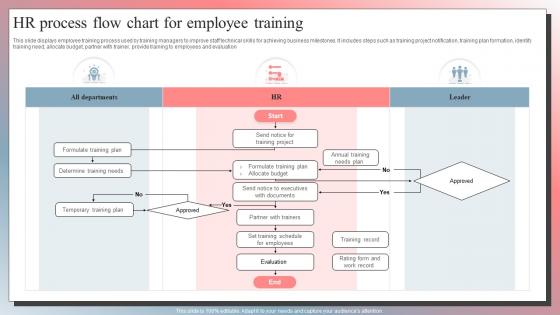
This slide displays employee training process used by training managers to improve staff technical skills for achieving business milestones. It includes steps such as training project notification, training plan formation, identify training need, allocate budget, partner with trainer, provide training to employees and evaluation.
People who downloaded this PowerPoint presentation also viewed the following :
HR Process Flow Chart For Employee Training with all 6 slides:
Use our HR Process Flow Chart For Employee Training to effectively help you save your valuable time. They are readymade to fit into any presentation structure.





FAQs for HR Process Flow Chart
Honestly, good training boils down to four things. First, get super specific about what people should actually learn - fuzzy goals are useless. Mix up how you deliver it because sitting through endless slides is torture. Give them real practice opportunities like simulations or actual project work. And build in feedback checkpoints so you can tweak things. The whole point is making it interactive and tied to what they do daily. I've seen too many companies skip the hands-on part and wonder why nothing sticks!
Honestly, the best way is mixing a bunch of approaches. Performance reviews help spot obvious gaps. But talking directly to your team? That's where you'll get the real story - people know what they're struggling with. I'd also throw in some skills assessments, though those can feel pretty formal. Check what your business actually needs to hit its goals and work backwards from there. Oh, and don't forget compliance stuff if that applies to your industry. The trick is getting multiple viewpoints since everyone sees different pieces of the puzzle.
Honestly, tech has completely changed how we do training at work. LMS platforms let you push the same content to hundreds of people without losing your mind. VR simulations are crazy realistic now - way better than those cheesy role-plays from before. The data side is huge too. You'll actually see where people get stuck instead of just guessing. AI can customize learning paths, though some of it still feels gimmicky to me. My advice? Look at what you're already using first. Pick one thing that's eating up your time and see if there's a way to automate it.
Track the obvious stuff first - post-training tests and knowledge checks to see if people actually got it. But here's what most people miss: employee feedback surveys are gold. They'll straight-up tell you what was helpful versus total waste of time. Monitor performance changes over 3-6 months, plus whatever KPIs matter for your goals - productivity, error rates, that kind of thing. The sweet spot is connecting training directly to business results. Honestly, I've seen too many programs fail because they didn't set up proper measurement from the start.
So basically onboarding is all that stuff you dump on new people - company rules, how things work here, the basics to not completely fail their first month. Ongoing training happens later when they're not drowning anymore. Onboarding gets someone functional fast. After that? You focus on actually developing them - new skills, career growth, whatever tech changes are happening. It's way more strategic. Honestly most people forget half the onboarding info anyway since it's such an overload. The real learning happens with ongoing stuff when they can actually absorb it.
Honestly, the biggest thing is making it feel rewarding instead of just another box to tick. Celebrate when people finish training - even the small stuff counts. Give them actual work time to learn because nobody's doing it at home, let's be real. Your managers need to participate too or everyone will see right through it. Connect learning to promotions and career paths so there's a real payoff. Oh, and here's what most companies mess up - actually ask your team what they want to learn instead of guessing. Seems obvious but you'd be surprised how rarely it happens.
Okay so you've basically got three ways to do this. In-person is amazing for hands-on stuff and team bonding, but wow it gets pricey fast and scheduling is a nightmare. Online's the opposite - cheap, flexible, people can go at their own speed (which let's be honest, everyone loves). Then there's hybrid where you mix both - like maybe do the boring theory stuff online first, then get everyone together for the actual practice sessions. Really depends what you're teaching though. Is it something they need to physically do, or more like concepts and ideas? That's kinda where I'd start.
First thing - figure out where everyone's at with a quick skills check or survey. Some people need the absolute basics while others are ready for advanced stuff. Group them into maybe 2-3 levels, then match the format to what works. Beginners usually do better with hands-on workshops and those step-by-step guides (honestly, they're lifesavers). Your experienced folks? They can handle self-paced modules or dive straight into complex scenarios. The worst thing you can do is create some generic training that doesn't hit anyone's actual needs. Oh, and don't overthink the grouping part - you can always adjust later.
Honestly, breakout sessions and polls are game-changers - way better than those soul-crushing PowerPoint marathons we've all suffered through. Mix it up with videos, hands-on stuff, group talks. The magic happens when you connect everything to their actual job. Like, "this will save you 20 minutes every day" hits different than generic theory. Ask them "how would you handle this?" instead of just lecturing at them. Get their input during the session, not after when they've already checked out. Oh, and start small - pick one interactive thing for your next session and see how it goes. You don't need to reinvent everything at once.
Get feedback from a bunch of places - surveys after training, manager check-ins, casual chats with people. Ask specific stuff about whether content made sense and if they can actually use it, not just generic "how'd it go?" The real gold comes from random conversations like a month later when someone's actually tried applying what you taught them. I'd track everything in a basic spreadsheet - if multiple people say the same section sucked, obviously fix it before round two. Review patterns every few months and you'll start seeing what consistently works vs. what doesn't.
Honestly, figure out what you actually want people to *do* after the training - like, be super specific about it. Mix up your content formats because everyone learns differently. Videos, quick exercises, reference sheets, whatever works. Keep stuff short and tied to their real job tasks - nobody wants to sit through irrelevant fluff. Oh, and definitely test your materials on a few people first! What seems obvious to you might totally confuse them. Build in some way to check if it's actually working too. Otherwise you're just making content that'll sit there unused.
Mix up your groups constantly so people meet coworkers they'd never normally talk to. Build in team projects and peer teaching sessions - honestly, having trainees present to each other works way better than you'd expect. Virtual breakout rooms are solid for remote stuff (yeah, they're weird at first but people get used to it). Quick team challenges right at the start break the ice perfectly. The trick is making it feel natural, not like some forced team-building nightmare. Oh, and collaborative problem-solving beats lectures every time. Just don't overthink it.
Start with OSHA safety stuff - those fines will wreck your budget if you're not compliant. Anti-harassment training is mandatory in most states now (which, thank god). Food safety, healthcare protocols, financial regs - depends what industry you're in obviously. Federal contractors need accessibility training too. Honestly? Get a lawyer to audit what's actually required for your specific situation first. Way easier than guessing and getting hit with violations later. Build around those requirements, then worry about the other training stuff.
Honestly, mentorship programs are a game-changer for new hires. They get paired with someone who actually knows the ropes and can answer those random questions that never come up in training. Way less awkward than figuring everything out solo! People stick around longer too since they feel more plugged into the company culture. Oh, and here's the thing – match mentors based on similar roles, not just whoever's free. I learned that the hard way at my last job. Makes a huge difference in how useful the whole thing actually is.
Honestly, microlearning is where it's at - short chunks employees can do on their phones whenever. AI-powered stuff that adapts to how fast people learn is really taking off too. VR training's getting cheaper but still feels kinda gimmicky to me. The real game-changer though? Making it social. Peer mentoring, group challenges, live feedback instead of those awful solo courses everyone hates. Oh, and definitely survey your team first about what actually works for them. No point building something they won't use, right?
-
Definitely recommend SlideTeam to all who need help with PowerPoint presentations. Their design team can create anything you need.
-
The best part about SlideTeam is their meticulously prepared presentations (complete-decks and single-slides both), infused with high-quality graphics and easy to edit. All-in-all worthy products.