


Employee Onboarding Sop Flowchart For HR Department




Try Before you Buy Download Free Sample Product
 Impress Your
 Audience
 100%
100% Editable
 Save Hours
 of Time


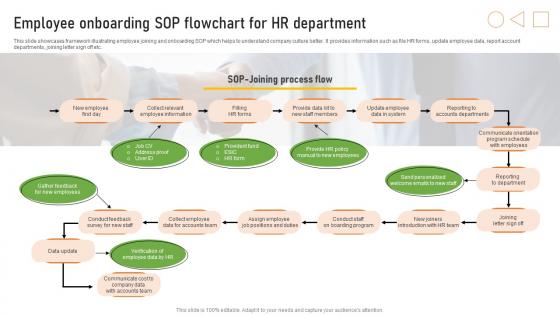
This slide showcases framework illustrating employee joining and onboarding SOP which helps to understand company culture better. It provides information such as file HR forms, update employee data, report account departments, joining letter sign off etc.
People who downloaded this PowerPoint presentation also viewed the following :
Employee Onboarding Sop Flowchart For HR Department with all 6 slides:
Use our Employee Onboarding Sop Flowchart For HR Department to effectively help you save your valuable time. They are readymade to fit into any presentation structure.





FAQs for Employee Onboarding Sop Flowchart
So basically you want to get everything ready beforehand - workspace, computer setup, all that boring paperwork stuff. Day one is about making them feel welcome and meeting everyone (don't just dump them at their desk lol). Training comes next where they'll learn your systems and how things actually work around there. Honestly, this part always feels like drinking from a fire hose but you can't really avoid it. Then you've got to check in with them regularly for the first few weeks. See how they're doing, answer questions, that kind of thing. Oh and definitely keep that flowchart somewhere - I always forget steps when I'm swamped.
Honestly, it saves new hires from that horrible "what am I supposed to be doing?" feeling. You know how awkward those first few days can be. Map out everything from day one through 90 days - every single touchpoint matters. People quit over dumb stuff like never getting computer access (I've literally seen this happen). Clear steps help them understand their role and feel supported instead of abandoned. The consistency makes a huge difference too. They'll actually feel confident about joining instead of second-guessing their decision. Trust me, it's worth the upfront work.
For flowcharts? Depends what you're working with budget-wise. Lucidchart and Visio are solid if you need the fancy stuff - templates, easy sharing, all that. Draw.io is free and decent enough, just looks kinda old school. Your team already using Miro or Figma for other projects? Those work fine too. Hell, I've made flowcharts in PowerPoint before when I was desperate. Start with whatever your company's already paying for. You can always switch later if you need something with more bells and whistles like automation or integrations.
So basically start with your core stuff - HR paperwork, IT setup, company culture intro. Everyone gets that. Then branch off into department tracks. Finance people need compliance training, marketing folks get the creative processes, etc. Honestly, the best approach I've seen is when departments actually tell you what their new people struggle with most. Map out what's universal first, then figure out the role-specific pieces. It's like having a main road that splits off - everyone starts the same place but ends up where they need to be for their actual job.
I'd start with time-to-productivity - basically how long before new people actually hit their targets. Retention at 30/90/365 days is huge too, plus whatever scores you're getting from onboarding surveys. Training completion rates matter, but honestly? Manager feedback is where you'll find the real stuff. Sometimes your metrics look perfect but managers are still babysitting everyone for months. Track how long each onboarding stage takes vs what you planned. Oh and don't try measuring everything right away - pick like 3-4 things, get your baseline, then add more later.
Dude, flowcharts are clutch for this stuff. They force you to write down every compliance thing so nothing gets forgotten when you're scrambling with new hires. Like when someone needs harassment training or security clearance - it's all mapped out with timing. Honestly saved my butt during our last HR audit because I could just point and say "yep, they did everything." When regulations change, you update it once instead of crossing your fingers that everyone remembers. Oh, and definitely add checkboxes so managers can see what's actually done in real-time.
Honestly, tech can fix most of your onboarding headaches. Digital signatures kill the paperwork shuffle, and automated workflows handle welcome emails plus training schedules without you doing anything. HR platforms put benefits enrollment and policy stuff all in one spot. Interactive training modules beat the hell out of boring PDFs - nobody wants to read through 50 pages of company policies on day one. Chatbots answer basic questions anytime, so new people aren't waiting around. I'd probably start with whatever manual process is eating up most of your time first.
Honestly, feedback is what saves you from creating a flowchart that looks great but totally bombs in real life. Get input from new hires, their managers, and HR - they'll catch the weird bottlenecks you missed. I'd do quick surveys at 30/60/90 days, maybe after big milestones too. Then actually use that feedback! Update timelines, clarify confusing parts, ditch steps that don't add value. Oh and set up quarterly reviews to go through everything - sounds boring but it's worth it. Trust me, I've seen too many "perfect" processes that new people couldn't follow to save their lives.
Honestly, visuals are a game-changer for onboarding flowcharts. Nobody wants to stare at walls of text. Icons and colors help new hires scan through everything without their eyes glazing over. Think IKEA instructions - you'd be lost without the pictures, right? Different colors work great for separating departments too. That way people can follow their own path instead of getting confused by everyone else's steps. Short sentences keep things moving. Plus it just looks way less scary than some boring bullet-point list that screams "corporate handbook."
Don't overcomplicate it - that's the main thing. I see people trying to map out every single detail when you really just need the big picture stuff. Generic steps are useless too, honestly. New hires can tell when you're being vague instead of showing them what actually happens at your company. Decision points are huge though! Most flowcharts act like onboarding is this straight line, but it's not - remote people need different stuff than office workers, different departments have their own quirks. Oh and don't just lock yourself in a room to make this. Talk to HR, managers, recent hires. They'll catch things you'd never think of.
So basically, you're their first real person contact - way better than sitting through another boring HR slideshow. Do the welcome meeting and introduce them to the team right away. Walk them through what they'll actually be doing day-to-day. The flowchart says to check in regularly for the first month, which honestly makes sense since people get overwhelmed fast. Help them set some goals and introduce them to the people they'll work with most. Your main thing is making sure they don't feel totally lost in all the paperwork nonsense.
Don't just throw all the culture stuff into orientation day - that's honestly pretty lazy. Mix it throughout everything instead. Give them a "culture buddy" the second they accept your offer. Week one should have casual coffee meetups with different people on the team. Skip the boring PowerPoint about company values (nobody remembers those anyway). Try story sessions where actual employees share real examples of your values happening. Oh, and definitely get them to a team happy hour or something social within two weeks. Culture has to feel real, not like some HR checklist thing.
Look, your onboarding flowchart is basically where all your HR strategy actually happens in real life. Whatever your company cares about most - retention, compliance, scaling fast - needs to show up in those steps. Like if engagement matters, build in regular check-ins and mentorship stuff. Don't just use some random template you found online (we've all been there). Compare what you have now against your actual priorities and fix the gaps. It's honestly wild how this one document connects to everything else you're doing in HR. Start there and work backwards.
For each step, write down who's doing what and by when. Pre-boarding stuff like IT setup and workspace prep needs to happen first. Day one is introductions, getting system access, paperwork - you know the drill. First week should cover training schedules and pairing them with a mentor. Honestly, I'd go super detailed here because that's where things usually get forgotten. Your 30/60/90 day check-ins are huge for goal setting and seeing how they're doing. Oh, and definitely flag when one task depends on another finishing first - like they can't access certain systems until IT does their thing. Trust me, mapping those dependencies saves headaches later.
Build those inclusivity checks right into your flowchart at each major step. Multiple languages for materials, different training formats for various learning styles, plus accessibility stuff for disabilities. Cultural context is huge too - some company norms aren't obvious if you're from a different background. I'd add decision points that literally ask "did we think about diverse needs?" before moving forward. Oh, and definitely audit what you have now first to spot where bias might sneak in. It's wild how many companies still skip this basic stuff.
-
The best and engaging collection of PPTs I’ve seen so far. Great work!
-
Great product with highly impressive and engaging designs.