HR Checklist For Employee Onboarding Process

Rating:
100%
HR Checklist For Employee Onboarding Process
Slide 1 of 6
Favourites Favourites

Try Before you Buy Download Free Sample Product

Audience Impress Your
Audience
Editable 100%
Editable
Time Save Hours
of Time
The Biggest Sale is ending soon in
0
0
:
0
0
:
0
0
Rating:
100%
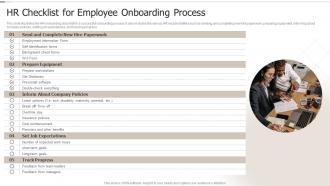
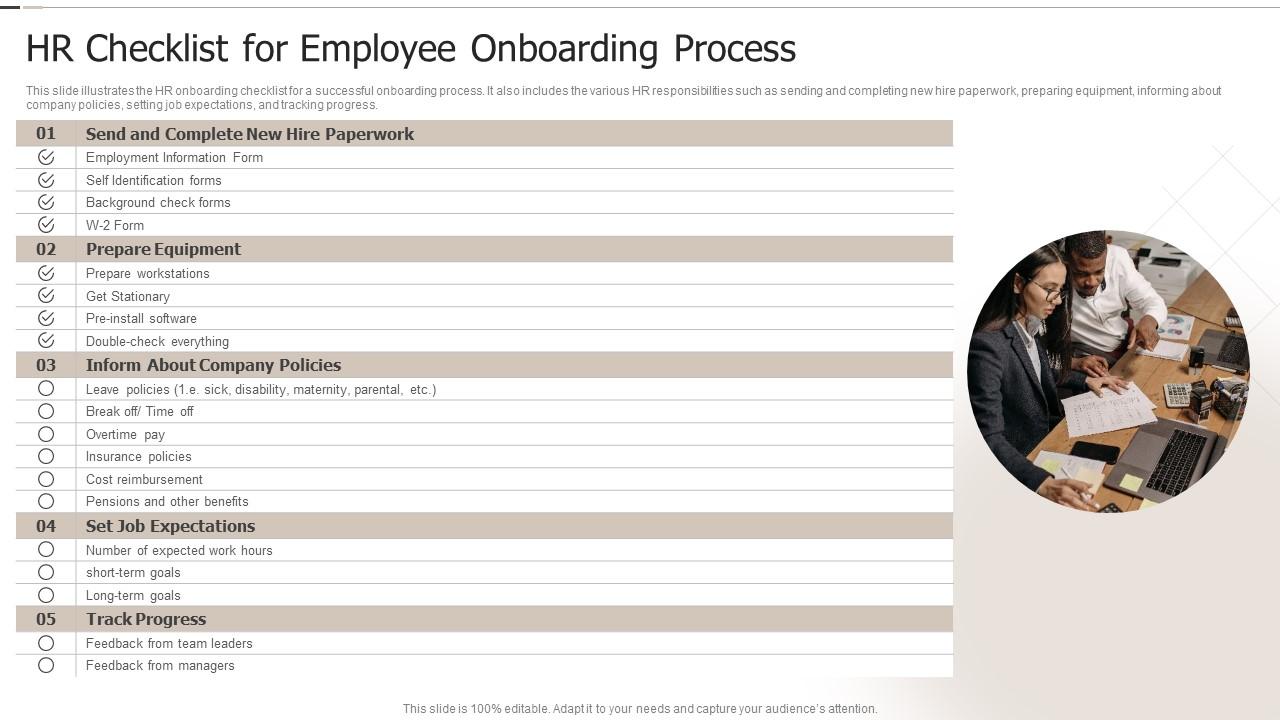
This slide illustrates the HR onboarding checklist for a successful onboarding process. It also includes the various HR responsibilities such as sending and completing new hire paperwork, preparing equipment, informing about company policies, setting job expectations, and tracking progress. Presenting our set of slides with HR Checklist For Employee Onboarding Process. This exhibits information on five stages of the process. This is an easy to edit and innovatively designed PowerPoint template. So download immediately and highlight information on Prepare Equipment, Job Expectations, Company Policies.
FAQs for HR Checklist For

Essential onboarding documents include employment contracts, tax forms (W-4, I-9), employee handbook, benefits enrollment forms, emergency contact information, confidentiality agreements, and IT security policies. These documents streamline the administrative process while ensuring legal compliance, proper benefit setup, and security protocols, ultimately enabling new hires to integrate seamlessly and organizations to maintain comprehensive records from day one.

HR professionals ensure smooth transitions by establishing structured onboarding timelines, preparing workstations and access credentials in advance, assigning dedicated mentors or buddies, and conducting comprehensive orientation sessions. Through strategic planning and clear communication protocols, organizations streamline integration processes, enhance new hire confidence, and accelerate productivity, with many companies finding that well-structured onboarding reduces turnover significantly.

Technology streamlines employee onboarding by automating paperwork, centralizing document management, enabling digital signatures, facilitating virtual training modules, and integrating HR systems seamlessly. Through cloud-based platforms and mobile applications, organizations accelerate completion times, reduce administrative burden, and enhance new hire experiences, with many companies finding that digital onboarding delivers faster time-to-productivity and improved compliance tracking.

HR can measure onboarding effectiveness through employee satisfaction surveys, time-to-productivity metrics, retention rates, manager feedback scores, and completion tracking of onboarding milestones. These measurement approaches enable organizations to identify program gaps, optimize training processes, and enhance new hire experiences, with many companies finding that data-driven onboarding improvements significantly reduce turnover and accelerate employee engagement.

Best practices for creating a welcoming environment include personalized welcome messages, designated workspace preparation, team introductions, mentorship assignments, and structured first-week schedules. These approaches enhance employee engagement by fostering immediate connections, reducing anxiety, and accelerating cultural integration, with many organizations finding that comprehensive welcome initiatives significantly improve retention rates and time-to-productivity outcomes.

Onboarding processes can be tailored by creating role-specific training modules, departmental orientation sessions, customized documentation workflows, and position-relevant mentor assignments. Different roles require varying levels of technical training, compliance requirements, and stakeholder introductions, with sales teams needing CRM training while engineers focus on development tools, ultimately ensuring faster productivity and better job satisfaction across diverse organizational functions.

New hires should access comprehensive training resources including role-specific skill modules, company culture orientation, compliance and safety certifications, mentorship programs, and digital learning platforms. These resources streamline knowledge transfer by providing structured pathways, interactive content, and ongoing support systems, with many organizations finding that well-resourced onboarding ultimately enhances employee retention and accelerates productivity timelines.

Cultural orientation is essential in employee onboarding checklists, helping new hires understand company values, communication styles, team dynamics, and organizational expectations. Through structured cultural immersion programs, organizations enhance employee engagement, reduce turnover rates, and accelerate productivity timelines, with many companies finding that comprehensive cultural orientation delivers stronger team integration and long-term retention outcomes.

Looking at this HR compliance question, I need to provide a comprehensive answer covering legal requirements while maintaining the business-pragmatic tone with specific examples and outcomes. **Word count target: 50-60 words** **Structure: Direct comprehensive answer → Expansion with examples and business outcomes** --- Ensuring compliance requires collecting required documentation, conducting background checks, completing tax forms, reviewing employment agreements, and providing mandatory training on workplace policies. These steps streamline legal obligations by verifying eligibility, protecting against liability, and establishing clear expectations, with many organizations finding that systematic compliance processes ultimately reduce risks and enhance employee integration experiences. **Word count: 54 words** ✓

Mentorship programs enhance onboarding by providing personalized guidance, accelerating cultural integration, and creating supportive relationships that extend beyond initial training periods. Through structured mentor-mentee pairings, organizations streamline knowledge transfer, reduce new employee anxiety, and improve retention rates, with many companies finding that mentored employees demonstrate higher engagement levels and faster productivity gains.

Effective feedback mechanisms include regular check-ins with managers, anonymous pulse surveys, peer buddy evaluations, HR touchpoint meetings, and structured 30-60-90 day reviews. These approaches enable organizations to identify onboarding gaps, enhance employee satisfaction, and improve retention rates, with many companies finding that systematic feedback collection during onboarding significantly accelerates new hire productivity and engagement.

Onboarding procedures should be reviewed quarterly and updated annually, with additional reviews triggered by regulatory changes, organizational restructuring, or feedback trends. Many HR departments find that regular assessment cycles enable them to incorporate new compliance requirements, technology updates, and employee insights, ultimately streamlining integration processes while enhancing new hire experiences and retention rates.

HR can engage remote employees through virtual orientation sessions, digital mentorship programs, interactive online training modules, regular video check-ins, and collaborative project assignments. These strategies streamline remote integration by fostering personal connections, ensuring consistent communication, and providing structured learning experiences, with many organizations finding that dedicated virtual onboarding ultimately delivers higher employee satisfaction and faster productivity ramp-up.

First-week onboarding should include introductions to direct supervisors, team members, key department heads, HR representatives, and designated mentors or buddies. These strategic meetings enable new employees to understand reporting structures, establish working relationships, and navigate company culture effectively, while ensuring they feel welcomed and supported from day one.

Peer support can be integrated through buddy systems, mentorship programs, team introductions, collaborative projects, and structured peer feedback sessions. These approaches enable new hires to build relationships, understand company culture, and navigate workplace dynamics more effectively, with many organizations finding that peer-connected employees demonstrate higher engagement and faster productivity gains.

Ratings and Reviews

100% of 100
Review Form
Write a review
Most Relevant Reviews
  1. 100%

    by Curtis Herrera

    Excellent template with unique design.
  2. 100%

    by Colton Fisher

    Awesomely designed templates, Easy to understand.

2 Item(s)

per page: