


Hr checklist for efficient employee onboarding training playbook template




Try Before you Buy Download Free Sample Product
 Impress Your
 Audience
 100%
100% Editable
 Save Hours
 of Time


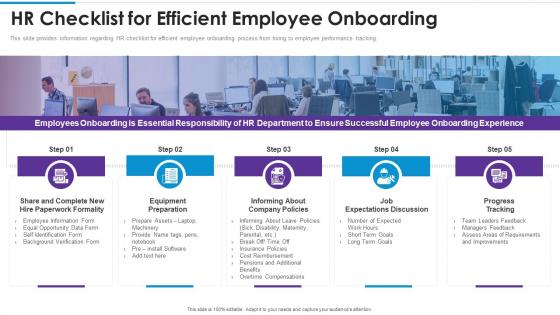
This slide provides information regarding HR checklist for efficient employee onboarding process from hiring to employee performance tracking.
People who downloaded this PowerPoint presentation also viewed the following :
Hr checklist for efficient employee onboarding training playbook template with all 6 slides:
Use our HR Checklist For Efficient Employee Onboarding Training Playbook Template to effectively help you save your valuable time. They are readymade to fit into any presentation structure.





FAQs for Hr checklist for efficient employee onboarding
Honestly, start with all the boring paperwork - I-9s, tax stuff, benefits. Get that out of the way because payroll screwups are a nightmare. Equipment and system access comes next, obviously. But here's what most people mess up: the social side matters way more than you think. Set up those coffee chats with teammates and assign someone as their go-to person. Oh, and definitely do check-ins at 30/60/90 days with clear goals so they're not just wandering around confused. Make it a template and you won't have to reinvent this every single time.
Honestly, tech makes onboarding so much easier. I'd start with basic automation - digital paperwork, welcome videos, maybe some training modules people can do whenever. Chatbots are clutch for answering those random questions new hires always have at like 9pm on a Sunday. Mobile apps work great too since everyone's glued to their phones anyway. Don't go crazy though - I've seen companies add so many "helpful" tools that it actually makes things worse. Pick one or two simple ones first. You can always add more later once you see what actually works.
Dude, culture during onboarding is everything - like seriously, it's why people either love their job or bail after 3 months. Don't just do one boring "culture presentation" though. Mix it throughout the whole process. Get them shadowing different people, sitting in on your team meetings or whatever random coffee chats happen. Here's the thing - you gotta show them how stuff actually works, not just the pretty values on your website. People can smell BS from a mile away when there's a gap between what you preach and what really goes down. Real examples of how decisions get made? That's gold.
So you'll want to build role-specific branches off your main checklist. Everyone gets the basics first - IT setup, HR stuff, company policies, you know the drill. Then it splits based on what they actually need. Sales people get CRM training and territory info, while devs need their coding environment and repo access. Don't go crazy though - I've seen companies with like 40+ different versions which is just ridiculous. Keep your core template the same but swap out maybe 25% of the items depending on their department and seniority level. That way everyone still gets the same foundational experience but with the specifics they need.
Definitely track time-to-productivity first - like how fast people actually hit their stride. Retention at 90 days and one year matters too, plus satisfaction scores from onboarding surveys. Oh, and don't sleep on engagement stuff during those early weeks. Are they finishing training? Speaking up in meetings? I'm big on tracking manager satisfaction since they're the ones actually dealing with everything day-to-day. But honestly, the best metric is probably just asking new hires regularly when they start feeling confident in their role through check-ins.
Quarterly reviews are the bare minimum, but honestly? Update that thing whenever something major changes - new policies, compliance stuff, system updates, whatever. I can't tell you how many outdated checklists I've seen that still mention software from like 2019. Super awkward for new hires. Set a quarterly calendar reminder, sure, but also have someone flag urgent changes right when they happen. Nobody wants to be the new person getting instructions for systems that don't even exist anymore. Treat it like it's alive - because it should be.
Honestly, the worst thing you can do is make it super generic. Like, nobody benefits from some cookie-cutter list that applies to everyone and no one at the same time. Also don't go crazy with tasks - I've seen checklists with like 40+ items and new people just shut down. Skip the obvious stuff (seriously, "set up their desk" doesn't need to be written down). Focus on what actually matters for their specific role instead. Oh, and assign owners to each task! Otherwise everyone thinks someone else is handling it and things get forgotten. Test it out with a couple new hires first - you'll probably need to adjust it anyway.
Dude, new hire feedback is absolute gold for fixing your onboarding mess. Survey them after week one, then at a month and quarter mark - ask what confused them or what they wish they'd known earlier. I swear, some of the best fixes come from random stuff like "why did I get IT setup before building access?" Their fresh eyes catch things you totally miss because you're too close to it. We used to have people doing redundant paperwork for like three departments until someone finally spoke up. Just collect this stuff regularly and actually look at it every few months to tweak things.
Oh man, remote onboarding is tricky but totally doable! Send them all the tech setup stuff and login info first - nothing worse than staring at your laptop on day one with no access. I always throw in some company swag because honestly, free stuff just hits different. Set up their first week with video calls to meet everyone, and definitely assign them a buddy for virtual coffee chats. Make sure they have your IT person's contact info saved. Can't just walk over to someone's desk when Slack crashes, you know? Your company handbook and remote policies should be easy to find too. Over-communicate everything since they'll feel pretty isolated otherwise.
Build compliance checks right into your onboarding flow so stuff doesn't slip through the cracks. I-9s, W-4s, state forms - collect everything within those legal deadlines because missing them is honestly a nightmare. HR software that auto-flags missing docs is worth every penny, trust me. Create a solid checklist covering federal, state, and local requirements for wherever you operate. Train your team on what's actually mandatory vs. just fluff paperwork - there's usually way more fluff than you'd think. Regular audits help catch issues before they blow up. Make it systematic so you're not relying on someone's memory.
Honestly, ditch the PowerPoint marathon - nobody learns that way. Get them a buddy who's actually social (not just whoever drew the short straw). Coffee chats with different teammates work better than formal introductions, trust me. Give them a real project within two weeks so they feel useful, not like they're just sitting there absorbing endless info. Oh, and do check-ins at 1 week, 1 month, 3 months - keeps everyone on track. The whole thing's about mixing structure with actual human connection instead of treating them like a checklist item.
Add mentorship stuff around week 2-3 of onboarding when people aren't completely overwhelmed anymore. Basic tasks: assign the mentor, set up their first meeting, give both people the guidelines. Here's the thing though - most companies do this terribly. They pair people up and then... nothing. Build in check-ins for the first 90 days or it's pointless. Also, mentors forget they signed up half the time, so add reminders for them too. Track it somehow so you know if it's actually helping with retention. Otherwise you're just making busy work.
Honestly, just nail three things: connection, clarity, and some quick wins. Set up regular check-ins with their manager plus assign them a buddy - nobody wants to eat lunch alone the first week, you know? Clear role expectations are huge too. Don't let them wonder what the hell they're supposed to be doing. Map out training timelines and throw in a couple small projects they can actually finish and feel proud of. When people feel supported AND see progress right away, that's where the magic happens. Oh, and plan this stuff out for 90 days, not just the first week.
Look, good training is what separates companies that keep people from ones where everyone bails after a month. Map out what they actually need to know for their specific role first. Then mix real training sessions with hands-on stuff - don't just dump them in front of boring modules all day. Pair them with someone who knows what they're doing. I'd set up those 30-60-90 day check-ins too, because you'll catch problems early. Oh, and make sure your systems training doesn't suck - that's usually where people get lost and frustrated.
Honestly, it's not that complicated - just bake it into your regular onboarding instead of treating it like some separate thing. Have new people meet folks from different teams that first week. Share your diversity goals upfront (transparency actually matters here). Those "culture buddy" programs? They're surprisingly effective. Unconscious bias training should happen early, and your onboarding stuff needs to actually show your diverse workforce - not just stock photos of people in suits. Oh, and introduce the employee resource groups right away. The whole point is making inclusion feel normal from day one, not like you're checking boxes.
-
Topic best represented with attractive design.
-
Informative presentations that are easily editable.