

Flow Chart For Human Resource Management Process




Try Before you Buy Download Free Sample Product
 Impress Your
 Audience
 100%
100% Editable
 Save Hours
 of Time


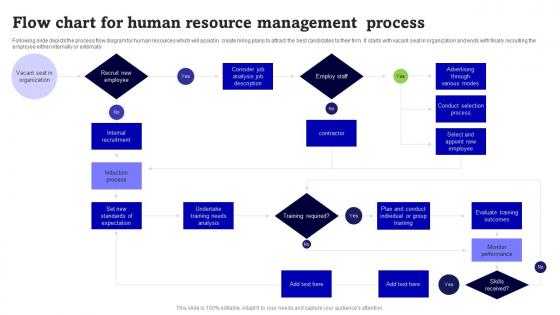
Following slide depicts the process flow diagram for human resources which will assist in create hiring plans to attract the best candidates to their firm. It starts with vacant seat in organization and ends with finally recruiting the employee either internally or externally.
People who downloaded this PowerPoint presentation also viewed the following :
Flow Chart For Human Resource Management Process with all 6 slides:
Use our Flow Chart For Human Resource Management Process to effectively help you save your valuable time. They are readymade to fit into any presentation structure.





FAQs for Flow Chart For Human
Okay so for your HR flowchart, start with recruitment and selection - that's your entry point. Then onboarding, performance management, training and development, compensation stuff, and employee relations. Exit process too (seriously, everyone forgets that one but it matters). Map out what you're doing now first - way easier than starting from scratch. Each piece should connect logically, but throw in some feedback loops because let's be real, this stuff isn't a straight line. Employees bounce around between stages all the time. Look for where things get stuck or slow down, that's where you'll find your problems.
Flow charts are like giving your new people a map instead of just throwing them into the maze, you know? Visual stuff clicks way faster than those boring policy books nobody actually reads through. Your team can see the whole process - onboarding, reviews, time off requests - laid out step by step. People who hate reading paragraphs will actually love this approach. I'd start with whatever process generates the most confused emails (probably onboarding tbh). Once you roll it out, you'll notice way fewer "wait, what's next?" messages hitting your inbox.
Start with the basics - recruitment, onboarding, performance reviews, training, payroll/benefits, and when people leave. Compliance stuff is boring but trust me, you'll thank yourself later when you're not scrambling during an audit. Employee relations and disciplinary procedures matter too. The trick isn't just listing everything though. Map out how people and info actually flow between these functions - like how does someone go from new hire to getting their first review? I'd tackle your most common processes first. Save the messy stuff like grievances for later once you've got the foundation solid.
Honestly, flow charts are like having a roadmap everyone can actually follow. Your whole HR team sees the same steps and knows who's doing what. No more endless email chains trying to explain stuff! New hires especially love them - way better than dumping a manual on their desk. When someone goes "wait, wasn't that supposed to be my job?" you just pull up the chart. Problem solved. I'd start with whatever process confuses people most right now. You'll be shocked how fast those awkward "whose turn is it" moments just... disappear.
Honestly, flow charts are game-changers for onboarding. Map out every step so new hires aren't wandering around confused on day one. You'll spot the annoying bottlenecks too - like when someone's sitting there for three days waiting for IT to create their login (classic). Everyone gets the same solid experience instead of some people getting the full tour while others get forgotten about. I'd start by writing down what you're doing now, then fix the obvious mess-ups. Makes tracking way easier since you can see exactly where things usually fall apart.
Honestly, I'd just start with Draw.io (they renamed it to diagrams.net or something). It's totally free and does everything you need. Lucidchart's pretty solid too if you want fancier templates - plus it's web-based so sharing's easy. Visio's the old reliable but kinda pricey. Oh, and if your team's into that whole collaborative whiteboard thing, Miro's actually fun to use during meetings. I mean, you could even throw something together in PowerPoint if you're in a rush. Try the free ones first though - why pay for features you might not even use?
Honestly, flow charts are amazing for this stuff. You basically map out every step in your HR process, and suddenly all the dumb inefficiencies become super obvious. Like, you'll see three approval layers that don't actually do anything, or realize information keeps getting lost when it bounces between departments. The visual layout just makes bottlenecks pop out – it's wild how much clearer things get when you actually draw it all out. I'd start with whatever process annoys you the most. That's usually where you'll find the biggest problems hiding.
Honestly, flow charts are like having a cheat sheet for staying compliant. You map out your hiring process, disciplinary stuff, terminations - whatever's most risky for your company. That way you're not making it up as you go. If someone sues or you get audited, boom - you've got documented proof you followed the rules consistently. Your team will actually thank you too because compliance training becomes way less painful when it's visual instead of just boring policy manuals. I'd definitely start with whatever processes scare you most from a legal standpoint.
Flow charts seriously save your butt with performance reviews. Map out the whole timeline - goal setting, check-ins, final reviews, all that stuff. When you've got employees at different stages (which, let's be real, is always), it keeps you from forgetting important pieces like 360 feedback or calibration meetings. Your team actually loves seeing what's next too. I learned this the hard way after missing a few steps last cycle. Just sketch one out and share it with your direct reports - they'll thank you for not keeping them guessing about timing.
Honestly, flowcharts are a game changer compared to those boring HR manuals nobody wants to read. You can actually see what happens next just by following the arrows - no more digging through paragraphs of jargon. They're perfect for onboarding new people or those crazy approval processes that always confuse everyone. When stuff changes, you just move some boxes around instead of rewriting half a manual. Super efficient. I'd start with whatever processes people ask you about most - probably saves you from answering the same questions over and over. Then just build from there when you have time.
Skip the generic templates and just map what you're actually doing. Work backwards from your company values - like if collaboration matters, add more team touchpoints in hiring and reviews. Honestly, I've watched companies overcomplicate this so much. Document what's already working for your culture first. Then throw in your real approval chains and the people who actually make decisions (not who's supposed to). Use your team's normal language too. Oh, and definitely test it with some managers before rolling it out. You want something that matches reality, not just what looks impressive.
Honestly, the worst part is getting your team on board - nobody wants more "process documentation" shoved at them. Plus keeping the damn things current is a nightmare. HR stuff changes constantly with new rules and policies, so that perfect flowchart you spent hours on? Outdated in three months. You'll go crazy trying to make them detailed enough to actually help but not so complex that people ignore them completely. Oh, and finding someone who'll actually own the updates quarterly - good luck with that! Start with just one process that's really broken. Get a few key people excited about it first, then worry about expanding later.
Honestly? Every 6 months if you're growing fast, otherwise once a year is fine. Your company's probably changing constantly - new policies, compliance stuff, people coming and going. Major red flag: when everyone keeps asking about the same process that should be obvious from the flowchart. That's when you know it's totally out of date. Also review after big changes like leadership shifts or mergers, obviously. Here's the thing though - actually assign this to someone specific with a calendar reminder. Otherwise it'll just sit there forever and you'll be scrambling during your next audit. Been there!
Oh totally! Most HR flow chart tools these days play really well with whatever you're already using - your HRIS, ATS, all that stuff. I'd honestly just start by seeing what your current HR platform already connects to. Then grab something like Lucidchart that has decent APIs. The cool part is when everything talks to each other automatically - like your flow chart triggers an onboarding email without you lifting a finger. Even works with Slack if your team's into notifications (though honestly, who needs more Slack pings?). It's way less complicated than it used to be.
Honestly, flowcharts are amazing for HR planning because you can actually see your whole talent pipeline laid out. Map your hiring process first - I swear you'll find weird bottlenecks you never noticed before. They're perfect for showing executives what's going on since those guys love anything visual. You can spot where processes overlap or fail completely. The coolest part? Use them to figure out future headcount needs and succession planning gaps. I know it sounds boring, but just putting everything on paper (or screen) reveals so many inefficiencies. Plus your workflows become way clearer when you can trace cause-and-effect relationships visually.
-
“I really like the convenient operation and professionalism I saw on the SlideTeam website. I want to express my regards and appreciation to the team.”
-
Like always a great experience with you guys. Always there on the drop of hat to help.