

Employee Learning And Development Roadmap Plan




Try Before you Buy Download Free Sample Product
 Impress Your
 Audience
 100%
100% Editable
 Save Hours
 of Time


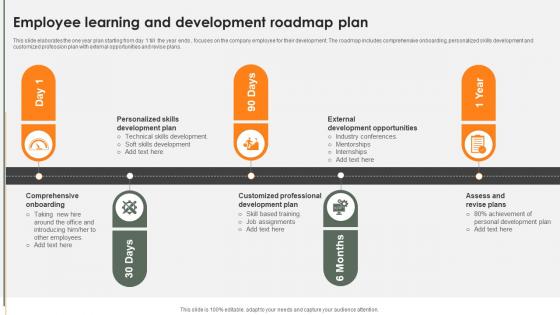
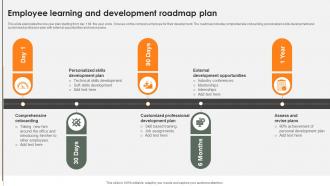
This slide elaborates the one year plan starting from day 1 till the year ends , focuses on the company employee for their development.The roadmap includes comprehensive onboarding, personalized skills development and customized profession plan with external opportunities and revise plans.
People who downloaded this PowerPoint presentation also viewed the following :
Employee Learning And Development Roadmap Plan with all 6 slides:
Use our Employee Learning And Development Roadmap Plan to effectively help you save your valuable time. They are readymade to fit into any presentation structure.





FAQs for Employee Learning And
Honestly, start by just asking your team what skills they actually want to develop - that'll save you from guessing wrong. You'll need clear career paths mapped out, plus regular check-ins to see how people are progressing. Mix formal training with mentoring (seriously, people love having someone to actually talk through stuff with). Oh, and make sure whatever you build connects to business goals or leadership won't care about funding it. The biggest mistake? Launching something awesome then letting it die because nobody's maintaining it. Keep it simple at first - you can always add more later once you see what works.
Honestly, you need both the hard numbers and the touchy-feely stuff to really know what's working. Check promotion rates, who's sticking around, performance scores - the usual suspects. But don't sleep on engagement surveys either. Those will tell you if people actually feel better at their jobs or just went through the motions. Oh, and definitely get manager input on behavioral changes they're seeing. That's huge. The timing matters too - measure right after training, then again in like 3-6 months to see if it actually stuck. Just pick 3-4 metrics and track them consistently on a simple dashboard.
Dude, tech totally transforms how people learn at work. Online courses, mobile apps, virtual mentoring - your team can access stuff whenever they want. AI assessments figure out what skills people need. Learning management systems track everything and suggest personalized content. Honestly, there's almost too many options now (which is kinda crazy but also awesome). I'd start by asking your team what they actually want to learn first. Then you can pick the right tools to make it happen. Way more effective than just throwing random training at people.
Honestly, just start having regular one-on-ones and actually ask what they want to do next - I know it sounds basic but tons of managers never bother. Check their performance reviews against their goals, see where the gaps are. I'm always watching how people react to different projects too, like do they light up during certain tasks? That tells you a lot. Oh, and don't assume they want to move up - sometimes people want sideways moves or totally different stuff. Set up these conversations every few months and write things down because you'll forget otherwise. Trust me on that one.
Honestly, you've gotta actually talk to them first about what they want career-wise - I always screw this up by jumping straight into "here's what you're bad at" mode lol. Sit down together and figure out their strengths and weak spots, then set up some real goals with deadlines. Mix it up with different stuff - maybe a challenging project, some mentoring, actual training courses. Whatever clicks for how they learn. The whole thing needs to be collaborative though, and don't just do it once then forget about it. Check in regularly or it's basically useless.
Honestly, mentorship only works if you bake it right into your development process from the start. Match your experienced people with newer folks based on what skills they actually need to grow. Set real expectations and deadlines - I've watched too many "mentorship programs" turn into awkward coffee meetings that fizzle out after two weeks. Track how it's going in performance reviews. Have mentors act like actual coaches who push people forward, not just someone to bug with random questions. Structure makes all the difference here.
Honestly, development stuff makes a massive difference for keeping people happy and sticking around. The data backs this up big time. Your team wants to grow - when they can't, they get restless and start looking elsewhere. But give them training, mentoring, or even just new projects? They'll feel like you actually care about their future, not just what they're cranking out today. I always tell managers to just ask their people what skills they want to build. Doesn't have to be fancy or expensive either. Even small opportunities can totally flip how engaged someone feels at work.
Honestly, it's all about making learning feel exciting instead of like another task on their plate. Give people real time and budget - not just lip service while drowning them in deadlines. Peer-driven stuff works way better than corporate training, so try lunch-and-learns or skill swaps where they teach each other. I'm kind of obsessed with mentorship programs too. When someone uses what they learned? Make a big deal about it. Recognition is everything. The magic happens when your team realizes growing their skills actually helps their career, not just the company's bottom line.
Okay so there's actually a bunch of cool stuff you can try! VR training is blowing up right now - employees get to practice risky scenarios without any real consequences. Microlearning breaks everything down into quick 5-minute sessions they can squeeze in whenever. Gaming elements are pretty sweet too, like earning points or badges for completing modules. Oh, and don't sleep on peer mentoring - sometimes coworkers explain things better than any formal trainer ever could. Job shadowing works great for hands-on learners. I'd probably survey your people first to see what clicks with them, then test a couple approaches before going all-in.
Honestly, you'll need to get creative with digital touchpoints since you can't just bump into people anymore. Set up virtual coffee chats and online skill-sharing sessions - some people actually love this format once they adjust. Regular one-on-ones become super important now. You can't rely on those random water cooler conversations for development talks. Collaboration tools work great for peer learning too. I'd start by asking your team what formats they prefer - might surprise you what they say. Self-paced courses and cross-team projects help build those connections you're missing. It's more work upfront but totally doable.
Oh absolutely, there's a huge connection there. When companies actually invest in their people, performance shoots up across the board. You get higher productivity, way less turnover, and honestly? People just seem happier at work when they feel like they're growing. Revenue tends to follow too - studies back this up pretty consistently. The catch is you can't just throw random training at everyone and call it development. It's gotta tie back to what your business actually needs, otherwise you're just burning money on feel-good workshops that don't move the needle.
Don't wait for annual reviews - that's way too late! Set up monthly one-on-ones instead. Give specific feedback right when things happen, not three weeks later when nobody remembers what went wrong. Here's what actually works: ask your people what they want to develop, because honestly we guess wrong half the time. Build individual plans around their goals plus your feedback. The real difference comes from following up consistently and celebrating small wins. Oh, and don't try this with your whole team at once - pick one person this month and get that rhythm down first.
Budget's always the first headache. Getting executives on board? Good luck with that - they want ROI numbers that are basically impossible to nail down. Most employees will dodge training like it's extra homework, claiming they're swamped until review season hits. Balancing development time with actual work is brutal. Skills gaps make it confusing to even know where to begin. Oh, and if your company culture sucks at supporting learning, you're dead in the water no matter how much money you throw at it. Honestly, just start with small pilot programs first.
Honestly, you don't need to spend a fortune on this stuff. Free online courses and YouTube tutorials are surprisingly good these days - way better than they used to be. Get your team members teaching each other their skills, and pair people up for mentoring. Cross-training is huge too since it builds flexibility while developing everyone. Oh, and stretch assignments work great for giving people new challenges without any extra budget. Industry webinars are everywhere if you know where to look. Really, it's about being creative with what you've already got instead of throwing money at expensive programs.
Look, soft skills matter just as much as the technical stuff - maybe more honestly. I'd start with figuring out what each person on your team actually needs to work on first. Then build it into your regular one-on-ones instead of making it some separate thing. Feedback sessions help, peer mentoring works great too. Stretch assignments where they have to present or lead something? Perfect practice. Role-playing sounds dumb but I've seen it work. The trick is giving them real situations to practice in, not just talking about it. Oh, and don't try to fix everything at once - pick one skill per person to focus on.
-
The content is very helpful from business point of view.
-
I have just started downloading templates for my presentations and I must say this is a great design. It helped accelerate my presentation design process and made it more visually appealing.