Six Steps To Create Sales Territory Strategy
Try Before you Buy Download Free Sample Product
Audience
Editable
of Time
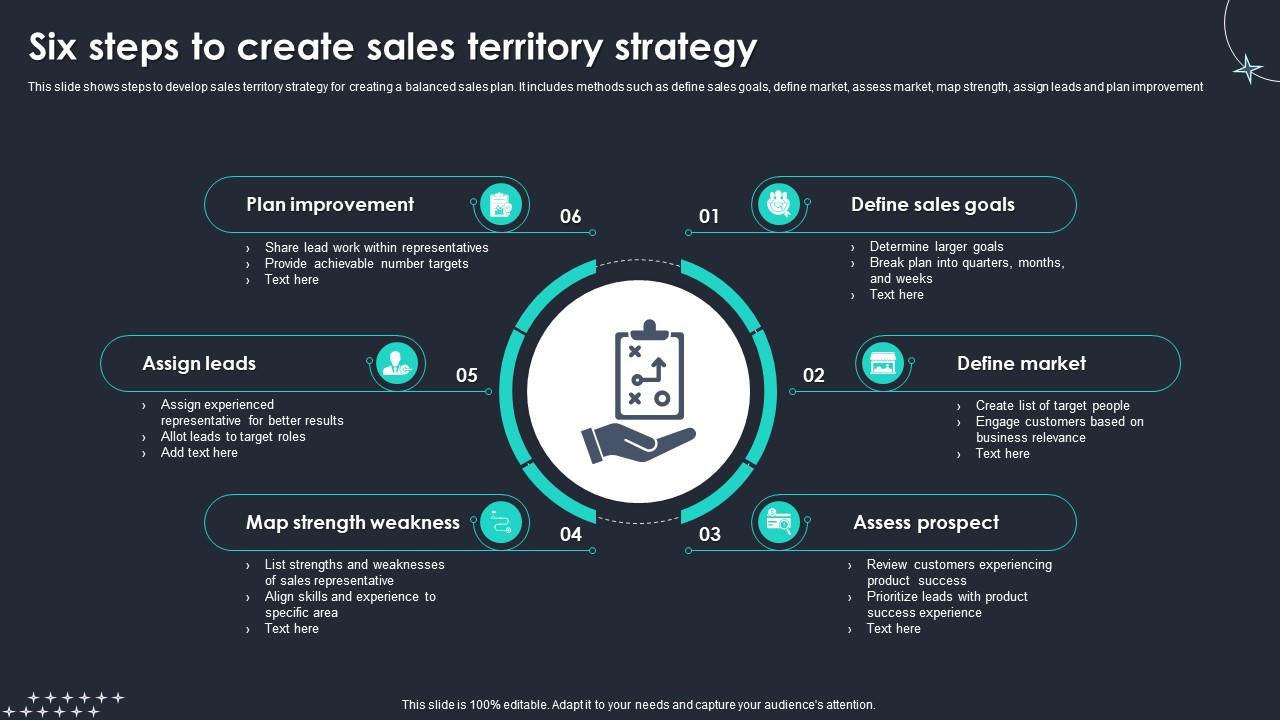
This slide shows steps to develop sales territory strategy for creating a balanced sales plan. It includes methods such as define sales goals, define market, assess market, map strength, assign leads and plan improvement.
People who downloaded this PowerPoint presentation also viewed the following :
Six Steps To Create Sales Territory Strategy with all 6 slides:
Use our Six Steps To Create Sales Territory Strategy to effectively help you save your valuable time. They are readymade to fit into any presentation structure.
FAQs for Six Steps To Create
When defining sales territories, consider geographic boundaries, customer density, market potential, travel logistics, sales rep capabilities, and competitive presence. These factors enable organizations to optimize resource allocation, minimize travel costs, and maximize market coverage, with many companies finding that strategic territory design enhances sales productivity and customer relationships while delivering sustainable revenue growth.
Sales territory effectiveness can be measured through revenue growth per territory, customer acquisition rates, sales cycle length, market penetration percentages, and cost per acquisition metrics. These measurements enable organizations to identify high-performing regions, optimize resource allocation, and adjust territorial boundaries strategically, with many companies finding that data-driven territory analysis delivers significantly improved sales outcomes and competitive advantage.
Market segmentation enables businesses to divide territories based on customer demographics, buying behaviors, industry verticals, and revenue potential, creating more targeted and efficient sales approaches. This strategic segmentation allows organizations to allocate resources effectively, customize messaging for specific segments, and optimize territory boundaries, with many companies finding that segmented territories deliver higher conversion rates and stronger customer relationships.
Technology enhances sales territory management through CRM systems, geographic mapping software, predictive analytics, mobile applications, and automated reporting tools. These solutions streamline territory planning, optimize route efficiency, and provide real-time performance insights, with many organizations finding that sales teams achieve faster customer response times, improved quota attainment, and ultimately stronger competitive positioning.
Sales territory reallocation best practices include analyzing revenue per territory, customer acquisition rates, market penetration levels, sales cycle lengths, and rep performance metrics. These assessments enable strategic redistribution by identifying underperforming regions, balancing workloads across high-potential areas, and optimizing resource allocation, with many organizations finding that data-driven reallocation delivers improved coverage and accelerated revenue growth.
Sales territory strategy aligns with business goals by mapping territories to strategic markets, assigning resources based on revenue potential, and establishing metrics that support company objectives like growth targets or market expansion. This strategic alignment enables organizations to optimize resource allocation, accelerate market penetration, and deliver consistent revenue growth, with many companies finding that territory-goal alignment increases overall sales performance significantly.
Imbalanced sales territories can lead to unequal workloads, inconsistent revenue distribution, reduced team morale, and missed growth opportunities across regions. These disparities often result in top performers becoming overwhelmed while others remain underutilized, ultimately creating compensation inequities, customer service gaps, and strategic blind spots that undermine overall sales effectiveness and competitive positioning.
Sales territories should be reviewed quarterly for performance metrics and annually for comprehensive restructuring, with major adjustments triggered by significant market changes, team expansion, or strategic shifts. Through regular analysis of sales data, customer feedback, and territory balance, organizations can optimize coverage, enhance rep productivity, and maintain competitive advantage, with many companies finding that proactive territory management delivers stronger revenue growth and improved customer relationships.
Territory analysis methods include demographic analysis, market penetration studies, competitor mapping, customer segmentation, and sales performance metrics evaluation. These approaches streamline territory planning by identifying underserved markets, revealing growth opportunities, and optimizing resource allocation, with many organizations finding that data-driven territory analysis ultimately delivers higher conversion rates and enhanced sales efficiency.
Territory changes can significantly impact team dynamics through altered collaboration patterns, shifted competitive relationships, and modified resource allocation structures. While reassignments may initially create tension around account ownership and compensation adjustments, strategic implementation ultimately enhances team performance by optimizing skill-territory matches, encouraging knowledge sharing between representatives, and fostering collaborative problem-solving approaches that drive collective sales success.
Effective sales territory motivation strategies include performance-based incentives, territory-specific goals, recognition programs, professional development opportunities, and collaborative competition initiatives. These approaches enhance team engagement by providing clear advancement paths, rewarding regional achievements, and fostering healthy rivalry between territories, with many organizations finding that personalized incentive structures ultimately deliver higher conversion rates and sustained sales performance.
Customer demographics significantly influence sales territory design by determining market potential, resource allocation requirements, communication preferences, and service delivery approaches across different geographic areas. Organizations analyze age groups, income levels, industry concentrations, and cultural factors to create territories that maximize coverage efficiency, with many companies finding that demographic-aligned territories enable more targeted messaging, faster relationship building, and ultimately higher conversion rates.
Territory assignments significantly impact sales performance by influencing workload balance, travel efficiency, customer relationship depth, and revenue potential across different market segments. Well-designed territories enhance rep satisfaction through achievable targets and reduced travel stress, while poor assignments can lead to burnout and turnover, with many organizations finding that strategic territory optimization delivers improved quota attainment and higher retention rates.
Data analytics optimizes territory design by analyzing customer demographics, purchasing patterns, geographic distribution, competitive landscape, and sales performance metrics to identify optimal boundaries and opportunities. Through predictive modeling and performance tracking, organizations streamline resource allocation, enhance sales team efficiency, and maximize revenue potential, with many companies finding significantly improved territory balance and accelerated growth outcomes.
Effective communication strategies include transparent change rationale, detailed territory mapping sessions, one-on-one discussions with affected representatives, comprehensive training on new market dynamics, and regular feedback loops. These approaches streamline transitions by addressing concerns proactively, maintaining team morale, and ensuring sales representatives understand their new opportunities, with many organizations finding that early involvement in planning processes ultimately delivers smoother implementations and sustained performance.
-
I downloaded some of the presentations for work. They were simple to modify and saved me a lot of time and effort.
-
It saves your time and decrease your efforts in half.