




 0 Comment
 Customer Reviews

The report's been sitting in the shared drive for two weeks. Everyone's agreed the data is there. Nobody's agreed on what it means.
That's the actual problem with data mining. Not the mining part—tools handle that well enough. The hard part is after. When someone has to stand in front of a room and explain why the pattern matters, what the model actually found, and what the organization should do about it. The data exists. The insight, sort of. The presentation? That's where things fall apart.
There's a specific kind of frustration that happens when you've run the analysis, built the pipeline, extracted something genuinely useful—and then spend three days trying to make a slide that communicates it clearly. Data scientists aren't paid to make slides. But the slides still need to get made.
And it's not just the formatting. It's the structure. How do you show a data processing pipeline to someone who doesn't know what ETL means? How do you explain a machine learning framework to a board that just wants to know if it works? How do you present fraud detection logic without the diagram turning into a wall of boxes?
This is what makes the presentation harder than the analysis. The analysis has a method. The slide has to somehow hold the method, the output, and the so-what—all at once, without losing the room.
That's why these templates exist. Not because data mining is new—it isn't—but because explaining it clearly to the right people, at the right level, at the right time, is genuinely hard. And most people are rebuilding that structure from scratch every single time.
SlideTeam's data mining framework templates are built for exactly this gap. Pre-designed layouts that handle the structure so you can focus on the content. Whether you're presenting a predictive analytics framework to leadership, walking an engineering team through architecture components, or explaining big data analytics to a mixed audience—there's a template for the specific thing you're trying to say.
Here's what's available.
Template 1: Advanced Healthcare Data Analytics Framework
Advanced healthcare data analytics gains real power when the framework behind it is clearly mapped. This template delivers a structured visual framework covering data integration, system operations, and pipeline health across clinical environments. Electronic health records and medical imaging workflows are represented with precision. Clinical Decision Support, Revenue Optimization, and Cost Management each get dedicated visual space. Stakeholders across IT, finance, and clinical operations can align immediately. Communicate complex healthcare data architecture with clarity and authority. Transform your healthcare analytics presentations today. Download this dynamic template now and unlock sharper clinical and operational insights.
[product_image id=1181456]
Template 2: Cycle of Data Analytics Framework
Structured data analysis presentations need a visual backbone that communicates the full analytics cycle. This template maps a six-stage process across Analytics Architecture, Analytics Framework, and Data Analysis with commanding visual flow. Each stage connects logically, giving audiences a clear progression from raw input to actionable insight. The layout empowers you to present data processing pipelines without overloading slides with text. Use it for strategy briefings, technical reviews, or stakeholder alignment sessions. Transform your analytics presentations with a framework that speaks for itself. Download this dynamic template now and elevate every data analytics conversation.

Download this PowerPoint Template
Template 3: Business Data Mining Framework Analysis
Business teams often struggle to show how raw data becomes a real decision. This PPT template covers the full arc — from business understanding and data preparation through data mining modelling, evaluation, and deployment. It is built for analysts and strategy leads presenting to mixed audiences. Use it to walk stakeholders through a pattern recognition or business intelligence reporting session. Explore more data mining framework templates with examples and samples to find the right fit for your context. The template is 100% editable and customizable.

Download this PowerPoint Template
Template 4: Framework of Data Mining Architecture Components
Data mining architecture is easier to explain when every component has a clear place. This PPT template maps the interrelation between key components — the GUI, pattern evaluation module, data mining engine, data warehouse server, and data cleaning, integration, and selection layer. It is useful for IT architects and data engineers presenting system design to leadership or technical peers. The slide handles web-scraping framework and ETL framework conversations equally well. The template is 100% editable and customizable.

Download this PowerPoint Template
Template 5: 4-Stages of Data Mining
Most decision-making failures trace back to skipping a step in the data pipeline. This PowerPoint slide outlines four stages — data gathering, data preparation, data mining, and data analysis and interpretation — with clear ownership by person responsible. It is built for operations leads and analysts who need to explain how raw data becomes a business decision. A solid fit for onboarding sessions or process review meetings. The template is 100% editable and customizable.

Download this PowerPoint Template
Template 6: Data Mining Analysis Framework with ERP System
ERP systems hold enormous amounts of operational data, but the mining logic behind them rarely gets explained clearly. This PPT preset maps a comprehensive data mining analysis framework that connects experts, specialized knowledge, defined goals, and the ERP database into one coherent visual. It is useful for IT and operations leaders presenting data integration framework choices to business stakeholders. The slide makes the otherwise invisible data processing pipeline visible and followable. The template is 100% editable and customizable.

Download this PowerPoint Template
Template 7: Data Mining Trends and Future Outlook PPT Guidelines
Staying ahead of data mining trends requires presentations that match the sophistication of the topic. This template captures future-facing data mining directions with a visually compelling design that commands boardroom attention. Clean layouts translate complex trend analysis into clear, audience-ready narratives. AI data mining developments, real-time data mining shifts, and emerging predictive analytics frameworks all find natural visual expression here. Use this for client pitches, leadership briefings, or industry conference presentations. Transform your trend analysis presentations into conversations that stick. Download this dynamic template now and make your future-outlook sessions land.
[product_image id=1805538]
Template 8: Knowledge Discovery Framework in Data Mining
Knowledge discovery is one of the most misunderstood parts of the data mining process—and one of the hardest to present. This template maps six stages, including Preprocessing, Transformation, and Data Mining, into a logical visual sequence that audiences can actually follow. Each stage builds on the last, giving decision-makers a clear view of how raw data becomes actionable knowledge. It anchors deep learning framework and data science platform conversations in a structure anyone can grasp. Transform your knowledge discovery presentations with a framework that guides rather than overwhelms. Download this dynamic template now and bring clarity to your most complex data narratives.

Download this PowerPoint Template
Template 9: Data Mining Techniques Explained Simply PPT
Explaining data mining techniques to a non-technical audience is harder than it sounds. This deck is built for that exact challenge — translating complex data extraction techniques into visuals that any stakeholder can follow. Read the definitive guide to data mining with a free template for deeper context before presenting. Analysts, trainers, and consultants reach for this PPT when clarity matters more than jargon. The template is 100% editable and customizable.
[product_image id=1740925]
Template 10: Step-by-Step to Data Mining Phases and Tasks PPT
Audiences disengage when data mining phases are presented as a list without visual logic. This template walks through each phase and task step by step, giving data scientists and project managers a presentation structure that mirrors how the work actually unfolds. Color-scheme alignment with your brand identity keeps the deck consistent and professional across every phase. Use it for project kickoffs, methodology reviews, or client-facing data science platform presentations. Transform your phased analysis presentations into clear, credible narratives. Download this dynamic template now and turn your data mining methodology into a compelling story.
[product_image id=1690560]
Template 11: Data Mining Patterns and Insights PPT Outline
Patterns in data only matter when the audience can see them clearly. This PPT deck is designed for analysts and data leads who need to present data mining patterns and insights without losing the room to complexity. It handles cluster analysis tools outputs and pattern recognition algorithm results equally well, framing findings in visuals that non-technical stakeholders can act on. A solid choice for insight readouts, executive briefings, and quarterly business reviews. The template is 100% editable and customizable.
[product_image id=1805534]
Template 12: Automated Data Management Machine Learning Framework
Automating data governance is a hard sell without a clear visual model. This PPT slide maps the machine learning framework for automating data management, covering data repositories, data dictionary, reference repositories, data operations, and data quality rules in one structured view. It is built for data governance leads and ML engineers presenting automation proposals to IT leadership. The slide makes abstract ML-driven governance tangible and auditable for decision-makers. The template is 100% editable and customizable.

Download this PowerPoint Template
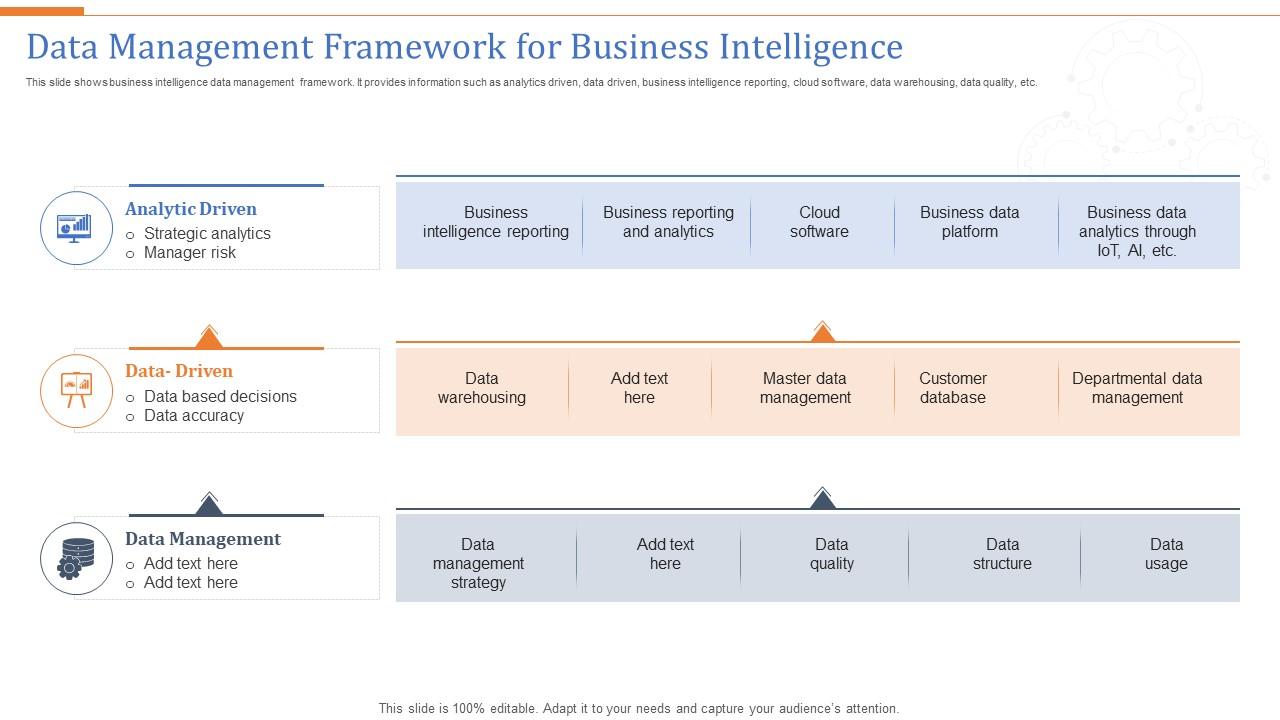
Template 13: Data Management Framework for Business Intelligence
Business intelligence reporting only works when the data management layer beneath it is well understood. This PowerPoint slide lays out a business intelligence data management framework — analytics driven, data driven, cloud software, data warehousing, and data quality — in a structured three-stage view. It is a practical fit for BI leads and CDOs presenting data warehousing solutions and governance models to executive teams. The slide grounds abstract BI architecture in a visual that stakeholders can respond to. The template is 100% editable and customizable.
Download this PowerPoint Template
Template 14: Data Mining Based Financial Fraud Detection Framework
Financial fraud detection is only credible when the underlying data mining logic is clearly mapped. This PPT template walks through five steps — data collection, data processing, data mining, post-processing, and performance evaluation — giving compliance and risk teams a visual model that auditors and executives can scrutinize. It is built for financial analysts and fraud prevention leads who need to present a defensible, data-driven detection framework. The slide turns a complex process into a traceable, stage-by-stage narrative. The template is 100% editable and customizable.
[product_image id=1157514]
Template 15: Utilise Data Analysis and Processing Framework
Data quality problems are rarely visible until they break something downstream. This PPT preset covers the practical steps for utilizing a data analysis and processing framework — from defining objectives and choosing the right framework through validation. It is built for data managers and operations leads who need to present framework selection and data quality decisions to project stakeholders. A clear fit for governance reviews and data processing pipeline planning sessions. The template is 100% editable and customizable.
[product_image id=1099163]
Template 16: Framework for Implementing Data Analytics
Implementation plans for data analytics rarely fail on the technical side — they fail when stakeholders aren't aligned on the steps. This PowerPoint slide maps five stages — Plan, Implement, Analytic, and beyond — into a clean sequential structure that project sponsors and delivery teams can both follow. It is designed for program managers and analytics leads presenting rollout plans to business leadership. The slide makes the implementation arc concrete, trackable, and easy to discuss. The template is 100% editable and customizable.

Download this PowerPoint Template
Template 17: Data Mining Critical Components of Data Mining
Data science presentations often lose audiences at the component level—when the parts don't connect to the whole. This template maps critical data mining components—Data, Programming, Statistics and Probability, Development Tools, Machine Learning, and Big Data—across four visual stages that build coherence. Each component is framed as a functional contributor, not just a label. Structured data analysis discussions, university lectures, and executive technology briefings all benefit from this layout. Transform your data science overview presentations into clear, confident narratives. Download this dynamic template now and give your audience a framework they'll actually remember.

Download this PowerPoint Template
Template 18: Multiple Stages of Data Mining for Decision Making
Sound business decisions depend on a clear view of the full data mining pipeline. This PPT slide outlines six stages — data sources, warehouse, exploration, mining, presentation, and decision making — with defined roles for business analyst and data teams at each step. It is a strong fit for data leads presenting end-to-end workflows to operations or strategy teams. The structure makes the handoff between data presentation and decision making explicit and accountable. The template is 100% editable and customizable.

Download this PowerPoint Template
Template 19: Key Approaches for Integration in Data Mining
Data integration approaches look simple on paper but get contested quickly in practice. This PowerPoint slide covers tight coupling and loose coupling side by side, including the centralized data warehouse model and how each approach handles consistency. It is built for data architects and IT leads explaining data integration framework trade-offs to technical and business stakeholders alike. The visual makes an often abstract architectural debate concrete and comparable. The template is 100% editable and customizable.
[product_image id=1160674]
Template 20: Data Mining Phases of Data Mining Model Building
Model building is where data mining either delivers or stalls, and the tooling choices matter. This PPT template maps the data modeling phase across six stages, covering platforms like SAS Enterprise Miner, SPSS Modeler, MATLAB, Alpine Miner, and Statistica with clear breakdowns by employees, purposes, and testing approaches. It is built for data scientists and project leads presenting platform selection or model development roadmaps to technical sponsors. The slide makes tooling decisions visible and justifiable. The template is 100% editable and customizable.

Download this PowerPoint Template
Elevate Every Data Mining Presentation with SlideTeam
SlideTeam's PowerPoint templates are the best in the industry for presenting data mining frameworks clearly and credibly. These content-ready slides save hours of design work while delivering professional structure across every stage — from data processing pipelines to predictive analytics frameworks. Use these PowerPoint slides to communicate complex data science concepts with precision and confidence. Grab these ready-made templates today and turn your next data mining presentation into a decision-driving asset.
FAQs on Data Mining Framework
What are the core components that distinguish a robust data mining framework from a basic analytics tool?
A robust data mining framework includes a data pipeline, a modeling engine, and an evaluation layer — not just query tools. Basic analytics tools stop at reporting; a framework connects data ingestion, pattern recognition, and output validation in one system. It also handles iterative model building, not just one-time analysis. The result is repeatable, auditable insight generation rather than ad hoc data pulls.
How does a data mining framework handle unstructured data compared to structured datasets?
Structured datasets fit directly into relational models — rows, columns, defined types. Unstructured data — text, images, audio — needs preprocessing first: parsing, tokenization, or feature extraction before any mining can begin. Most modern frameworks use NLP or computer vision modules to convert unstructured inputs into structured representations. The key difference is that unstructured data requires an extra transformation layer before standard mining algorithms can be applied.
What role does feature engineering play in optimizing the performance of a data mining framework?
Feature engineering converts raw variables into inputs that algorithms can learn from effectively. Poor features produce poor models, regardless of algorithmic sophistication. In practice, this means removing redundant variables, encoding categorical data, and creating interaction terms that reflect real business logic. Most performance gaps in data mining outcomes trace back to weak feature design, not weak algorithms.
How do scalability requirements influence the architectural design of a data mining framework?
High scalability requirements push frameworks toward distributed processing — tools like Apache Spark replace single-node computation. The architecture shifts to horizontal scaling: adding nodes rather than upgrading one machine. Storage layers separate from compute layers, enabling independent scaling of each. Frameworks designed for small datasets often break under enterprise data volumes without a fundamental redesign of the processing pipeline.
What are the key differences between supervised and unsupervised learning modules within a data mining framework?
Supervised learning uses labeled data — the correct output is known during training. Unsupervised learning finds patterns in data with no predefined labels. In a data mining framework, supervised modules handle classification and regression tasks; unsupervised modules handle clustering and association. The choice depends on whether you have labeled training data and a defined target variable to predict.
How does a data mining framework integrate with real-time data streaming pipelines?
Real-time data mining requires the framework to connect to a streaming layer — typically Apache Kafka or similar event-stream tools — rather than batch-loaded databases. The mining logic must process records as they arrive, not after full dataset assembly. This means lightweight, low-latency models rather than heavy batch algorithms. Most frameworks handle this through a separate streaming module that feeds into the core mining engine.
What preprocessing techniques are most critical for ensuring data quality within a mining framework?
The three most critical preprocessing steps are handling missing values, removing duplicates, and normalizing data ranges. Missing values skew model outputs; duplicates inflate pattern frequency; unnormalized ranges cause distance-based algorithms to misweight variables. Beyond these three, outlier detection matters for fraud or anomaly use cases. Skipping any one of these steps produces unreliable mining results, regardless of how sophisticated the downstream model is.
How do modern data mining frameworks address the challenge of high-dimensional data?
High-dimensional data causes the 'curse of dimensionality' — distances become meaningless as dimensions grow. Modern frameworks address this through dimensionality reduction techniques like PCA or feature selection methods that drop irrelevant variables before modeling. Regularization in ML models also penalizes complexity, preventing overfitting on noisy dimensions. The practical rule: reduce dimensions to only those with clear predictive relevance before running any mining algorithm.