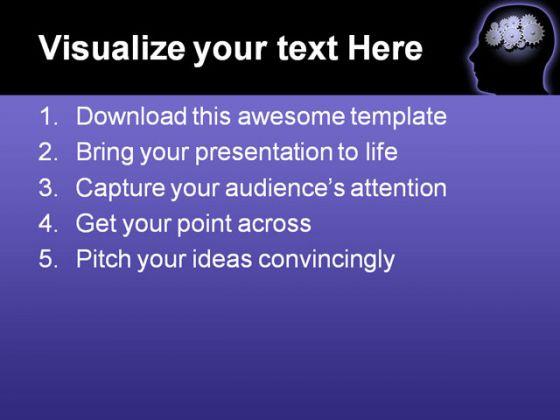
Brain gears science powerpoint templates and powerpoint backgrounds 0211

Rating:
90%
Brain gears science powerpoint templates and powerpoint backgrounds 0211
Slide 1 of 3
Favourites Favourites

Try Before you Buy Download Free Sample Product

Audience Impress Your
Audience
Editable 100%
Editable
Time Save Hours
of Time
The Biggest Sale is ending soon in
0
0
:
0
0
:
0
0
Rating:
90%
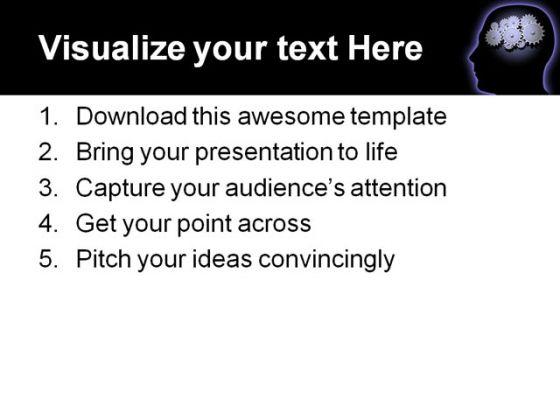
Microsoft PowerPoint Template and Background with gears inside the profile of a man's head

People who downloaded this PowerPoint presentation also viewed the following :

FAQs for Brain gears science powerpoint templates and

Key mechanisms underlying cognitive function include synaptic transmission, neural plasticity, neurotransmitter regulation, memory consolidation, and executive control networks. These interconnected systems enhance cognitive performance by facilitating information processing, adapting neural pathways, and coordinating complex mental tasks, with healthcare institutions and educational organizations increasingly leveraging this understanding to optimize learning outcomes and cognitive interventions.

Neurotransmitters serve as chemical messengers that facilitate communication between neurons, influencing neural network synchronization, signal transmission speed, and cognitive processing efficiency across different brain regions. These biochemical signals regulate attention, memory formation, and decision-making processes by modulating synaptic strength and neural firing patterns, ultimately enabling coordinated brain function and optimized information processing throughout interconnected neural circuits.

Neuroplasticity significantly enhances cognitive efficiency by strengthening neural pathways, eliminating redundant connections, and optimizing information processing speeds through targeted mental exercises and learning experiences. Organizations in healthcare, education, and professional training increasingly leverage neuroplasticity-based programs to accelerate employee skill acquisition, improve decision-making capabilities, and ultimately deliver enhanced performance and competitive advantage.

Glial cells support brain function through maintaining neural connections, regulating neurotransmitter levels, providing metabolic support, and facilitating communication between neurons. These cells enhance cognitive processes by ensuring optimal brain environment, protecting against inflammation, and supporting synaptic plasticity, with research increasingly showing their critical role in memory formation, learning efficiency, and overall neurological health.

Memory formation acts as the brain's fundamental gearing mechanism by strengthening neural pathways, creating synaptic connections, and establishing retrieval networks that enhance cognitive processing speed and accuracy. Through repeated encoding and consolidation processes, organizations leveraging brain-training programs and educational institutions find that structured memory enhancement delivers improved decision-making capabilities, faster problem-solving responses, and ultimately competitive cognitive advantages in increasingly complex operational environments.

Aging affects brain function through reduced processing speed, declining working memory, decreased neural connectivity, weakened attention control, and slower information retrieval. While these changes present challenges, many older adults compensate by leveraging experience and crystallized knowledge, with research showing that cognitive training and lifelong learning help maintain mental agility and optimize remaining neural pathways.

Mindfulness and meditation optimize brain performance by strengthening neural pathways, improving focus and attention span, reducing stress hormones like cortisol, and enhancing cognitive flexibility and memory consolidation. These practices enable professionals to make better decisions under pressure, process information more efficiently, and maintain sustained concentration, with many organizations finding that employee meditation programs ultimately deliver improved productivity and reduced burnout rates.

Sleep patterns significantly impact cognitive processing by affecting memory consolidation, attention span, neural connectivity, and decision-making capabilities. Poor sleep disrupts the brain's glulymphatic system, which clears metabolic waste, while quality sleep enhances synaptic plasticity and information retention, with many professionals finding that consistent sleep schedules ultimately deliver sharper focus and improved analytical performance.

Different learning styles activate distinct neural networks, with visual learners engaging spatial processing regions, auditory learners stimulating language centers, and kinesthetic learners activating motor cortex areas. These varied activation patterns enhance retention and comprehension by aligning with individual cognitive strengths, ultimately delivering more effective educational outcomes and personalized learning experiences across diverse academic and professional training environments.

Nutrition significantly impacts cognitive performance through improved memory, enhanced focus, increased mental clarity, better decision-making abilities, and sustained attention spans. Omega-3 fatty acids, antioxidants, and complex carbohydrates optimize neurotransmitter function and blood flow, with many professionals finding that strategic dietary choices ultimately deliver sharper thinking and competitive mental advantages.

Neuroimaging techniques like fMRI, PET scans, and EEG can visualize neural network activity in real time, revealing how brain regions coordinate during cognitive tasks, decision-making, and information processing. These technologies enable researchers and healthcare professionals to observe synchronized brain activity patterns, identify neural inefficiencies, and develop targeted interventions, ultimately delivering enhanced diagnostic capabilities and personalized treatment approaches across neurology, psychology, and cognitive rehabilitation fields.

External stimuli influence cognitive synchronization by modulating neural oscillations, adjusting brainwave frequencies, and coordinating activity across different brain regions through attention networks. When processing complex information, the brain synchronizes theta, alpha, and gamma waves to integrate sensory input with memory and decision-making processes, ultimately enabling faster cognitive responses and enhanced focus during demanding tasks.

Technology enhances brain functionality understanding through neuroimaging techniques like fMRI and PET scans, brain-computer interfaces, computational modeling, optogenetics, and advanced data analytics. These technologies streamline research by enabling real-time monitoring, precise neural manipulation, and pattern recognition, with medical institutions and pharmaceutical companies finding that enhanced brain mapping accelerates treatment development and diagnostic accuracy.

Emotional intelligence interacts with cognitive processes through the limbic system's connection to the prefrontal cortex, enabling better decision-making, memory formation, and attention regulation. This neural integration enhances workplace performance, leadership effectiveness, and social problem-solving, with organizations increasingly finding that emotionally intelligent employees demonstrate superior analytical thinking and strategic outcomes.

Brain injuries can disrupt cognitive gears through impaired memory formation, reduced processing speed, compromised attention control, altered executive function, and damaged neural connectivity. These disruptions affect workplace productivity, learning capacity, and decision-making abilities, with many rehabilitation programs finding that targeted cognitive training and neuroplasticity interventions help restore mental efficiency and functional independence.

Ratings and Reviews

90% of 100
Write a review
Most Relevant Reviews
  1. 100%

    by CHRISTOPER CHAVEZ

    It saves your time and decrease your efforts in half.
  2. 80%

    by DARNELL TUCKER

    Great quality slides in rapid time.

2 Item(s)

per page: