

Brand Collaboration Investor Funding Elevator Pitch Deck Ppt Template




Try Before you Buy Download Free Sample Product
 Impress Your
 Audience
 100%
100% Editable
 Save Hours
 of Time


Brand collaboration is a strategy to combine two or more businesses to add value to each others products and services to get access to broader markets. Grab our professionally designed Brand Collaboration pitch deck that shows the overview and includes mission, core values, and revenues. It covers the problems faced by prospects and possible solutions offered by brand collaboration firms. This deck depicts key focused parameters, people involved, benefits, marketing campaign, and value proposition to boost equity. Also, you can showcase a strategic brand collaboration model, competitive advantage from entering into collaboration, various competitors existing in the global market, etc., by having your hands on this pitch deck. Further this deck talks about the competitive positioning map of different brands, financial progress in product performance, actual and project revenue, and client testimonials. At last, it incorporates a contact us slide with address, contact number, and email address. Book a free demo with our research team now.
People who downloaded this PowerPoint presentation also viewed the following :
Content of this Powerpoint Presentation
Slide 1: This slide displays title i.e. 'Brand Collaboration Investor Funding Elevator Pitch Deck'.
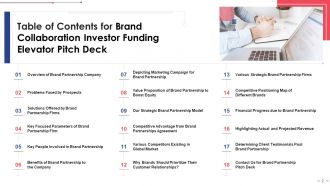
Slide 2: This slide presents table of contents.
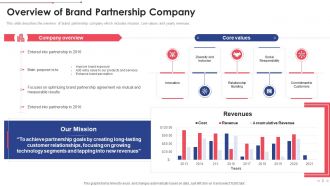
Slide 3: This slide describes the overview of brand partnership company which includes mission, core values and yearly revenues.
Slide 4: This slide focuses on the problems faced by the prospects which includes inconsistent customer experience, lack of JIT information to consumers, etc.
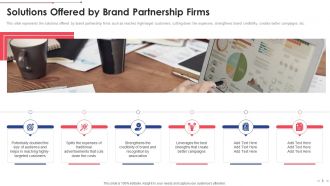
Slide 5: This slide represents the solutions offered by brand partnership firms such as reaches high-target customers, cutting down the expenses, etc.
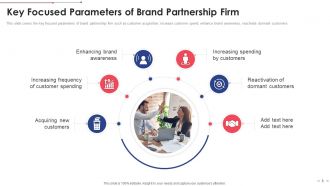
Slide 6: This slide covers the key focused parameters of brand partnership firm such as customer acquisition, increase customer spend, enhance brand awareness, etc.
Slide 7: This slide covers the key people involved in brand partnership which shows the designations, skills and their experience.
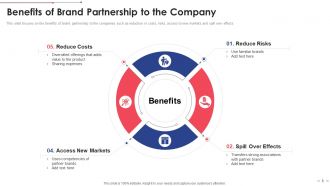
Slide 8: This slide focuses on the benefits of brand partnership to the companies such as reduction in costs, risks, access to new markets and spill over effects.
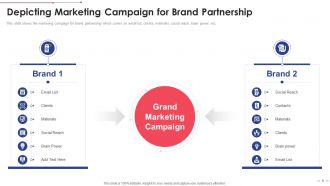
Slide 9: This slide shows the marketing campaign for brand partnership which covers on email list, clients, materials, social reach, brain power, etc.
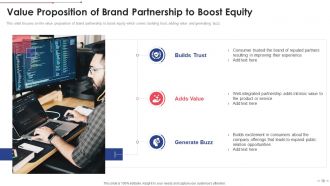
Slide 10: This slide focuses on the value proposition of brand partnership to boost equity which covers building trust, adding value and generating buzz.
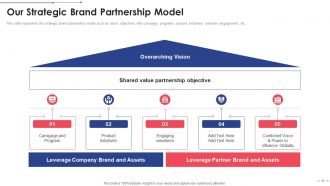
Slide 11: This slide represents the strategic brand partnership model such as vision, objectives with campaign, programs, product initiatives, volunteer engagement, etc.
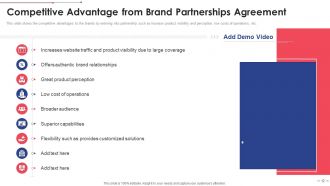
Slide 12: This slide shows the competitive advantages to the brands by entering into partnership such as increase product visibility and perception, etc.
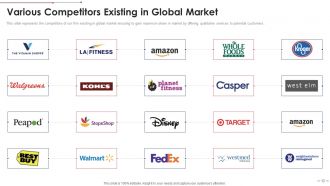
Slide 13: This slide represents the competitors of our firm existing in global market ensuring to gain maximum share in market.
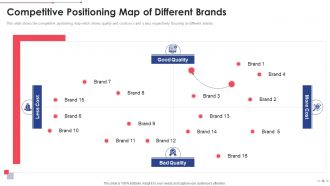
Slide 14: This slide shows the competitive positioning map which shows quality and costs on x and y axis respectively focusing on different brands.
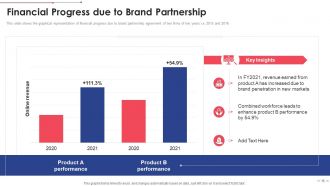
Slide 15: This slide shows the graphical representation of financial progress due to brand partnership agreement of two firms of two years i,e, 2015 and 2016.
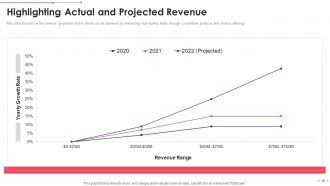
Slide 16: This slide focuses on the revenue projection of firm which can be achieved by enhancing high-quality leads through competitive products and service offerings.
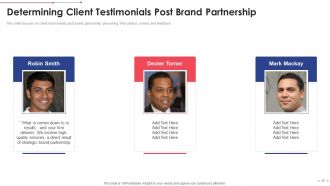
Slide 17: This slide focuses on client testimonials post brand partnership presenting their photos, names and feedback.
Slide 18: This slide focuses on the information for contacting that includes company logo, name, office address, contact number and email address.
Slide 19: This is the icons slide.
Slide 20: This slide presents title for additional slides.
Slide 21: This slide shows about your company, target audience and its client's values.
Slide 22: This slide presents your company's vision, mission and goals.
Slide 23: This slide depicts posts for past experiences of clients.
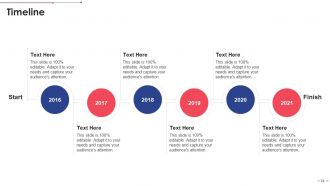
Slide 24: This slide exhibits yearly timeline.
Slide 25: This slide displays puzzle.
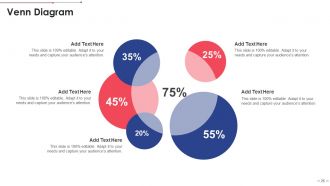
Slide 26: This slide displays Venn.
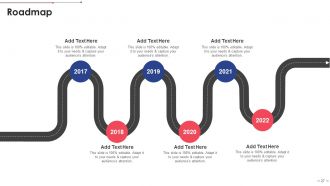
Slide 27: This slide shows roadmap.
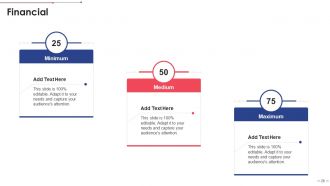
Slide 28: This slide showcases financials.
Slide 29: This slide presents goals of the company.
Slide 30: This is thank you slide & contains contact details of company like office address, phone no., etc.
Brand Collaboration Investor Funding Elevator Pitch Deck Ppt Template with all 35 slides:
Use our Brand Collaboration Investor Funding Elevator Pitch Deck Ppt Template to effectively help you save your valuable time. They are readymade to fit into any presentation structure.








FAQs for Brand Collaboration Investor Funding Elevator Pitch
Dude, collaborating with other brands is honestly a game-changer when you're starting out. You get access to their audience while they tap into yours - basically doubling your reach without the crazy ad spend. Plus there's this instant credibility boost, especially if they're more established than you are. I'd definitely start small though. Find brands that vibe with your values but aren't competing directly with you - like, don't partner with your biggest rival, you know? The shared creativity usually produces way better content too. Oh, and test things out first before jumping into some massive commitment. You don't want to get stuck with a brand that's weird to work with.
Find brands with your same audience but not competing directly - that's the goldmine. Honestly, forced partnerships are so obvious and cringey. Check their engagement rates and recent campaigns first. Do your values actually align? Also peek at industry events and see what brands your customers already follow on social. Oh, and definitely start engaging with them casually online before you pitch anything formal. Makes the whole thing feel way less weird when you finally reach out. Your customer data's probably got some good intel on this too.
Honestly, audience alignment makes or breaks these partnerships. Don't just look at demographics - dig into actual shared interests and values. I've watched so many collabs crash because brands only checked age ranges, which is pretty lazy if you ask me. The audiences need to genuinely care about each other's stuff. When that happens naturally, engagement goes crazy and you'll actually convert people instead of getting meaningless views. Real alignment makes everything feel authentic rather than forced. Always check how their audience actually engages before you start talking money or terms.
Track the obvious stuff first - reach, engagement, conversions, sales. But the real gold is in brand sentiment and whether your audiences actually meshed well together. Social listening tools help with this, though they can be kinda clunky. Set clear KPIs with your partner upfront so nobody's confused later about what success looks like. After everything wraps up, do a proper debrief together. What clicked? What was a total disaster? Would you work together again or nah? Those conversations tell you way more than spreadsheets ever will.
Honestly, get your brand guidelines sorted right from the start - saves you so much drama later. Map out what each brand actually stands for, how they look, their whole vibe. Then find where they naturally fit together instead of fighting each other. Build a style guide that works for both without making either one feel weird. I'd probably test it small first though, see how it actually feels before going big. Oh and definitely do regular check-ins so you can catch any weirdness early. Focus on messaging that doesn't sound fake to either audience.
Dude, cross-industry partnerships are honestly genius for reaching new people. You get access to their customers, they get yours. Win-win. Look at Nike teaming up with Apple or how Spotify worked with Uber - totally different worlds but it just works, you know? The best part? You can try out marketing tactics that work in their space. I'd say find brands that have similar values but aren't competing with you at all. That's usually where you'll see the biggest payoff. It's way easier than trying to build an audience from scratch.
Oh man, social media makes brand collabs super intense because everything happens so fast. Your audiences basically crash into each other and start commenting and sharing in real-time - it's wild to watch honestly. I always think of it like having a bunch of mini focus groups all going at once (probably a weird comparison but whatever). The first 48 hours are crucial though. You'll see pretty quickly if people are vibing with it or not based on engagement and how the content performs. If it's not landing right, don't be stubborn about changing your approach.
Honestly, the biggest thing to watch out for is your brand getting totally mismatched with theirs - super awkward when that happens. You might lose creative control too, plus if they mess up, it reflects on you. Their audience data could be way off from what they promised. My advice? Research the hell out of them first. Check their past collabs, see if your values actually align. Get everything in writing - who approves what, success metrics, the whole deal. Oh, and don't go big right away! Try a small test campaign first. Way smarter than diving into some massive partnership that could backfire.
Honestly? Get everything in writing - it's not negotiable. Memories get fuzzy and people remember things totally differently than you do. A simple contract saves your ass by covering deliverables, deadlines, payment, and usage rights. I've watched so many collabs blow up over stuff that seemed "obvious" but wasn't documented. Even a basic one-page agreement works. Just get those key details down before you create anything. Trust me on this one.
Honestly, start by digging into your customer data - see who they are and what other brands they're obsessed with. Check out which companies have audiences that overlap with yours, and don't just look at follower counts (those numbers lie). Engagement rates from old collabs tell you way more. I'd also peek at what your competitors are doing partnership-wise. There's probably some obvious gaps you're missing! Your customers' purchase patterns and social media habits will basically spell out the perfect brand matches for you. Sometimes the best partnerships are hiding in plain sight.
Honestly, the messy collabs usually work better than the super polished ones - weird but true. Try co-branded stuff or behind-the-scenes content that shows both your personalities. Joint product launches are solid, or do social challenges together. Pop-up events work great too if you can swing it. Cross-pollination is huge - get each other's customers to try your stuff and post about it. The trick is finding what your audiences actually have in common first. Don't just throw two brands together and hope it works. Both sides need to feel like they're getting something they can't find anywhere else.
So first thing - actually check if your potential partners walk the walk on sustainability before signing anything. Pick brands that genuinely care about the environment, not just ones with green marketing. Use eco-friendly materials or processes in whatever you create together. Honestly, consumers are way smarter about spotting fake eco stuff these days. Focus your collab around a real message like cutting waste or clean energy. Some partnerships even give profits to environmental groups, which is cool. Just don't make it feel forced or people will see right through it.
Okay so here's the thing - stories make partnerships actually stick in people's heads. Don't just post "we're collab-ing with Brand X!" Instead, explain WHY you two make sense together. What problem are you both trying to solve? People's brains are wired for narratives, not boring announcements. Your collab becomes about shared values or helping customers through something, rather than just slapping logos together. I mean, context is everything, right? Find that common thread between your brands first, then build all your content around that story. Way more engaging than typical partnership posts.
Nike x Off-White totally changed the sneaker game with that deconstructed look - genius move. Supreme x Louis Vuitton? That one literally broke the internet (and probably gave some luxury execs heart attacks). Then you've got practical stuff like Spotify x Uber where you can actually play your own music during rides, which honestly should've happened way sooner. LEGO x NASA was brilliant too - suddenly kids everywhere wanted to be astronauts again. The key thing is finding partners where you're not stepping on each other's toes. Your strengths should fill their gaps and vice versa. Don't just slap logos together and call it collaboration.
Okay so first thing - get your messaging straight before anything goes live. I'm talking a simple doc with tone, key messages, logos, stuff you absolutely won't touch. Most collabs crash and burn right here because people think they'll figure it out as they go. Big mistake. Set up some kind of approval process where you're both checking each other's content first. Nobody wants their audience getting mixed signals or seeing something that's totally off-brand. Keep posting consistent stuff across all your channels. Oh, and maybe don't skip the "no-go topics" conversation - trust me on that one.
-
Wow! The design and quality of templates on SlideTeam are simply the best.
-
Unique research projects to present in meeting.