

Brand management ppt summary




Try Before you Buy Download Free Sample Product
 Impress Your
 Audience
 100%
100% Editable
 Save Hours
 of Time


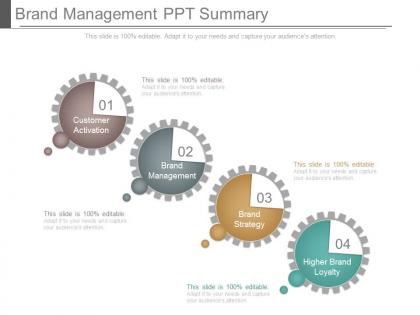
Maintaining the brand value of your product is quite essential in this competitive world. Our brand management PowerPoint slide is designed on this aspect. Manufacturing the quality product can assist you to engage your consumer but to convert them into customers you need to increase its brand value. This impressive design is designed by the team of designing experts with taking assistance from the marketing team. Promotion is required to let the world aware of your new product or services. If the consumer find that this can be the one that they are looking for then you can achieve your desired objective. With this Presentation slide, you can demonstrate the four features of the brand management that are customer activation, brand management, brand strategy and higher brand loyalty. The gear shaped colorful graphics makes it a worthy template to present to the viewers and ensure the positive results from them. So just download, edit and then present it to your audience.Effectively handle constraints with our Brand Management Ppt Summary. Don't allow compulsions to get you down.
People who downloaded this PowerPoint presentation also viewed the following :
Brand management ppt summary with all 7 slides:
Don't let your presentation be overlooked. Make sure it stands out with our vibrant Brand Management Ppt Summary.





FAQs for Brand
Key components of a successful brand management strategy include brand positioning, consistent visual identity, targeted messaging, customer experience management, and performance monitoring across all touchpoints. These elements work together by establishing clear market differentiation, building customer loyalty, and maintaining brand equity, with many organizations finding that strategic integration ultimately delivers enhanced customer retention and competitive advantage.
Companies can measure brand management effectiveness through brand awareness surveys, customer sentiment analysis, net promoter scores, social media engagement metrics, and market share tracking. These measurement tools enable organizations to assess brand perception, customer loyalty, and competitive positioning across different markets, with many finding that regular monitoring helps optimize marketing strategies, improve customer experiences, and ultimately deliver stronger brand equity and revenue growth.
Storytelling serves as a cornerstone of brand management by creating emotional connections, differentiating brands from competitors, and communicating core values in memorable ways. Through compelling narratives, companies like Nike and Apple build deeper customer relationships, enhance brand loyalty, and drive engagement across multiple touchpoints, ultimately delivering stronger market positioning and sustained competitive advantage.
Social media significantly impacts brand perception by amplifying customer feedback, enabling real-time engagement, and creating viral content opportunities that can enhance or damage reputation instantly. Through strategic social media management, organizations streamline customer service, build authentic relationships, and monitor brand sentiment across platforms, ultimately delivering improved customer experiences and competitive advantage in an increasingly digital marketplace.
Common challenges include varying channel requirements, inconsistent messaging across teams, different audience expectations, resource allocation difficulties, and maintaining visual identity standards. These obstacles can significantly impact brand recognition and customer trust, with many organizations finding that establishing clear brand guidelines, centralized approval processes, and regular training helps streamline consistency while delivering stronger market presence.
Brand equity significantly influences customer loyalty by creating emotional connections, establishing trust, and differentiating products from competitors through consistent quality perceptions. Strong brand equity enables companies to command premium pricing, reduce customer acquisition costs, and increase retention rates, with many organizations in sectors like technology and retail finding that customers become advocates who drive organic growth and sustained competitive advantage.
Effective brand crisis management strategies include immediate transparent communication, proactive social media monitoring, stakeholder engagement, consistent messaging across all channels, and swift corrective action implementation. These approaches streamline reputation recovery by addressing concerns directly, maintaining customer trust, and demonstrating accountability, with many organizations finding that transparent crisis response ultimately strengthens long-term brand loyalty and competitive positioning.
Market research informs brand management decisions by providing customer insights, competitive analysis, market trends, consumer preferences, and brand perception data. Through surveys, focus groups, and analytics, companies can identify positioning opportunities, optimize messaging strategies, and track brand equity changes, ultimately enabling more targeted campaigns and strategic pivots that enhance market share and customer loyalty.
Brand positioning establishes a unique market space by differentiating products through value propositions, target audience alignment, competitive advantages, and emotional connections. This strategic differentiation enables companies to command premium pricing, build customer loyalty, and capture market share, with many brands in crowded sectors like technology and retail finding that clear positioning drives sustainable competitive advantage.
Companies leverage customer feedback for brand improvement through systematic collection via surveys, social media monitoring, reviews, and direct interactions, then analyzing patterns to identify enhancement opportunities. This strategic approach enables organizations to refine messaging, improve products, address service gaps, and strengthen customer relationships, with many brands finding that responsive feedback integration delivers increased loyalty, competitive differentiation, and sustained market growth.
Visual identity significantly impacts brand recognition by creating memorable impressions, establishing emotional connections, ensuring consistent touchpoints, and differentiating brands in competitive markets. Through strategic color schemes, typography, and logo design, companies like McDonald's golden arches or Coca-Cola's distinctive red achieve instant recognition, ultimately driving customer loyalty and enhancing market positioning across diverse consumer segments.
Successful rebranding practices include thorough market research, stakeholder engagement, phased implementation, consistent messaging across channels, and comprehensive employee training. Companies like McDonald's and Starbucks have demonstrated that gradual visual updates, clear communication of brand evolution reasons, and maintaining core value propositions while modernizing customer touchpoints ultimately delivers stronger market positioning and enhanced customer loyalty.
Brands cultivate emotional connections through authentic storytelling, consistent values-driven messaging, personalized customer experiences, and meaningful community engagement across all touchpoints. Companies like Nike and Patagonia demonstrate this by aligning brand purpose with customer beliefs, creating shared experiences through events and social causes, ultimately fostering loyalty that transcends product features and drives long-term advocacy.
**INPUT**: What are some innovative tools and technologies for modern brand management? **OUTPUT**: Innovative brand management tools include AI-powered analytics platforms, social listening technologies, automated content creation systems, real-time sentiment tracking, and integrated customer experience dashboards. These technologies streamline brand monitoring, enhance audience engagement, and accelerate response times, with many organizations finding that strategic combinations deliver improved brand consistency, deeper consumer insights, and ultimately stronger competitive positioning in increasingly dynamic markets. [Word count: 58 words]
Cultural shifts significantly impact brand management by requiring companies to adapt messaging, values alignment, product positioning, and communication channels to evolving consumer expectations and social norms. These changes drive brands to reassess their purpose-driven marketing, diversity representation, and sustainability commitments, with many organizations finding that authentic cultural responsiveness ultimately delivers stronger customer loyalty and competitive differentiation.
-
Understandable and informative presentation.
-
Understandable and informative presentation.