

Brownfield Vs Greenfield Foreign Direct Investment PPT Outline ACP





Try Before you Buy Download Free Sample Product
 Impress Your
Audience
 100%
Editable
 Save Hours
of Time


Explore the nuances of Brownfield vs. Greenfield Foreign Direct Investment with our comprehensive PowerPoint presentation. This deck outlines key concepts, advantages, and challenges, providing valuable insights for investors. Perfect for professionals seeking to understand strategic investment decisions in emerging markets. Engage your audience effectively.
People who downloaded this PowerPoint presentation also viewed the following :
Brownfield Vs Greenfield Foreign Direct Investment PPT Outline ACP with all 41 slides:
Use our Brownfield Vs Greenfield Foreign Direct Investment PPT Outline ACP to effectively help you save your valuable time. They are readymade to fit into any presentation structure.
















FAQs for Brownfield Vs Greenfield Foreign Direct Investment
Brownfield FDI involves acquiring or merging with existing companies in foreign markets, while greenfield FDI establishes entirely new operations from scratch, including facilities, workforce, and market presence. Brownfield investments enable faster market entry and immediate access to established customer bases, though with integration challenges, whereas greenfield projects deliver complete operational control and strategic alignment, with many multinational corporations finding that combining both approaches optimizes their global expansion strategies.
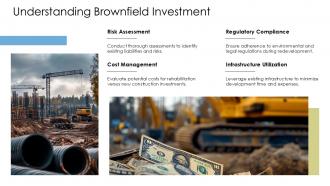
Brownfield investments typically present operational and regulatory risks from existing infrastructure, legacy systems, and established labor relations, while greenfield investments face market entry risks, construction delays, and regulatory approval challenges. Through strategic due diligence, companies in manufacturing and financial services find that brownfield ventures offer faster market penetration with known operational parameters, whereas greenfield projects deliver customized infrastructure and competitive positioning, ultimately requiring different risk management approaches.
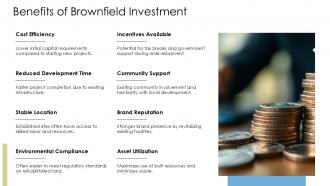
Companies typically choose brownfield over greenfield FDI based on factors including speed to market, existing infrastructure availability, regulatory complexities, cost considerations, and risk tolerance levels. Through brownfield investments, organizations access established operations, existing customer bases, and proven market presence while minimizing startup risks, with many multinational corporations finding this approach delivers faster revenue generation and competitive positioning.
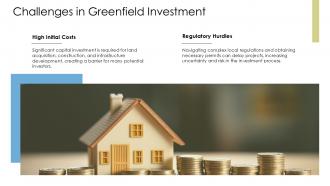
Greenfield investments are favored when companies require complete operational control, need to implement proprietary technologies or processes, or enter markets lacking suitable acquisition targets. This approach proves particularly valuable in highly regulated industries like pharmaceuticals or telecommunications, where building from scratch ensures compliance standards, while also enabling companies to establish optimal locations, corporate culture, and scalable infrastructure that delivers long-term competitive advantages.
Government policies significantly impact investment attractiveness through tax incentives, regulatory frameworks, land acquisition rules, and environmental compliance requirements, with brownfield investments often benefiting from existing infrastructure support while greenfield projects receive startup incentives. Many developing economies strategically balance policies to attract both types, offering streamlined approvals for brownfield efficiency gains while providing land grants and tax holidays for greenfield projects, ultimately enhancing their competitive investment landscape.
Local infrastructure significantly influences both investment types, with greenfield projects requiring comprehensive development of utilities, transportation, and communication networks, while brownfield investments leverage existing infrastructure but may need modernization upgrades. Strong infrastructure enables faster market entry, reduces operational costs, and enhances supply chain efficiency, with many multinational corporations finding that robust local infrastructure ultimately determines long-term competitiveness and scalability potential.
Companies mitigate brownfield investment challenges through comprehensive due diligence, cultural integration programs, stakeholder engagement strategies, and phased integration approaches that address legacy systems and operational differences. These methods enable organizations to streamline transitions, enhance workforce alignment, and minimize disruption, with many multinational corporations finding that strategic change management ultimately delivers improved operational efficiency and competitive advantage.
Greenfield investments require comprehensive environmental impact assessments, land use planning, and compliance with local regulations from project inception, while brownfield investments involve site remediation, contamination assessment, and addressing existing environmental liabilities. These considerations significantly influence investment costs and timelines, with many multinational corporations finding that brownfield projects offer sustainability advantages through industrial site rehabilitation, ultimately delivering environmental restoration and responsible resource utilization.
Cultural differences significantly impact both investment types through communication barriers, management integration challenges, and local market adaptation requirements. Greenfield projects enable companies to establish culturally aligned practices from inception, while brownfield investments require navigating existing organizational cultures, with many multinational corporations finding that comprehensive cultural due diligence and localized management approaches ultimately deliver smoother operations and enhanced stakeholder acceptance.
Brownfield investments typically access diverse financing through asset-backed loans, acquisition financing, and leveraged buyouts using existing infrastructure as collateral, while greenfield projects rely more heavily on project financing, development loans, and equity investments. Banks and financial institutions often favor brownfield deals due to reduced risk profiles and tangible assets, enabling faster capital deployment and more favorable lending terms compared to greenfield ventures.
Brownfield investments typically achieve faster time to market by leveraging existing infrastructure, established supply chains, and operational frameworks, while greenfield projects require longer development periods for construction, regulatory approvals, and market establishment. However, greenfield investments often deliver more streamlined operations and customized facilities, with many multinational corporations finding that brownfield acquisitions can reduce market entry time by 12-18 months compared to building from scratch.
**INPUT**: What examples of successful brownfield and greenfield investments can be analyzed for best practices? **OUTPUT**: Successful brownfield investments include Tata's acquisition of Jaguar Land Rover, Geely's purchase of Volvo, and Microsoft's LinkedIn acquisition, while notable greenfield projects encompass Tesla's Shanghai Gigafactory, Samsung's semiconductor plants in Austin, and Hyundai's manufacturing facilities in Alabama. These investments demonstrate how brownfield approaches enable rapid market entry through established infrastructure, while greenfield projects deliver customized operations and cutting-edge technology integration, ultimately providing strategic frameworks for competitive advantage.
Stakeholder interests differ significantly, with greenfield projects prioritizing job creation, infrastructure development, and community benefits, while brownfield investments focus on operational continuity, employee retention, and preserving existing relationships. Local governments typically favor greenfield for economic stimulus and tax revenue, whereas brownfield stakeholders emphasize maintaining established supply chains, customer bases, and institutional knowledge, ultimately delivering faster integration versus long-term strategic positioning.
Emerging markets show increasing brownfield investments through acquisitions and joint ventures, while greenfield projects focus on infrastructure, manufacturing, and technology sectors with longer development timelines. Countries like India, Brazil, and Southeast Asian nations attract both types, with brownfield delivering faster market entry and greenfield enabling customized operations, ultimately providing investors strategic flexibility in increasingly competitive global markets.
Brownfield projects typically integrate with existing communities, preserving local employment while potentially facing resistance to operational changes, whereas greenfield investments create new job opportunities but may disrupt traditional community structures and require extensive infrastructure development. Through strategic community engagement, companies in sectors like manufacturing and energy find that brownfield approaches deliver faster social integration and established workforce utilization, while greenfield projects enable greater long-term community planning and sustainable development outcomes.
-
Professionally designed slides with color coordinated themes and icons. Perfect for enhancing the style of the presentations.
-
“I always have a wonderful experience with SlideTeam. It's my ""go to"" when I need a template.”