

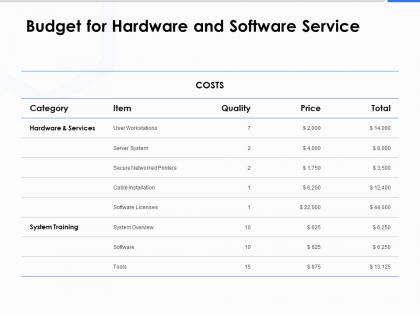
Budget for hardware and software service ppt powerpoint presentation portfolio




Try Before you Buy Download Free Sample Product
 Impress Your
Audience
 100%
Editable
 Save Hours
of Time


Behave in a down to earth fashion with our Budget For Hardware And Software Service Ppt Powerpoint Presentation Portfolio. Give them a glimpse of your fact based approach.
People who downloaded this PowerPoint presentation also viewed the following :
Budget for hardware and software service ppt powerpoint presentation portfolio with all 2 slides:
Give them a glimpse of your fact based approach with our Budget For Hardware And Software Service Ppt Powerpoint Presentation Portfolio. Be able to behave in a down to earth fashion.


FAQs for Budget for hardware and software service ppt
Key components of an effective budget include revenue projections, fixed and variable expenses, capital expenditures, contingency reserves, and performance metrics for tracking variance. These elements work together by providing comprehensive financial visibility, enabling strategic resource allocation, and facilitating proactive decision-making, with many organizations finding that structured budgeting ultimately delivers improved cash flow management and competitive operational advantages.
Individuals can prioritize spending by categorizing expenses into needs versus wants, allocating funds to essential categories like housing, utilities, and groceries first, then addressing debt payments and savings goals. This systematic approach enables better financial control, reduces unnecessary expenditures, and ultimately delivers improved financial stability and long-term wealth building.
Budgeting tools include Mint, YNAB, QuickBooks, Excel, PlanGuru, and Adaptive Insights, ranging from personal finance apps to enterprise-level platforms. These solutions streamline expense tracking, automate categorization, and provide real-time analytics, with many organizations finding that cloud-based platforms like Anaplan and Oracle Planning deliver enhanced collaboration and strategic forecasting capabilities.
Variable expenses fluctuate monthly based on usage and choices, like groceries, utilities, and entertainment, while fixed expenses remain constant, such as rent, insurance, and loan payments. This distinction enables businesses and individuals to strategically allocate resources, with many organizations finding that tracking variable expenses delivers greater cost control and operational flexibility during economic changes.
Effective budget adherence strategies include automated savings transfers, envelope budgeting for discretionary spending, regular expense tracking, setting realistic financial goals, and building small emergency buffers. These approaches work by removing temptation, creating accountability systems, and providing flexibility when unexpected costs arise, with many individuals and businesses finding that combining multiple methods delivers better long-term financial discipline and success.
Budgets should be reviewed monthly for operational adjustments and quarterly for comprehensive strategic evaluations, with annual overhauls incorporating major business changes and market shifts. This multi-tiered approach enables organizations to respond quickly to cash flow variations, seasonal demands, and unexpected opportunities, while maintaining long-term financial stability and competitive positioning in increasingly dynamic markets.
Emergency savings serves as a financial safety net within budgets, protecting against unexpected expenses, job loss, medical bills, and major repairs without deriving planned spending or accumulating debt. This strategic reserve enables households and businesses to maintain financial stability during crises, ultimately delivering peace of mind and operational continuity, with many financial advisors recommending three to six months of expenses reserved.
Budgeting helps achieve long-term financial goals by allocating resources strategically, tracking progress systematically, and identifying spending patterns that support or hinder objectives. Through disciplined financial planning, individuals and organizations can streamline savings efforts, minimize unnecessary expenses, and accelerate wealth building, with many finding that consistent budgeting ultimately delivers financial security and competitive advantage.
Common budgeting mistakes include underestimating expenses, failing to track actual spending, neglecting emergency reserves, setting unrealistic targets, and ignoring seasonal fluctuations. These oversights often lead to cash flow issues, missed opportunities, and strategic misalignment, with many organizations finding that regular budget reviews and flexible forecasting ultimately deliver better financial control and competitive positioning.
Cultural differences significantly impact budgeting practices through varying risk tolerance levels, time horizons, decision-making hierarchies, and communication styles across organizations. While Western companies often emphasize quarterly targets and individual accountability, Asian businesses frequently prioritize long-term planning and consensus-building, with many multinational organizations finding that adapting budgeting approaches to local cultural norms enhances employee engagement and ultimately delivers more accurate financial forecasting.
Family budgeting techniques include regular budget meetings, assigning age-appropriate financial responsibilities, using visual tracking tools, setting collective savings goals, and creating spending categories together. These approaches enhance financial transparency by encouraging open money discussions, teaching children budgeting fundamentals, and establishing shared accountability, ultimately delivering stronger financial discipline and unified family financial objectives.
Balancing debt repayment with everyday spending requires strategic prioritization through the 50/30/20 rule, debt avalanche method, or snowball approach, alongside careful expense categorization. Many individuals find success by automating minimum debt payments first, then allocating remaining funds to essential expenses like housing and groceries, while gradually reducing discretionary spending, ultimately delivering faster debt freedom and improved financial stability.
The 50/30/20 budgeting rule allocates 50% of after-tax income to needs, 30% to wants, and 20% to savings and debt repayment, providing a straightforward framework for financial planning. This approach streamlines personal finance management by establishing clear spending boundaries, enabling automatic savings habits, and maintaining lifestyle flexibility, with many individuals finding that consistent application delivers improved financial stability and long-term wealth building.
Budgeting for irregular income requires creating a baseline budget using your lowest expected monthly earnings, building larger emergency funds, and prioritizing essential expenses first. Unlike steady paychecks, freelancers, contractors, and seasonal workers must smooth income fluctuations by saving surplus earnings during high-income periods, ultimately delivering greater financial stability and predictable cash flow management.
Psychological benefits of maintaining a budget include reduced financial anxiety, enhanced sense of control, improved confidence in financial decisions, decreased stress about unexpected expenses, and greater peace of mind regarding future planning. These mental health advantages streamline daily decision-making by eliminating money-related uncertainty, while many individuals find that budgeting ultimately delivers improved sleep quality and stronger relationships through reduced financial conflicts.
No Reviews