


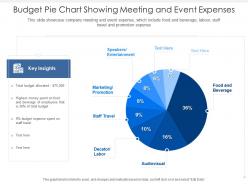
Budget pie chart showing meeting and event expenses





Try Before you Buy Download Free Sample Product
 Impress Your
Audience
 100%
Editable
 Save Hours
of Time


This slide showcase company meeting and event expense, which include food and beverage, labour, staff travel and promotion expense.
People who downloaded this PowerPoint presentation also viewed the following :
Budget pie chart showing meeting and event expenses with all 2 slides:
Use our Budget Pie Chart Showing Meeting And Event Expenses to effectively help you save your valuable time. They are readymade to fit into any presentation structure.

FAQs for Budget pie chart showing meeting
Key components of an effective budget include revenue projections, fixed and variable expenses, capital expenditures, cash flow forecasts, and contingency reserves. These elements work together by providing comprehensive financial visibility, enabling strategic resource allocation, and facilitating performance monitoring, with many organizations finding that well-structured budgets ultimately deliver better cost control and competitive advantage.
Individuals can prioritize spending by categorizing expenses into needs, wants, and savings goals, then allocating funds based on the 50/30/20 rule or similar frameworks. This approach enables households to streamline financial decisions, enhance long-term stability, and ultimately deliver better control over discretionary spending, with many finding that automated priority-based budgeting reduces financial stress significantly.
Fixed expenses provide budgeting stability through predictable costs like rent, insurance, and loan payments, while variable expenses fluctuate based on usage and demand, including utilities, materials, and discretionary spending. These categories enable organizations to prioritize essential commitments, allocate resources strategically, and maintain financial flexibility, ultimately delivering better cash flow management and operational control.
Technology assists personal budgeting through automated expense tracking, real-time spending alerts, goal-setting tools, bill reminders, and financial analytics dashboards. These digital solutions streamline budget management by categorizing transactions automatically, providing spending insights, and enabling proactive financial decisions, with many users finding that mobile apps and cloud-based platforms ultimately deliver better financial control and savings acceleration.
Common budgeting mistakes include underestimating expenses, failing to track actual spending, ignoring seasonal variations, setting unrealistic targets, and neglecting contingency reserves. These oversights significantly impact financial planning accuracy, with many organizations finding that implementing regular budget reviews, incorporating buffer funds, and using data-driven forecasting ultimately delivers better cost control and strategic resource allocation.
Budget reviews should occur monthly for detailed tracking, with quarterly assessments for strategic adjustments and annual comprehensive overhauls. This tiered approach enables individuals and organizations to respond to changing circumstances, identify spending patterns, and optimize financial allocation, while many financial advisors finding that regular monitoring ultimately delivers better cost control and improved financial outcomes.
**INPUT**: What budgeting methods are most effective for different income levels? **OUTPUT**: Effective budgeting methods include the 50/30/20 rule for moderate incomes, zero-based budgeting for variable earnings, envelope systems for tight budgets, and percentage-based allocation for higher incomes. These approaches enable individuals to streamline expense tracking, enhance financial control, and optimize savings rates, with many finding that income-appropriate methods ultimately deliver better financial stability and strategic wealth building.
Goal-setting enhances budgeting by providing clear financial targets, prioritizing resource allocation, and creating measurable benchmarks for performance tracking. Through strategic goal alignment, organizations streamline their budget planning, minimize unnecessary expenses, and focus investments on growth-driving initiatives, with many companies finding that goal-oriented budgeting delivers improved financial discipline and measurable business outcomes.
Effective budget adherence strategies include automated savings transfers, envelope budgeting for discretionary spending, regular weekly reviews, emergency fund buffers, and accountability partnerships. These approaches streamline financial discipline by removing emotional spending decisions, creating visual spending limits, and providing safety nets for unexpected expenses, with many individuals finding that automation and consistent monitoring ultimately deliver better financial outcomes and reduced money-related stress.
Inflation impacts budgeting by reducing purchasing power, increasing costs for essentials like food, housing, and utilities, and creating uncertainty in financial planning. Through strategic adjustments, households can mitigate these effects by prioritizing fixed expenses, seeking inflation-resistant investments, and regularly reviewing spending categories, ultimately maintaining financial stability while adapting to economic pressures.
Budgeting establishes the foundation for retirement savings by enabling systematic allocation of current income toward long-term financial goals, emergency funds, and investment accounts. Through strategic budgeting, individuals can maximize employer 401(k) matching, automate IRA contributions, and balance immediate needs with future security, ultimately delivering financial independence and peace of mind in retirement years.
Businesses utilize budgeting to improve financial performance by establishing clear spending limits, identifying cost-saving opportunities, and allocating resources strategically across departments and projects. Through comprehensive budget planning, organizations streamline operations, reduce unnecessary expenses, and enhance cash flow management, with many companies finding that structured budgeting delivers improved profitability and sustainable growth.
Zero-based budgeting requires justifying every expense from scratch each period, while traditional budgeting builds upon previous budgets with incremental adjustments. Through zero-based approaches, organizations eliminate redundant spending, optimize resource allocation, and enhance cost transparency, with many companies finding that this method delivers significant savings and strategic realignment, ultimately providing competitive advantage over traditional incremental approaches.
Families can incorporate budgeting by scheduling monthly planning sessions, using budgeting apps or spreadsheets, tracking expenses weekly, and involving all family members in financial discussions. This approach streamlines household financial management by enhancing transparency, encouraging accountability, and building financial literacy, with many families finding that consistent routines ultimately deliver better savings outcomes and reduced financial stress.
Budgeting education tools include online courses, financial planning software, budget tracking apps, interactive worksheets, and educational webinars from financial institutions. These resources enhance financial literacy by providing hands-on practice, real-time tracking capabilities, and structured learning paths, with many organizations finding that comprehensive budgeting education ultimately delivers improved employee financial wellness and reduced workplace stress.
-
Excellent template with unique design.