

Building Insurance Agency Business Plan Powerpoint Presentation Slides





Try Before you Buy Download Free Sample Product
 Impress Your
Audience
 100%
Editable
 Save Hours
of Time


A strategic business plan enables a roadmap for developing a successful insurance firm. It captures the firms objectives, product offerings, target market, financial projections. Here is a competently designed template on Building Insurance Agency Business Plan that will develop startup business plans for insurance agencies with fundamental essentials associated with the business plan. The deck will help build financial, marketing, and workforce plans for setting up an insurance agency. The development of a business plan will aid in making realistic objectives, allocating resources, streamlining workflows, improving communication and business expansion. The deck covers slides about the firms overview, growth potential analysis in terms of SWOT analysis, PESTLE analysis, Porters five forces analysis, go to market strategy, market assessment, target client groups for the insurance business, segmentation, firm positioning, etc. It portrays slides regarding the marketing plan in terms of the product marketing mix, brand building, and advertising strategies. The deck covers slides regarding personnel planning in terms of personnel management in insurance agencies, workforce training, and development roadmap. It showcases slides about financial planning in terms of projected financial statements, namely, income statements, balance sheets, etc. It caters to various risks associated with the insurance business tracking dashboard. Get access to it now.
People who downloaded this PowerPoint presentation also viewed the following :
Content of this Powerpoint Presentation
Slide 1: This slide introduces Building Insurance Agency Business Plan. State Your Company Name and begin.
Slide 2: This slide states Agenda of the presentation.
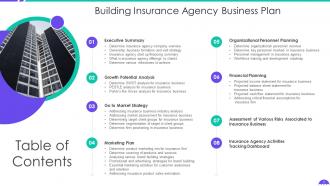
Slide 3: This slide presents Table of Content for the presentation.
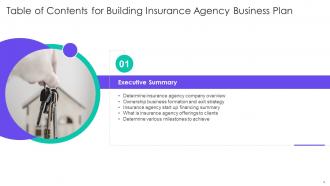
Slide 4: This slide highlights title for topics that are to be covered next in the template.
Slide 5: This slide displays Determine Insurance Agency Company Overview.
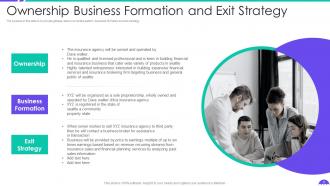
Slide 6: This slide represents Ownership Business Formation and Exit Strategy.
Slide 7: This slide shows Insurance Agency Start Up Financing Summary.
Slide 8: This slide presents insurance agency offerings to its clients.
Slide 9: This slide shows various milestones that insurance agency will achieve in upcoming future.
Slide 10: This slide highlights title for topics that are to be covered next in the template.
Slide 11: This slide represents Determine SWOT Analysis for Insurance Business.
Slide 12: This slide shows PESTLE analysis which will be used by insurance business as a framework.
Slide 13: This slide presents Porter’s Five Forces Analysis for Insurance Business.
Slide 14: This slide highlights title for topics that are to be covered next in the template.
Slide 15: This slide displays industry analysis of insurance business in US.
Slide 16: This slide represents Addressing Market Assessment for Insurance Business.
Slide 17: This slide shows Determining Target Client Groups for Insurance Business.
Slide 18: This slide presents Determine Segmentation of Target Insurance Client Groups.
Slide 19: This slide shows Determine Firm Positioning in Insurance Business.
Slide 20: This slide highlights title for topics that are to be covered next in the template.
Slide 21: This slide represents Determine Product Marketing Mix for Insurance Firm.
Slide 22: This slide shows Determine Sourcing of Products and Services.
Slide 23: This slide presents Analysing Various Brand Building Strategies.
Slide 24: This slide shows Promotional and Advertising Strategies for Brand Building.
Slide 25: This slide displays Essential Marketing Activities for Customer Awareness and Retention.
Slide 26: This slide represents Addressing Insurance Product Sales Estimation.
Slide 27: This slide highlights title for topics that are to be covered next in the template.
Slide 28: This slide presents organizational structure that firm will implement in order to handle frontline.
Slide 29: This slide shows Determine Key Personnel Involved in Insurance Business.
Slide 30: This slide displays personnel management in insurance agency with their personal staff planning.
Slide 31: This slide represents information regarding the standard procedure that takes place for training and development.
Slide 32: This slide highlights title for topics that are to be covered next in the template.
Slide 33: This slide shows Projected Income Statement for Insurance Business.
Slide 34: This slide shows Projected Balance Sheet Statement for Insurance Business.
Slide 35: This slide displays Projected Cash Flow Statement for Insurance Business.
Slide 36: This slide represents Addressing Critical Financial Assumptions for Insurance Firm.
Slide 37: This slide highlights title for topics that are to be covered next in the template.
Slide 38: This slide presents Assessment of Various Risks Associated to Insurance Business.
Slide 39: This slide highlights title for topics that are to be covered next in the template.
Slide 40: This slide displays Insurance Agency Activities Tracking Dashboard.
Slide 41: This slide showcases Icons for Building Insurance Agency Business Plan.
Slide 42: This slide is titled as Additional Slides for moving forward.
Slide 43: This slide provides 30 60 90 Days Plan with text boxes.
Slide 44: This is a Weekly Timeline slide. Show data related to time intervals here.
Slide 45: This slide represents Roadmap for Process Flow.
Slide 46: This slide depicts Venn diagram with text boxes.
Slide 47: This slide shows Post It Notes. Post your important notes here.
Slide 48: This is Our Target slide. State your targets here.
Slide 49: This is a Timeline slide. Show data related to time intervals here.
Slide 50: This slide represents Stacked Column chart with two products comparison.
Slide 51: This is a Financial slide. Show your finance related stuff here.
Slide 52: This is an Idea Generation slide to state a new idea or highlight information, specifications etc.
Slide 53: This slide contains Puzzle with related icons and text.
Slide 54: This is a Thank You slide with address, contact numbers and email address.
Building Insurance Agency Business Plan Powerpoint Presentation Slides with all 59 slides:
Use our Building Insurance Agency Business Plan Powerpoint Presentation Slides to effectively help you save your valuable time. They are readymade to fit into any presentation structure.










FAQs for Building Insurance Agency Business Plan
A comprehensive insurance agency business plan includes market analysis, target customer segments, competitive positioning, service offerings, financial projections, and operational strategies. These components work together by defining your niche markets, establishing pricing models, and outlining growth strategies, with many agencies finding that clear financial forecasting and competitive differentiation ultimately drive sustainable growth and market penetration.
Market research enhances your insurance agency business plan by identifying target demographics, analyzing competitor pricing strategies, and revealing underserved market segments within your region. Through comprehensive market analysis, insurance agencies can tailor their service offerings, optimize pricing models, and develop targeted marketing campaigns, ultimately delivering competitive positioning and sustainable growth in an increasingly crowded marketplace.
Differentiation strategies include specialized niche targeting, superior customer service models, digital-first experiences, competitive pricing structures, and strategic partnership development. These approaches enable agencies to capture specific market segments, streamline client interactions through technology platforms, and deliver personalized solutions, with many agencies finding that combining multiple strategies creates sustainable competitive advantages in increasingly crowded markets.
Effectively defining your target audience requires analyzing demographics, risk profiles, insurance needs, geographic location, and purchasing behaviors of potential clients. Focus on specific segments like young families needing life insurance, small businesses requiring liability coverage, or seniors seeking health supplements, while researching competitor client bases, conducting market surveys, and identifying underserved niches that align with your agency's expertise and growth objectives.
Essential financial projections include revenue forecasts, expense budgets, cash flow statements, break-even analysis, and profitability timelines, along with commission structures and client acquisition costs. These projections enable agencies to demonstrate viability to investors, track performance against targets, and make strategic decisions about staffing and marketing investments, ultimately delivering sustainable growth and competitive positioning in an increasingly dynamic insurance marketplace.
Creating an effective insurance marketing plan involves identifying target demographics, developing compelling value propositions, establishing multi-channel outreach strategies, and implementing performance tracking systems. Focus on trust-building content, client testimonials, and educational resources that address specific coverage needs, while leveraging digital platforms, community partnerships, and referral programs to demonstrate expertise and ultimately deliver consistent lead generation and stronger client relationships.
Technology serves as the foundation for modern insurance agency operations, enabling digital customer onboarding, automated underwriting, AI-powered claims processing, data analytics for risk assessment, and omnichannel customer service platforms. These technological capabilities streamline operational efficiency, reduce processing times, and enhance customer experiences, with many agencies finding that strategic technology integration delivers significant competitive advantages and scalable growth opportunities in an increasingly digital marketplace.
Incorporate regulatory compliance by establishing clear licensing procedures, implementing robust record-keeping systems, creating staff training protocols, and developing regular audit schedules. This strategic approach enables agencies to maintain state requirements, protect client data, and ensure policy accuracy, while ultimately reducing legal risks and building customer trust in an increasingly regulated insurance landscape.
Key performance indicators for insurance agencies include premium growth rate, client retention percentage, new policy acquisitions, loss ratios, and commission revenue per agent. These metrics enable comprehensive performance tracking by measuring revenue generation, customer loyalty, and operational efficiency, with many successful agencies finding that monitoring these indicators quarterly drives strategic decision-making and sustainable growth.
Address risk management through comprehensive operational protocols, regulatory compliance frameworks, financial reserve strategies, technology security measures, and client communication standards. These safeguards streamline agency operations by minimizing liability exposure, ensuring regulatory adherence, and protecting client data, with many successful agencies finding that proactive risk management ultimately delivers enhanced credibility and sustainable growth.
Potential funding sources include personal savings, bank loans, SBA loans, investor partnerships, and industry-specific financing options. These funding mechanisms enhance your agency's credibility by demonstrating financial planning, risk management, and growth scalability, with many insurance startups finding that diversified funding approaches ultimately deliver stronger market positioning and operational flexibility in an increasingly competitive landscape.
A comprehensive training strategy includes initial onboarding programs, ongoing professional development, industry certification requirements, technology training, and performance evaluation systems. Through structured learning pathways, insurance agencies enhance employee retention, improve customer service quality, and ensure regulatory compliance, with many firms finding that well-trained staff deliver significantly higher sales conversion rates and customer satisfaction scores.
Insurance agency business plans should incorporate quarterly performance reviews, annual market analysis updates, competitive landscape assessments, client feedback integration, and financial metric tracking. These strategies enable agencies to adapt to regulatory changes, shifting customer needs, and emerging market opportunities, with many successful agencies finding that regular plan revisions ultimately deliver sustained growth and competitive positioning in an increasingly dynamic insurance environment.
Strategic partnerships with banks, real estate agencies, financial advisors, and industry associations can significantly expand your client reach, reduce acquisition costs, and enhance service offerings through referral networks and cross-selling opportunities. These alliances enable insurance agencies to access new market segments, share resources for marketing initiatives, and build credibility through established relationships, ultimately delivering accelerated growth and competitive positioning.
New insurance agencies face regulatory compliance complexities, intense market competition, client acquisition costs, technology integration demands, and establishing credibility without extensive track records. Your business plan should address these through comprehensive compliance frameworks, differentiated service offerings, targeted digital marketing strategies, and strategic technology investments, while many agencies find that focusing on specialized niches and building strong referral networks ultimately delivers sustainable growth and competitive advantage.
-
Love the template collection they have! I have prepared for my meetings much faster without worrying about designing a whole presentation from scratch.
-
Very well designed and informative templates.