


Building Team Performance Management Plan




Try Before you Buy Download Free Sample Product
 Impress Your
 Audience
 100%
100% Editable
 Save Hours
 of Time


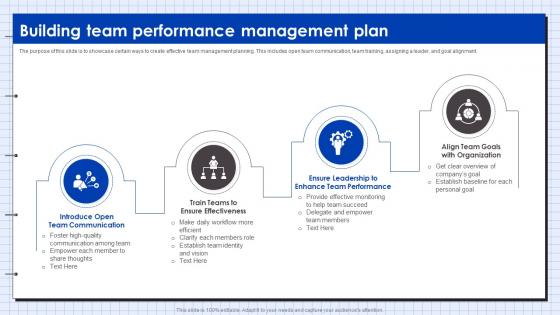
The purpose of this slide is to showcase certain ways to create effective team management planning. This includes open team communication, team training, assigning a leader, and goal alignment.
People who downloaded this PowerPoint presentation also viewed the following :
Building Team Performance Management Plan with all 6 slides:
Use our Building Team Performance Management Plan to effectively help you save your valuable time. They are readymade to fit into any presentation structure.






FAQs for Building Team
Key performance indicators for team effectiveness include productivity metrics, quality scores, goal achievement rates, collaboration indexes, and employee engagement levels. These KPIs enable organizations to streamline performance tracking, enhance resource allocation, and identify improvement opportunities across departments, with many companies finding that combining quantitative outputs with qualitative team dynamics ultimately delivers stronger competitive advantage and operational efficiency.
Effective communication enhances team performance by establishing clear expectations, facilitating seamless information sharing, reducing misunderstandings, and fostering collaborative problem-solving across all organizational levels. Through regular feedback mechanisms and transparent dialogue, teams in sectors like healthcare, finance, and manufacturing streamline workflows, accelerate decision-making, and ultimately deliver improved project outcomes while building stronger workplace relationships.
Team diversity enhances innovation by bringing together varied perspectives, experiences, skill sets, cultural backgrounds, and problem-solving approaches that challenge conventional thinking. Organizations across sectors, from tech companies to healthcare institutions, find that diverse teams generate more creative solutions, identify blind spots faster, and develop products that resonate with broader markets, ultimately delivering competitive advantage through enhanced decision-making.
Recognition and rewards significantly influence team motivation by reinforcing desired behaviors, increasing engagement, and creating positive reinforcement cycles that drive performance. Through strategic recognition programs, organizations enhance job satisfaction, reduce turnover, and build stronger team cohesion, with many companies finding that consistent acknowledgment ultimately delivers improved productivity and competitive advantage.
Best practices for setting team performance goals include establishing SMART objectives, aligning individual targets with organizational strategy, creating measurable milestones, fostering collaborative ownership, and implementing regular progress reviews. These approaches enhance accountability, transparency, and motivation by connecting daily tasks to broader business outcomes, with many organizations finding that teams achieve 25-30% better results when goals are clearly defined and consistently monitored.
Technology enhances team collaboration through real-time communication platforms, cloud-based document sharing, project management tools, video conferencing systems, and collaborative workspaces. These solutions streamline workflows by enabling instant messaging, seamless file access, and transparent task tracking, with many organizations finding that integrated platforms ultimately deliver faster project completion and improved cross-functional coordination.
Effective feedback should be regular, specific, and balanced between individual recognition and team-wide insights, incorporating peer-to-peer evaluations, goal-aligned assessments, and collaborative problem-solving sessions. This structured approach enables teams to identify strengths, address gaps collectively, and build trust through transparency, with many organizations finding that consistent feedback cycles ultimately enhance both performance metrics and team cohesion significantly.
Leadership style significantly impacts team dynamics through communication patterns, decision-making approaches, trust-building mechanisms, and motivation strategies. Transformational leaders in technology companies often enhance collaboration and innovation, while directive styles in manufacturing streamline operations, with many organizations finding that adaptive leadership approaches ultimately deliver higher engagement, improved performance outcomes, and sustained competitive advantage.
Conflict can be managed through early identification, structured mediation processes, clear communication protocols, and establishing shared team objectives that refocus energy on common goals. Organizations like healthcare teams and project management groups find that implementing regular feedback sessions, conflict resolution training, and transparent decision-making frameworks ultimately transforms disagreements into productive discussions, enhancing collaboration and accelerating team performance.
Teams can ensure accountability through peer reviews, shared goal-setting, regular check-ins, transparent progress tracking, and establishing clear role definitions with measurable outcomes. These approaches enhance team dynamics by creating mutual responsibility, improving communication transparency, and delivering consistent performance standards, with many organizations finding that structured accountability frameworks ultimately streamline project delivery and strengthen collaborative relationships.
Common barriers to high performance in teams include unclear goals, poor communication, lack of accountability, inadequate resources, and conflicting priorities. These challenges often manifest in organizations through misaligned expectations, siloed departments, and inconsistent feedback mechanisms, with many companies finding that addressing communication gaps and establishing clear performance metrics ultimately delivers improved collaboration, faster project completion, and enhanced operational efficiency.
Remote and hybrid work environments affect team performance by enhancing flexibility, reducing commute-related stress, and enabling access to global talent pools, while also presenting challenges around communication, collaboration, and maintaining company culture. These arrangements streamline operational costs and improve work-life balance, with many organizations finding that strategic digital collaboration tools ultimately deliver higher productivity and employee satisfaction when properly implemented.
Emotional intelligence enhances team interactions by improving communication, fostering empathy, managing conflicts constructively, and building trust among members. Through better self-awareness and social skills, teams with high emotional intelligence navigate workplace challenges more effectively, create psychological safety, and ultimately deliver stronger collaboration and performance outcomes.
Regular performance reviews can be transformed into growth opportunities by shifting from evaluation-focused discussions to development-centered conversations, incorporating two-way feedback, setting collaborative future goals, and providing specific skill-building resources. These approaches enable managers and employees to identify strengths, address development areas, and create actionable growth plans, with many organizations finding that this strategic combination ultimately enhances employee engagement, retention, and overall performance outcomes.
Strategies include regular feedback cycles, collaborative goal-setting, knowledge sharing sessions, cross-functional training, and data-driven performance reviews. These approaches enhance team dynamics by encouraging open communication, identifying skill gaps, and promoting collective problem-solving, with many organizations finding that structured improvement processes ultimately deliver higher productivity, innovation, and employee engagement across departments.
-
Been using SlideTeam for some time now…can’t imagine why I wasted all that time in front of the screen trying to make the perfect presentation.
-
I can always count on your designs for my professional needs. I believe I found a one-stop-shop for PPTs.