

Business Analysis Approach Document Elements




Try Before you Buy Download Free Sample Product
 Impress Your
 Audience
 100%
100% Editable
 Save Hours
 of Time


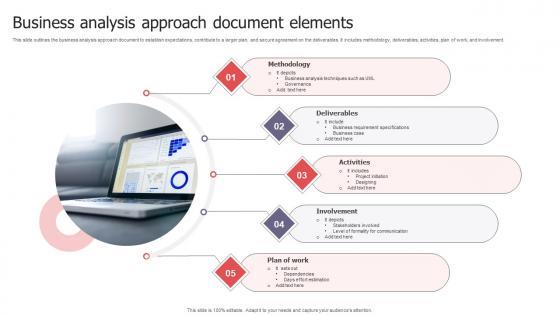
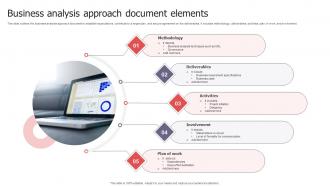
This slide outlines the business analysis approach document to establish expectations, contribute to a larger plan, and secure agreement on the deliverables. It includes methodology, deliverables, activities, plan of work, and involvement.
People who downloaded this PowerPoint presentation also viewed the following :
Business Analysis Approach Document Elements with all 6 slides:
Use our Business Analysis Approach Document Elements to effectively help you save your valuable time. They are readymade to fit into any presentation structure.





FAQs for Business Analysis
Essential business analyst skills include analytical thinking, stakeholder communication, requirements gathering, process mapping, and technical proficiency in tools like SQL and Excel. These competencies enable analysts to bridge business and technical teams effectively, translating complex requirements into actionable solutions while streamlining operations and enhancing decision-making processes across organizations.
Business analysis drives strategic decision-making by providing data-driven insights, identifying market opportunities, assessing operational inefficiencies, and evaluating competitive positioning through comprehensive research and modeling. Through systematic analysis of customer behavior, financial performance, and industry trends, organizations streamline resource allocation, minimize strategic risks, and accelerate growth initiatives, ultimately delivering sustainable competitive advantage in increasingly dynamic markets.
Effective business analysis tools include Microsoft Visio for process mapping, Tableau for data visualization, JIRA for project tracking, Lucidchart for workflow design, and SQL databases for data analysis. These technologies streamline requirements gathering, stakeholder communication, and documentation processes, with many organizations finding that integrated tool suites ultimately enhance analytical accuracy and accelerate decision-making across departments.
Business analysis encompasses strategic planning, stakeholder management, process improvement, solution evaluation, and organizational change management, while requirements gathering focuses specifically on documenting functional and technical specifications. Business analysts evaluate broader business needs, identify improvement opportunities, and assess solution impacts across organizations, whereas requirements gathering typically involves collecting detailed specifications from users, ultimately delivering comprehensive business transformation rather than just documentation.
Stakeholder communication serves as the foundation of successful business analysis, enabling requirements gathering, expectation alignment, change management, and project buy-in throughout the analysis lifecycle. Through regular updates, collaborative workshops, and transparent reporting, business analysts build trust, minimize resistance, and ensure solutions meet actual business needs, ultimately delivering projects that stakeholders actively support and adopt.
Data analytics enhances business analysis by providing deeper insights into patterns, trends, and correlations within organizational data, enabling more accurate forecasting and evidence-based decision making. Through advanced analytical tools, business analysts can identify operational inefficiencies, predict market behaviors, and quantify performance metrics, ultimately delivering strategic recommendations that drive measurable business outcomes and competitive advantage.
Common challenges for business analysts include unclear requirements, stakeholder resistance, scope creep, inadequate communication, and balancing technical constraints with business needs. These obstacles can be overcome through structured requirement-gathering techniques, stakeholder engagement strategies, and collaborative documentation processes, with many organizations finding that regular validation sessions and cross-functional workshops significantly enhance project outcomes and analyst effectiveness.
Requirements prioritization involves evaluating business value, urgency, stakeholder impact, implementation complexity, and regulatory compliance to determine development sequence. Through techniques like MoSCoW method, value-based ranking, and stakeholder impact analysis, business analysts enable organizations to maximize ROI, reduce project risks, and deliver critical functionality first, ultimately ensuring strategic alignment while managing resource constraints effectively.
**INPUT**: What methodologies are commonly used in business analysis? **OUTPUT**: Business analysis methodologies include Agile, Waterfall, Lean Six Sigma, Design Thinking, and BABOK framework approaches. These methodologies streamline project delivery, enhance stakeholder collaboration, and minimize operational risks, with many organizations finding that strategic combinations enable faster decision-making, improved process efficiency, and ultimately deliver competitive advantage in increasingly complex business environments. **Word count: 54 words**
Organizations can measure business analysis success through key performance indicators like project delivery timelines, stakeholder satisfaction scores, requirements accuracy rates, cost savings achieved, and solution adoption metrics. Through regular assessment frameworks, companies in sectors like healthcare, financial services, and retail track reduced project rework, faster implementation cycles, and improved operational efficiency, ultimately delivering measurable ROI and enhanced competitive positioning.
Business analysis significantly enhances project management by defining clear requirements, identifying stakeholder needs, and establishing measurable success criteria from the outset. Through systematic analysis, project managers can minimize scope creep, allocate resources more effectively, and deliver solutions that align with business objectives, ultimately reducing project risks while ensuring stakeholder satisfaction and strategic value.
Business analysts facilitate change management by conducting stakeholder analysis, creating communication strategies, documenting process changes, and providing training support throughout implementation phases. Through requirements gathering and impact assessments, analysts help organizations navigate transitions more effectively, ensuring employee buy-in and minimizing resistance, while ultimately delivering smoother implementations and sustainable organizational transformation.
Business analysis ethical considerations include data privacy protection, stakeholder transparency, conflict of interest management, unbiased requirement gathering, and responsible recommendation making. These principles enhance organizational integrity by ensuring fair stakeholder representation, maintaining confidential information security, and delivering objective insights, with many analysts finding that ethical frameworks ultimately strengthen stakeholder trust and long-term business credibility.
Business analysis enhances customer experience by identifying pain points, mapping customer journeys, and analyzing service gaps through data-driven insights. Through process optimization and requirements gathering, organizations streamline interactions, reduce response times, and personalize offerings, with many retail and financial services companies finding that systematic analysis ultimately delivers improved satisfaction rates and stronger customer loyalty.
Future trends in business analysis include AI-powered analytics, real-time data visualization, predictive modeling, automated process discovery, and cloud-based collaboration platforms. These technologies streamline decision-making by delivering faster insights, reducing manual analysis, and enabling cross-functional teams to respond quickly to market changes, ultimately providing organizations with significant competitive advantages in increasingly dynamic business environments.
-
Placing an order on SlideTeam is very simple and convenient, saves you a lot of your time.
-
They helped us design the pamphlets for our church’s food drive! The people loved the design, and I’m happy to say it was successful. Thank you, SlideTeam!