

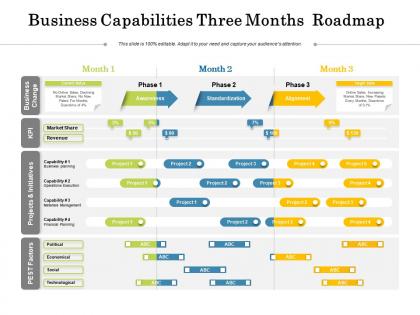
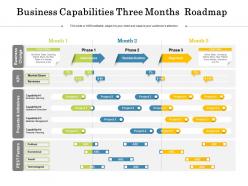
Business capabilities three months roadmap




Try Before you Buy Download Free Sample Product
 Impress Your
 Audience
 100%
100% Editable
 Save Hours
 of Time


The success rate of business plans is hugely dependent on the plan of action, and this editable Business Capabilities Three Months Roadmap rightly serves the purpose. Encapsulate all the information related to the project in a well structured manner to obtain maximum efficiency by incorporating our stunning PowerPoint theme. State the critical deliverable, steps involved, time frame, workforce allocation, and lots more in an easy to understand manner by utilizing this pre designed roadmap PowerPoint layout. You can also prioritize your tasks and discuss the problem areas with your colleagues by incorporating this tailor made PPT layout. Empower your work plan by employing this professionally designed PPT theme. Entrepreneurs can download Business Capabilities Three Months Roadmap as a beneficial communication tool that facilitates in collaborating with different tasks and achieve targets.
People who downloaded this PowerPoint presentation also viewed the following :
Business capabilities three months roadmap with all 2 slides:
Give your audience a fulfilling experience. They will find our Business Capabilities Three Months Roadmap elevating.
FAQs for Business capabilities
You'll need your current state assessment, future vision, and capability gaps mapped out first. Timeline with priorities comes next. Don't forget dependencies between different capabilities - that'll bite you later if you miss it. Resource requirements for each initiative too, obviously. Honestly, the hardest part is getting everyone to agree on priorities since every team thinks their project is life-or-death urgent. Define what each capability actually means upfront because "customer management" means something totally different to sales vs IT. I'd start by mapping what you have now against where you want to be, then work backwards from your goals to figure out the sequence.
So first thing - figure out which capabilities actually matter for your business goals. Like if you're going global, focus on language stuff and payment systems that work internationally. Every capability you build should connect to making money, saving money, or beating competitors. Otherwise what's the point? I've seen too many teams chase shiny new tech that doesn't move the needle. Map each one directly to specific objectives. Check in regularly too - strategies change and your roadmap needs to keep up. Don't just build something because it sounds impressive.
Start with mapping what your business actually does - capabilities plus how work flows between them. Get your key people in a room for workshops. Heat map the problem areas and figure out which capabilities matter most strategically. TOGAF's helpful if you're into frameworks, but honestly? Don't overthink the methodology part. Sticky notes and whiteboards work better than you'd think before you go buying expensive software. The real trick is connecting everything back to business outcomes and timelines. Short workshops beat long theoretical planning sessions every time.
Honestly, just start by looking at what's actually making you money right now and what's broken. Score everything on impact vs how much work it'll take - but real talk, sometimes you gotta prioritize whatever the loudest executive is complaining about. Go after stuff that either fixes major problems, opens up new revenue, or saves serious cash. Dependencies will bite you though. Some things have to happen before others can work. I'd make a simple matrix scoring business value, how urgent it is, and whether you can actually pull it off. Then definitely run it by the key people before promising any deadlines.
Dude, you absolutely need stakeholder buy-in for this - learned that the hard way on my last project! Business folks know where the company's going strategically. IT gets the technical stuff that might blow up. End users? They'll tell you exactly what's driving them crazy right now. Without all those voices, you're basically guessing what people need. I'd start by figuring out who your key players are, then get them in a room (or Zoom, whatever) to hash things out before you even touch the roadmap. Trust me, that upfront time saves you from major headaches later when someone goes "wait, that's not what we meant."
So you need metrics that actually tell you if this roadmap thing is working, right? Track the obvious stuff first - time-to-market, cost cuts, customer happiness scores. But honestly, the soft metrics matter just as much. Like how confident your team feels about executing the strategy, or whether departments are actually talking to each other. Oh, and track if you're hitting capability milestones on time (spoiler: you're probably not). Get baseline numbers before you start anything, then check quarterly. Pick maybe 3-5 metrics that tie directly to business results and stick with them religiously.
For capabilities roadmaps, you've got a few routes. Enterprise tools like MEGA or Sparx Enterprise Architect are pretty robust if you need all the bells and whistles. But honestly? Most teams I know just start with Visio or Lucidchart - way less overwhelming. Miro works great too, especially for collaborative stuff. There's also Planview and ProductPlan which are built specifically for roadmapping (ProductPlan's interface is actually pretty slick). My take? Don't overthink it initially. Start with whatever your team already uses, then you can always upgrade once you figure out what features you actually need vs. what sounds cool in demos.
Market trends basically force your hand on what to build first and how quickly. Customers screaming for AI features? That jumps straight to the top even if you planned to fix other stuff. Regulatory changes do the same thing - totally mess up your timeline. Here's what actually works: build trend scanning into your roadmap process instead of treating it separately. Every quarter, look at customer behavior shifts, new tech, competitor moves. Then ask "what do we need to handle this?" Otherwise you're building cool internal pet projects while everyone else moves ahead. Been there, it sucks.
Don't go crazy detailed from day one - you'll drown in complexity and confuse everyone. I've watched teams spend months perfecting some beautiful taxonomy while completely ignoring what stakeholders actually need. Major red flag there. Your capabilities map is worthless if it's disconnected from real business strategy. Treat this as ongoing work, not a check-the-box project. Start with maybe 8-12 big capabilities, run them by key people first, then dig deeper only where it matters for your actual initiatives. Going too granular too fast is probably the
No Reviews