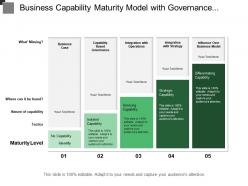
Business capability maturity model with governance operations and integration with strategy
Try Before you Buy Download Free Sample Product
Audience
Editable
of Time
Our Business Capability Maturity Model With Governance Operations And Integration With Strategy go beyond the obvious. Unearth their true worth with your probing thoughts.
People who downloaded this PowerPoint presentation also viewed the following :
Business capability maturity model with governance operations and integration with strategy with all 5 slides:
Our Business Capability Maturity Model With Governance Operations And Integration With Strategy cut out any haggling. You will not find any gaps to fill.
FAQs for Business capability maturity model with governance operations and
So there are basically five levels to this thing. You've got Initial (total chaos), then Managed (some basic controls), Defined (actual standardized stuff), Quantitatively Managed (numbers everywhere), and finally Optimizing (always improving). Most companies I've seen get completely stuck between Managed and Defined - that's honestly where all the heavy lifting happens. It's kinda like those video game levels where you grind forever. My advice? Figure out where you actually are right now, then just focus on the next level up. Don't try to jump ahead or you'll just frustrate yourself.
So BCMM looks at your actual business stuff - customer service, product development, that whole side of things. Most other models like CMMI are super focused on tech processes and software development. But here's the thing - BCMM evaluates how your entire business functions work together to create value for customers. Instead of just checking if your code deployment is solid, you're looking at whether your "get new customers" process actually works well. Honestly, it's way more useful because you get the full picture of what needs fixing, not just the technical side.
Honestly, the hardest part is getting departments to be real about their actual capabilities - everyone thinks they're doing better than they are. The criteria for each maturity level? Super vague, so people interpret things differently. Then you get this whole box-checking mentality instead of actually looking at gaps. Oh, and the politics are brutal when teams feel judged. I'd say start small with a pilot first. Get everyone on the same page about definitions upfront. Frame it as "we're trying to improve" not "you suck at this." That usually helps people chill out about it.
Start with scoring your current processes against the model's benchmarks - most places do self-assessments plus interviews with stakeholders. Here's the thing though: you gotta be brutally honest about where you actually are, not where you think you should be. We've all done that before, right? Focus on real evidence instead of just gut feelings. Process documentation reviews help too. Running workshops with your key people is clutch for validating what you find and spotting the gaps. That way you've got something solid to measure progress against later.
Dude, this might sound obvious but stakeholder buy-in is make-or-break for maturity models. Without executives backing you up and actually putting money behind it, you're screwed. Middle managers need to spot the gaps in their teams and push adoption. Meanwhile, your frontline people have to change how they work every single day - which honestly is the hardest part. I've seen so many projects crash because someone forgot to loop in key influencers early on. Map out who you need at each level first, then create a solid communication plan. Oh, and definitely get those influencers involved during the assessment phase. Trust me on that one.
Just swap out the generic stuff for what actually matters in your field. Healthcare orgs focus way more on compliance and patient safety, while tech companies are all about innovation metrics. The basic framework stays the same though. Start by figuring out your critical business capabilities first - that's honestly the hardest part. Then you can tweak the maturity levels to make sense for your industry. I've watched teams completely redefine what "advanced" means for their context. Some add regulatory requirements or whatever. Map your capabilities, then adapt from there.
So IBM totally transformed their services business with this approach. Amazon used maturity models when scaling their cloud stuff too. Microsoft did the same thing during their whole cloud transition - tech companies are obsessed with these frameworks honestly. JPMorgan Chase applied it for their digital transformation, and even the Department of Defense uses capability maturity models for IT upgrades. Pretty wide range there. My advice? Start with just one department first. Test it out before you roll it everywhere - way less messy that way.
So basically this thing shows you exactly where your business sits right now vs where it needs to be. Map out each capability against those maturity levels - say your strategy needs killer data analytics but you're stuck doing basic Excel reports. Pretty brutal wake-up call honestly. Then you can figure out what to tackle first based on your biggest gaps. I'd start with whatever's most critical to your main goals and throw your budget there first. Don't try to fix everything at once though - you'll just spread yourself too thin.
TOGAF and COBIT are your main go-tos - TOGAF handles the enterprise architecture side while COBIT covers IT governance. Six Sigma's great for the actual process improvements, and honestly ITIL works pretty well if you're doing service management stuff. Lean methodologies fit in there too. Think of it this way: BCMM tells you where you are maturity-wise, but these other frameworks actually help you get stuff done. Like TOGAF maps out your architecture roadmap, Six Sigma fixes the broken processes. I'd start by seeing what your company already uses - no point reinventing the wheel - then just layer BCMM over it.
Honestly? Every 12-18 months is usually solid, but it totally depends on what's happening at your company. Major changes or new systems rolling out? Maybe check quarterly. I've watched some places get way too obsessed with measuring everything constantly - that's just overkill and burns people out. Try timing these assessments with your strategic planning so the results actually matter for decisions. Oh, and don't bother doing it unless you're actually gonna act on what you discover. Otherwise you're just creating fancy paperwork that sits in someone's drawer.
Track stuff that actually matters for each maturity stage you're hitting. Process metrics first - how consistent you're being, cycle times, fewer screw-ups. That's how you know things are actually getting stable. Customer satisfaction and revenue impact come next. Just don't go crazy measuring everything (I've seen teams drown in their own dashboards). Stick with 3-5 solid indicators per capability and track them consistently. Baseline where you are right now, then set targets that won't make your team want to quit. Much better than constantly switching up what you're measuring.
Make it part of your regular routine instead of some big separate project. I'd do quarterly check-ins against that maturity model - honestly assess where you actually are vs where you think you are. Create feedback loops so the stuff happening day-to-day actually feeds back into planning (this is where most teams mess up honestly). Don't wait to "complete" one level before working on others. That's a trap. Quick wins plus long-term stuff works better. Pick one capability gap this quarter and make someone own fixing it. The key is making improvement automatic, not something you remember to do.
Start with some basic training on capability modeling - workshops covering how to identify capabilities, maturity levels, that kind of stuff. Your team needs hands-on practice with whatever framework you're using (TOGAF or custom ones). The theory's honestly pretty boring at first, but it makes sense once you apply it to actual business situations. Get some templates and assessment tools sorted. Maybe bring in a consultant for the initial setup - worth the investment. Oh, and definitely pilot it with one capability area first. Build some wins before you roll it out everywhere. Trust me on that one.
So here's the deal with tech and maturity - it can speed things up and automate the boring stuff, but only if your processes aren't a mess first. Early on, you're mostly winging it with basic tools and relying on people. But once you get more mature, you need proper systems to keep everything consistent. Don't make the mistake I've seen tons of companies make though - slapping technology on broken processes just gives you faster chaos. Map out what you're actually doing first, then figure out where automation makes sense. Sometimes the manual way is honestly better until you get your act together.
Most companies see 15-30% ROI within 2-3 years with BCMM, but honestly your starting point matters a lot. The big wins come from cutting operational waste and getting IT actually aligned with what the business needs. You'd be surprised how much money gets burned on duplicate systems that nobody realizes exist. BCMM helps spot that stuff fast. Higher maturity usually means you can get products to market quicker too, which customers notice. Oh, and definitely measure where you're at now - otherwise you won't know if you're actually improving or just spinning your wheels.
-
Perfect template with attractive color combination.
-
Unique research projects to present in meeting.