


Business innovation research strategy ppt images gallery




Try Before you Buy Download Free Sample Product
 Impress Your
 Audience
 100%
100% Editable
 Save Hours
 of Time


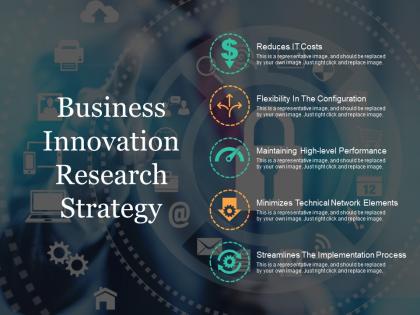
Developing innovative ideas, testing their practicality and finally introducing them to the teams requires visual slides of great impact. It is at this moment that the business innovation research strategy PPT images gallery comes in use. With pre-designed slides of business innovation, PPT presentation model one can devote more of his energy and intellect in more crucial endeavors such as business goal setting, research & development, and execution of the pioneering commercial plans, ideas, and strategic schemes for getting the desired results. Communicating your message gets easier and more effective with this extensive slide of professionally crafted innovation strategy PPT PowerPoint slides based on your presentation theme. By use of this template, you don’t just get powerful visual aids to support your point but also get a more intelligent way of self-expression thus ensuring clearer and better articulation to your audiences. Get them dancing with glee with our Business Innovation Research Strategy Ppt Images Gallery. They allow you to drum up a great beat.
People who downloaded this PowerPoint presentation also viewed the following :
Business innovation research strategy ppt images gallery with all 5 slides:
Intoxicate folks with our Business Innovation Research Strategy Ppt Images Gallery. Give them a heady dose of enjoyment.





FAQs for Business innovation research strategy
Key drivers of business innovation in today's digital economy include artificial intelligence, data analytics, cloud computing, automation technologies, and customer-centric digital platforms. These technologies streamline operations by enhancing decision-making capabilities, accelerating product development, and enabling personalized customer experiences, with many organizations finding that strategic technology integration delivers competitive advantage and sustainable growth.
Companies foster innovation culture through encouraging experimentation, providing dedicated innovation time, establishing cross-functional collaboration spaces, implementing idea-sharing platforms, and rewarding creative problem-solving efforts. These approaches streamline creative processes by reducing hierarchical barriers, accelerating idea development, and enhancing team engagement, with many organizations finding that strategic innovation frameworks ultimately deliver competitive advantage and improved market responsiveness.
Customer feedback drives innovative business solutions by identifying pain points, revealing unmet needs, validating product concepts, and guiding feature development priorities. This strategic input enables companies across retail, healthcare, and financial services to streamline product iterations, enhance user experiences, and ultimately deliver solutions that resonate with market demands, with many organizations finding that customer-driven innovation significantly reduces development risks while accelerating market adoption.
Small businesses can compete through agile decision-making, personalized customer experiences, niche market specialization, rapid technology adoption, and strategic partnerships. These innovative practices enable faster response to market changes, deeper customer relationships, and cost-effective solutions, with many small firms finding that their flexibility and focused approach ultimately delivers competitive advantages larger corporations struggle to replicate.
Key methods for measuring innovation success include revenue from new products, time-to-market metrics, customer adoption rates, return on innovation investment, and patent applications filed. These approaches enable organizations to track both quantitative outcomes and strategic progress, with many companies finding that combining financial metrics with operational indicators like employee engagement and market penetration ultimately delivers comprehensive performance insights.
Open innovation contributes to collaborative problem-solving by bringing together diverse perspectives, external expertise, and shared resources to tackle complex business challenges. Through strategic partnerships with startups, universities, and industry peers, organizations accelerate solution development, reduce costs, and access specialized knowledge, ultimately delivering faster innovation cycles and more robust solutions than traditional internal approaches.
Emerging technologies poised to disrupt traditional business models include artificial intelligence, blockchain, Internet of Things, quantum computing, and augmented reality. These technologies revolutionize operations by automating complex processes, enabling decentralized transactions, and creating immersive customer experiences, with many organizations finding that strategic adoption delivers significant competitive advantages and operational efficiencies.
Organizations balance risk and creativity by implementing staged innovation processes, diversifying project portfolios, establishing clear risk tolerance frameworks, and creating dedicated innovation labs alongside core operations. Through strategic resource allocation, companies like 3M and Google enable controlled experimentation while maintaining operational stability, ultimately delivering breakthrough innovations and competitive advantage without compromising business continuity.
Ethical considerations in rapid innovation include data privacy protection, algorithmic bias prevention, workforce displacement management, environmental impact assessment, and stakeholder transparency requirements. These considerations present both challenges and opportunities, with many organizations finding that integrating ethical frameworks early streamlines compliance, enhances customer trust, and ultimately delivers sustainable competitive advantage in increasingly regulated markets.
Industries leverage big data to drive innovation by identifying market trends, predicting customer behaviors, optimizing operations, and uncovering new business opportunities through advanced analytics. Through machine learning and predictive modeling, companies in retail, healthcare, and manufacturing streamline decision-making, enhance customer experiences, and accelerate product development, ultimately delivering competitive advantages and operational efficiency.
Businesses can adopt strategies including circular economy principles, green technology integration, stakeholder collaboration frameworks, long-term R&D investment, and sustainability-focused performance metrics. These approaches streamline resource efficiency while enhancing competitive advantage, with companies in manufacturing, retail, and technology finding that sustainable innovation ultimately delivers cost reduction, improved brand reputation, and stronger market positioning.
Partnerships and collaborations enhance innovation potential by combining diverse expertise, sharing research and development costs, accelerating time-to-market, and accessing new customer bases and distribution channels. Through strategic alliances, organizations leverage complementary strengths, mitigate risks through shared resources, and create breakthrough solutions that individual companies couldn't achieve alone, ultimately delivering competitive advantages in increasingly complex markets.
Globalization trends accelerate business innovation by increasing competitive pressures, expanding access to global talent pools, and facilitating rapid technology transfer across borders. Companies now leverage international partnerships, cross-cultural insights, and diverse market demands to drive faster product development cycles, with many organizations finding that global collaboration ultimately delivers enhanced innovation capabilities and competitive advantages.
Startups face unique innovation challenges including limited funding, resource constraints, market uncertainty, talent acquisition difficulties, and intense competition from established players. While these obstacles can slow development cycles, many startups leverage their agility and adaptability to pivot quickly, test concepts rapidly, and deliver personalized solutions that larger organizations struggle to match, ultimately creating competitive advantages through focused innovation.
Innovation integration requires aligning creative initiatives with core business objectives, establishing dedicated innovation pipelines, allocating strategic resources, and embedding experimental thinking across all departments. Through structured innovation frameworks, organizations streamline product development, enhance customer experiences, and accelerate market responsiveness, with many companies finding that systematic innovation approaches ultimately deliver sustained competitive advantage and measurable growth outcomes.
-
Great product with effective design. Helped a lot in our corporate presentations. Easy to edit and stunning visuals.
-
Commendable slides with attractive designs. Extremely pleased with the fact that they are easy to modify. Great work!