

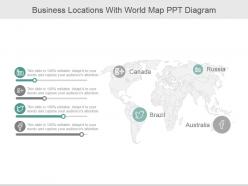
Business locations with world map ppt diagram





Try Before you Buy Download Free Sample Product
 Impress Your
Audience
 100%
Editable
 Save Hours
of Time


Handle the jibes with our Business Locations With World Map Ppt Diagram. Bring an end to erroneous impressions.
People who downloaded this PowerPoint presentation also viewed the following :
Business locations with world map ppt diagram with all 5 slides:
Avoid folks going around aimlessly with our Business Locations With World Map Ppt Diagram. They believe in conservation of energy.




FAQs for Business locations with world
Key factors include market demographics, competition density, accessibility and transportation, operational costs, and regulatory environment. These considerations streamline decision-making by balancing customer reach, supply chain efficiency, and cost structures, with many retail and service businesses finding that strategic location analysis ultimately delivers higher foot traffic, reduced logistics expenses, and sustainable competitive advantage.
Proximity to suppliers and customers significantly enhances operational efficiency by reducing transportation costs, minimizing delivery times, and enabling faster response to market demands. Companies strategically located near key partners streamline their supply chains, reduce inventory holding costs, and improve customer service levels, with many manufacturing and retail businesses finding that geographic clustering ultimately delivers competitive advantages through lower logistics expenses and enhanced market responsiveness.
Local competition significantly influences location decisions by affecting market saturation, pricing strategies, customer acquisition costs, and differentiation opportunities. While high competition can indicate strong market demand, it also requires businesses to invest more in marketing and unique value propositions, with many companies finding that moderate competition levels often deliver optimal market validation without oversaturation.
Demographic trends inform location decisions by revealing population growth patterns, age distributions, income levels, education statistics, and consumer behavior shifts. These insights enable businesses to identify emerging markets, assess workforce availability, and predict future demand, with retail chains and healthcare providers finding that demographic analysis significantly reduces expansion risks while maximizing market penetration opportunities.
Urban locations offer greater market access, talent pools, infrastructure, and networking opportunities, while rural areas provide lower costs, less competition, and stronger community ties. While urban businesses benefit from higher customer density and diverse resources, they face increased overhead and competition, whereas rural enterprises enjoy cost advantages but may struggle with limited workforce access and market reach, ultimately requiring strategic alignment with business objectives.
Zoning laws significantly impact business locations by dictating permitted activities, building specifications, and operational requirements within designated areas. These regulations influence site selection, renovation costs, and compliance obligations, with retail businesses finding commercial zones offer customer accessibility while manufacturing operations require industrial zoning, ultimately affecting startup expenses and long-term operational efficiency.
Accessibility and transportation networks directly impact customer reach, employee recruitment, supply chain efficiency, and operational costs for business locations. Strong transportation infrastructure enables companies to attract talent from wider geographic areas, facilitate faster product distribution, and enhance customer convenience, with retail businesses and manufacturing facilities finding that strategic proximity to highways, airports, and public transit ultimately delivers competitive advantage and reduced logistics expenses.
Economic incentives and tax breaks significantly influence business location decisions by reducing operational costs, offering startup capital assistance, and providing long-term financial advantages through reduced corporate taxes. Many manufacturers and tech companies relocate to states offering substantial incentive packages, ultimately delivering improved profit margins and competitive positioning while enabling reinvestment in growth initiatives.
Employee commuting considerations include transportation accessibility, travel time impact, parking availability, public transit connections, and flexible scheduling options. These factors significantly influence recruitment success, employee satisfaction, and retention rates, with many organizations finding that strategic location choices near transit hubs or offering hybrid work arrangements ultimately enhance productivity while reducing turnover costs.
Local business ecosystems support startups through accelerators, mentorship programs, seed funding networks, and co-working spaces that reduce initial costs and provide guidance. Established businesses benefit from mature supply chains, strategic partnerships, skilled talent pools, and infrastructure investments, while startups gain access to innovation hubs and networking events that accelerate growth and market entry.
Community resources like quality schools and healthcare facilities significantly enhance business viability by attracting skilled talent, reducing employee turnover, and improving workforce productivity and satisfaction. These amenities enable companies to recruit top professionals more easily, lower healthcare-related costs, and create stable communities that support long-term business growth, ultimately delivering competitive advantage in talent acquisition.
Technology and remote work capabilities are revolutionizing traditional business location strategies by enabling companies to access global talent pools, reduce overhead costs, and maintain operational flexibility regardless of physical presence. Through cloud computing, video conferencing, and collaborative platforms, organizations can establish distributed teams across multiple regions while streamlining communication and productivity, ultimately delivering competitive advantages and enhanced scalability in an increasingly digital marketplace.
Businesses should evaluate climate conditions, natural disaster risks, air and water quality, proximity to transportation networks, and local environmental regulations when selecting sites. These factors significantly impact operational costs, employee health, supply chain efficiency, and regulatory compliance, with many organizations finding that environmentally favorable locations ultimately deliver lower insurance premiums, reduced utility expenses, and enhanced workforce attraction.
Businesses can leverage data analytics to evaluate potential locations through demographic analysis, foot traffic patterns, competitor mapping, economic indicators, and predictive modeling. These analytical approaches streamline location decisions by identifying target customer concentrations, optimizing market penetration strategies, and minimizing operational risks, with many retail and service organizations finding that data-driven site selection significantly enhances profitability and competitive positioning.
During economic downturns, companies can adapt location strategies through cost reduction measures, flexible lease negotiations, downsizing to smaller spaces, relocating to lower-cost markets, and embracing hybrid work models. These approaches streamline operational expenses while maintaining productivity, with many organizations finding that strategic relocations and flexible arrangements ultimately deliver sustained cost savings and enhanced workforce adaptability.
-
Great designs, really helpful.
-
Thanks for all your great templates they have saved me lots of time and accelerate my presentations. Great product, keep them up!