

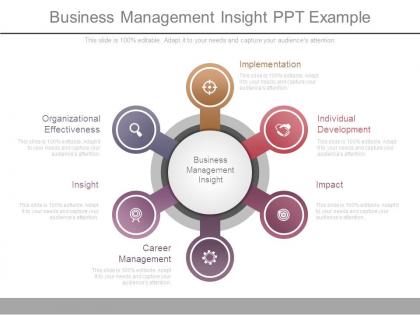
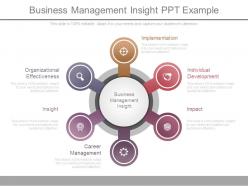
Business management insight ppt example




Try Before you Buy Download Free Sample Product
 Impress Your
 Audience
 100%
100% Editable
 Save Hours
 of Time


Don't hang back with our Business Management Insight Ppt Example. They help you give it all you got.
People who downloaded this PowerPoint presentation also viewed the following :
Business management insight ppt example with all 7 slides:
Our Business Management Insight Ppt Example keep the clients coming. You will be continuously active.



FAQs for Business management
Effective innovation strategies include empowering employee experimentation, establishing cross-functional collaboration spaces, implementing idea management systems, providing dedicated innovation time, and creating fail-fast learning environments. These approaches streamline creative processes by encouraging risk-taking, breaking down silos, and rewarding breakthrough thinking, with many organizations finding that structured innovation frameworks ultimately deliver competitive advantages and accelerated growth.
Small businesses can leverage technology through cloud-based management systems, automated accounting software, customer relationship management platforms, digital marketing tools, and e-commerce solutions. These technologies streamline operations by reducing manual tasks, enhancing customer experiences, and enabling data-driven decisions, with many small enterprises finding that strategic technology adoption delivers cost savings, scalability, and competitive advantage in increasingly digital markets.
Emotional intelligence enables leaders to understand, manage, and leverage emotions effectively, encompassing self-awareness, empathy, social skills, and emotional regulation in decision-making processes. Through enhanced communication and conflict resolution, leaders with strong emotional intelligence create more cohesive teams, improve employee engagement, and drive better organizational outcomes, ultimately delivering competitive advantage in increasingly complex business environments.
**INPUT**: How do you measure the success of a business management strategy? **OUTPUT**: Success measurement involves tracking key performance indicators like revenue growth, operational efficiency, employee engagement, customer satisfaction, and market share expansion. Through comprehensive analytics and regular assessment cycles, organizations can evaluate strategy effectiveness while adapting to market changes, with many companies finding that balanced scorecards and quarterly reviews ultimately deliver clearer strategic alignment. [Word count: 54]
Key elements include stakeholder analysis, clear communication strategies, training programs, timeline development, and resistance management protocols. These components work together by identifying affected parties, establishing transparent messaging channels, and building organizational capability, with many companies finding that structured change management reduces implementation time by 30-40% while improving employee adoption rates.
Data analytics enhances decision-making by providing real-time insights, predictive modeling, performance metrics, and trend analysis that eliminate guesswork from strategic choices. Through advanced analytics platforms, organizations streamline resource allocation, identify market opportunities, and minimize risks, with many financial services and retail companies finding that data-driven decisions ultimately deliver faster growth and competitive advantage.
Effective employee engagement and retention strategies include competitive compensation packages, flexible work arrangements, professional development opportunities, recognition programs, and clear career advancement paths. These approaches enhance workplace satisfaction by addressing individual growth needs, work-life balance concerns, and achievement recognition, with many organizations finding that engaged employees deliver higher productivity, reduced turnover costs, and stronger competitive advantage.
Organizations effectively manage remote teams through clear communication protocols, robust digital collaboration platforms, regular performance check-ins, flexible scheduling arrangements, and strong company culture initiatives. These approaches streamline workflow coordination, enhance team connectivity, and maintain productivity standards, with many companies finding that strategic combination of synchronous meetings and asynchronous collaboration ultimately delivers improved work-life balance and competitive talent acquisition advantages.
Agile methodologies deliver enhanced flexibility, faster project delivery, improved team collaboration, better customer responsiveness, and increased adaptability to market changes. While these approaches streamline operations and accelerate innovation, they also require cultural shifts and consistent stakeholder engagement, with many organizations finding that proper training and leadership commitment ultimately enable competitive advantage through more efficient resource allocation.
Businesses create sustainable practices while maintaining profitability by integrating eco-friendly operations, optimizing resource efficiency, and leveraging green technologies that reduce costs. Through strategic investments in renewable energy, waste reduction programs, and sustainable supply chains, companies streamline operations, enhance brand reputation, and access new markets, ultimately delivering competitive advantages and long-term financial resilience.
Stakeholder communication ensures project alignment, manages expectations, facilitates informed decision-making, and builds essential trust throughout the project lifecycle. Through regular updates, feedback sessions, and transparent reporting, project managers minimize risks, reduce scope creep, and accelerate problem resolution, with many organizations finding that structured communication protocols ultimately deliver higher project success rates and stronger stakeholder relationships.
Market trends influence strategic planning by shaping resource allocation, competitive positioning, product development timelines, and customer engagement strategies. Through comprehensive trend analysis, organizations identify emerging opportunities, anticipate market shifts, and adjust operational priorities, with many financial services and retail companies finding that proactive trend monitoring delivers enhanced market responsiveness and sustainable competitive advantage.
Best practices for conducting a SWOT analysis include gathering diverse stakeholder input, using current market data, focusing on actionable insights, setting specific timeframes, and conducting regular reviews. Through collaborative workshops and data-driven assessment, organizations streamline strategic planning by identifying realistic opportunities, addressing genuine threats, and leveraging authentic strengths, ultimately delivering competitive advantage and informed decision-making in an increasingly dynamic business environment.
Mentorship programs significantly enhance organizational development by improving employee retention, accelerating skill development, strengthening leadership pipelines, and fostering knowledge transfer across generations. Through structured pairing of experienced professionals with emerging talent, companies like financial institutions and healthcare organizations streamline succession planning, boost employee engagement, and cultivate innovative thinking, ultimately delivering stronger performance and competitive advantage.
Businesses should consider employment law compliance, data protection regulations, intellectual property rights, contract management standards, and regulatory reporting requirements in their management practices. These legal frameworks vary across industries, with healthcare organizations navigating HIPAA compliance, financial services managing SEC regulations, and manufacturing companies addressing safety standards, ultimately protecting against litigation while enabling sustainable growth.
-
Excellent Designs.
-
Use of different colors is good. It's simple and attractive.