

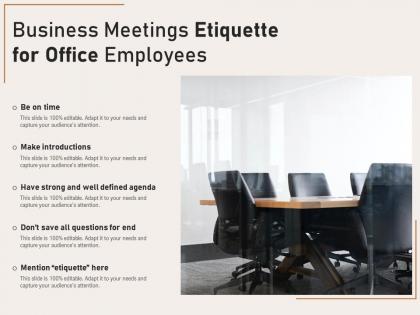
Business meetings etiquette for office employees




Try Before you Buy Download Free Sample Product
 Impress Your
 Audience
 100%
100% Editable
 Save Hours
 of Time


Our Business Meetings Etiquette For Office Employees are topically designed to provide an attractive backdrop to any subject. Use them to look like a presentation pro.
People who downloaded this PowerPoint presentation also viewed the following :
Business meetings etiquette for office employees with all 2 slides:
Use our Business Meetings Etiquette For Office Employees to effectively help you save your valuable time. They are readymade to fit into any presentation structure.
FAQs for Business meetings etiquette
Okay so first thing - get your objectives down and set clear start/end times. List who's coming and what you'll actually discuss (with time limits or you'll go way over). Send any prep docs ahead of time because nobody reads stuff during meetings anyway. Pick someone to lead each topic - this part's huge honestly. Leave room for action items at the end. Oh and 24 hours notice minimum so people aren't scrambling. I learned this the hard way but a good agenda literally saves you from those awkward "so... why are we here again?" moments.
Dude, your body language is everything in meetings. Sit up straight and make eye contact - you'll instantly look more confident and people will actually listen to your ideas. I learned this the hard way after slouching through presentations for years lol. Don't check your phone either, even if the meeting's boring as hell. Your gestures can totally back up what you're saying or make you look like you don't know what you're talking about. People notice this stuff without realizing it. Pro tip: copy how the important people are sitting. Sounds weird but it works.
Honestly? Just call people out directly - "Hey Sarah, what do you think about this?" It sounds awkward but it totally works. I also do this thing where everyone has to share one quick thought before we dive into the real discussion. Oh, and break the chatty people into smaller groups if you can swing it (you know the ones who never stop talking lol). Setting expectations upfront helps too - like actually telling people you want everyone's input. Don't just wait for shy people to magically start participating because... they won't.
Deal with disruptions fast but don't be a jerk about it. When people go off-topic, try "Great point, but let's get back to this and maybe chat about that after?" Honestly, some folks just can't help themselves - they live for the sound of their own voice. If someone keeps cutting you off, acknowledge them then redirect: "Thanks Sarah, lemme just wrap up this thought first." Stay polite but firm. The meeting will go completely sideways otherwise. If they keep doing it, pull them aside afterward to set some boundaries.
Okay so virtual meetings are way more finicky than in-person ones. Test your camera and mic beforehand because tech always fails at the worst moment. Position your camera at eye level and sit facing a window - the lighting makes such a difference, trust me. Mute yourself when you're not talking. For in-person meetings, it's more about reading the room and actual body language. Don't be that person scrolling through their phone. Both need the same basics though: show up on time, come prepared, listen when others talk. Virtual just amplifies every little disruption, so double-check everything works first.
Dude, being on time for meetings is huge. It shows you respect everyone else's schedule and makes you look professional. I've literally watched people get passed over for promotions because they're always rolling in 10 minutes late - it's brutal but true. When you're late, you miss important stuff and then everyone has to stop to bring you up to speed, which is super awkward. Try to get there like 5 minutes early. Running behind? Just shoot a quick text with your ETA so people know what's up.
Okay so as facilitator, you're basically the meeting referee. Send agendas beforehand - people love to show up clueless otherwise. Start on time, stick to your plan, and redirect when things go sideways (which happens constantly). Watch for quiet people who never speak up and gently bring them in. Also manage the loudmouths who think every meeting is their personal TED talk. Don't push your own agenda - you're Switzerland here. Wrap with clear action items so people actually do stuff afterward. Oh, and actually facilitate the discussion instead of just reading slides like a robot.
Honestly, shoot them an email within 24 hours while everything's still fresh. People have terrible memories - I've learned this the hard way! List out what you decided, who's doing what, and all the deadlines. Don't make it super formal or anything, just clear. This saves you from those awkward moments weeks later when everyone's like "wait, what did we actually decide?" Also helps keep people accountable since it's all written down. If anything seemed confusing during the meeting, now's your chance to clarify. CC everyone so nobody can claim they missed something.
Get your invites out a week early with all the basics - agenda, time zones, dial-in info. People are swamped, so tell them WHY they need to be there or they'll blow it off. I always set RSVP deadlines 2-3 days out so I can actually plan. Don't do those annoying group "friendly reminder!" emails - just text the stragglers directly. For bigger groups, Calendly or Doodle polls work great. Oh, and if your key people can't make it? Just reschedule. There's nothing worse than a meeting full of people who shouldn't really be there anyway.
Don't just drop the bomb on them - ease into touchy stuff. Give people a heads up first, like "hey, this might be uncomfortable but we need to talk about it." I've watched so many meetings crash and burn when someone just blurts out the drama without warning lol. Stick to facts before you get into opinions or fixes. Frame everything around how it affects the business, not personal stuff. Then ask what they think instead of demanding answers right away - keeps people from getting all defensive. Works way better than the direct approach, trust me.
Oh man, this stuff is tricky but you'll get the hang of it. I always start by saying something like "I hear you" or "that's interesting" - just acknowledge their point first. Don't use words like "wrong" or "bad idea" when you restate what they said. Ask questions instead of immediately pushing back. Honestly, I bombed this so many times early on, it was painful. When things get tense, try redirecting to what everyone agrees on: "We all want this project to work, so let's look at both ideas." Also follow up privately with anyone who seemed pissed off afterward.
Honestly, just flip your phone face-down and put it on silent. People definitely notice when you're scrolling Instagram behind your laptop screen - it's so obvious! If you need to use your laptop, stick to actual meeting stuff like notes or pulling up documents they're talking about. Don't check random emails unless they're about whatever's being discussed. Oh and if something urgent comes up, just step out for a sec instead of handling it at the table. Trust me, showing you're actually paying attention makes a way better impression than being glued to your devices.
Honestly, just match whatever vibe the meeting has. Big client presentation or meeting with executives? Go full suit mode. Regular team stuff though - business casual works fine, skip the tie. Video calls are weird now since everyone's standards are all over the place, but I'd still do business casual on top just to be safe. You can't really go wrong being a little overdressed vs underdressed. Oh and if you're totally unsure, just peek at what your coworkers usually wear or shoot someone a quick message asking what's normal there.
Honestly, just stick to easy stuff like coffee, water, and maybe some pastries or crackers. Nothing that needs a fork - learned that one the hard way during a budget meeting with spaghetti (what was I thinking?). Let people know ahead of time if you're providing food so they don't show up starving or already full. Short meetings though? Skip food entirely. Always grab napkins and try to think about allergies if you can. Oh, and set everything up before anyone arrives - you don't want to be running around serving people while trying to lead the discussion.
Ugh, yeah cultural stuff can totally derail meetings if you're not ready for it. Time zones are one thing, but some places are super strict about being on time while others... not so much. Found that out the awkward way on a Brazil call once! Communication styles vary tons too - Americans tend to jump right in, but I've noticed colleagues from other places prefer listening first or chatting one-on-one before speaking up. Oh and hierarchy's huge in some cultures. Junior people won't say a word unless you directly ask them. Honestly just check with local teammates beforehand - saves so much confusion.
-
Use of icon with content is very relateable, informative and appealing.
-
Out of the box and creative design.
-
Wonderful templates design to use in business meetings.
-
Nice and innovative design.