

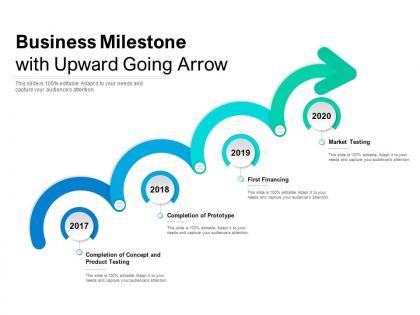
Business milestone with upward going arrow




Try Before you Buy Download Free Sample Product
 Impress Your
Audience
 100%
Editable
 Save Hours
of Time


Your ideas will earn the credit they deserve. Our Business Milestone With Upward Going Arrow will work in your favour.
People who downloaded this PowerPoint presentation also viewed the following :
Business milestone with upward going arrow with all 2 slides:
Srengthen the credibility of your views. Add to their credence with our Business Milestone With Upward Going Arrow.


FAQs for Business milestone with
Key business growth metrics include revenue growth rate, customer acquisition cost, customer lifetime value, market share expansion, and profit margin trends. These indicators enable organizations to assess performance comprehensively by tracking financial health, operational efficiency, and competitive positioning, with many companies finding that monitoring these metrics together delivers strategic insights for sustainable scaling and resource optimization.
Market research informs scaling strategies by identifying target demographics, analyzing competitor positioning, assessing market demand, and revealing growth opportunities across different segments. Through comprehensive data analysis, businesses can optimize resource allocation, minimize expansion risks, and tailor their offerings to meet specific market needs, ultimately delivering strategic competitive advantage and sustainable growth.
Innovation drives long-term business growth by enabling companies to adapt to market changes, differentiate from competitors, and create new revenue streams through improved products, services, and processes. Through strategic innovation, organizations streamline operations, enhance customer experiences, and capture emerging opportunities, with many businesses finding that continuous innovation ultimately delivers sustained competitive advantage and market leadership.
Small businesses can leverage digital marketing through social media advertising, search engine optimization, email campaigns, content marketing, and targeted online ads. These strategies enhance customer reach by building brand awareness, generating qualified leads, and improving customer engagement, with many small retailers and service providers finding that consistent digital presence ultimately delivers higher conversion rates and sustainable competitive advantage.
Successful market expansion strategies include thorough market research, strategic partnerships with local entities, phased entry approaches, cultural adaptation of products and services, and competitive pricing models. These approaches enable businesses to minimize risks while maximizing opportunities, with many organizations finding that combining digital marketing with local relationship-building delivers sustainable growth and competitive advantage in new territories.
Customer feedback is crucial for sustainable growth, providing insights into product improvements, service gaps, customer satisfaction levels, and market opportunities that drive strategic decisions. Through systematic collection via surveys, reviews, and direct interactions, businesses can enhance offerings, reduce churn, identify expansion opportunities, and build stronger customer relationships, ultimately delivering competitive advantage and accelerated growth in increasingly customer-centric markets.
Common pitfalls include overextending resources, neglecting operational infrastructure, losing focus on core customers, hiring too quickly without proper systems, and sacrificing quality for speed. These challenges often result in cash flow problems, cultural dilution, and operational bottlenecks, with many companies finding that sustainable growth requires balancing ambitious expansion with strategic operational development.
Strategic partnerships enhance business growth by expanding market reach, sharing resources and expertise, reducing operational costs, and accelerating innovation cycles. Through collaborative ventures, companies access new customer bases, distribution channels, and technological capabilities while mitigating risks, with many organizations finding that strategic alliances deliver faster market penetration and sustainable competitive advantages.
Financial strategies for scaling operations include diversifying funding sources, implementing robust cash flow management, establishing strategic partnerships, optimizing working capital, and creating scalable financial systems. These approaches enable businesses to maintain liquidity during expansion, reduce funding risks, and support growth through multiple revenue streams, with many organizations finding that combining debt, equity, and operational financing delivers sustained competitive advantage.
Team culture influences company growth by fostering collaboration, innovation, and employee engagement, which directly impact productivity, talent retention, and customer satisfaction. Organizations with strong cultures, like those in technology and financial services, experience faster decision-making, improved problem-solving capabilities, and enhanced adaptability, ultimately delivering competitive advantage and sustainable expansion in increasingly dynamic markets.
Technological advancements driving growth include artificial intelligence, cloud computing, automation, IoT sensors, and data analytics platforms. These technologies streamline operations by reducing manual processes, enhancing decision-making capabilities, and improving customer experiences, with sectors like manufacturing, healthcare, and financial services finding that strategic technology adoption delivers significant competitive advantages and operational efficiency gains.
Businesses balance short-term gains with long-term growth by establishing clear strategic priorities, allocating resources between immediate revenue opportunities and future investments, and implementing phased approaches that deliver incremental wins. Through disciplined planning, companies in sectors like technology and retail achieve quarterly targets while building sustainable competitive advantages, ultimately creating resilient operations that thrive across market cycles.
Social responsibility initiatives contribute to business growth by enhancing brand reputation, attracting conscious consumers, improving employee retention, and opening new market opportunities. Companies implementing sustainability programs, community partnerships, and ethical practices often find increased customer loyalty, operational cost savings through efficiency improvements, and competitive advantages in securing partnerships, ultimately delivering stronger financial performance and long-term market positioning.
Scalable business model best practices include standardizing operations, leveraging technology for automation, creating recurring revenue streams, building efficient systems, and establishing clear performance metrics. These approaches enable organizations to expand capacity without proportional cost increases, with many companies in software, subscription services, and franchising finding that systematic processes, data-driven decisions, and strategic partnerships ultimately deliver sustainable growth and competitive advantage.
Businesses can effectively manage resources during rapid growth by implementing scalable systems, prioritizing strategic hiring, automating routine processes, and establishing clear resource allocation frameworks. Through careful capacity planning and technology integration, growing companies streamline operations, minimize inefficiencies, and maintain service quality, while many organizations find that investing in robust infrastructure early ultimately delivers sustained competitive advantage.
No Reviews