

Business Model Canvas Courier Service Company Business Model BMC SS V





Try Before you Buy Download Free Sample Product
 Impress Your
Audience
 100%
Editable
 Save Hours
of Time


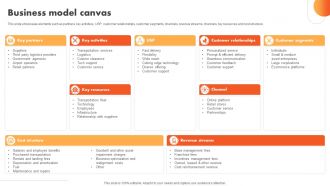
This slide showcases elements such as partners, key activities, USP, customer relationships, customer segments, channels, revenue streams, channels, key resources and cost structure.
People who downloaded this PowerPoint presentation also viewed the following :
Business Model Canvas Courier Service Company Business Model BMC SS V with all 9 slides:
Use our Business Model Canvas Courier Service Company Business Model BMC SS V to effectively help you save your valuable time. They are readymade to fit into any presentation structure.








FAQs for Business Model Canvas Courier Service Company Business Model
Key components include reliable logistics infrastructure, efficient route optimization systems, real-time tracking technology, competitive pricing strategies, and strong customer service capabilities. These elements work together by streamlining operations, reducing delivery times, and enhancing customer experiences, with many courier companies finding that strategic technology investments ultimately deliver significant cost savings and competitive advantage in an increasingly demanding marketplace.
Technology integration enhances courier service efficiency by enabling real-time tracking, automated route optimization, digital proof of delivery, and predictive analytics for demand forecasting. Through GPS systems, mobile apps, and AI-powered logistics platforms, courier companies streamline operations, reduce delivery times, and minimize operational costs, while providing customers with transparent tracking experiences that build trust and competitive advantage.
Customer experience serves as a critical differentiator in the courier service industry, directly impacting customer retention, brand loyalty, and competitive positioning through reliable delivery times, transparent tracking systems, and responsive customer support. Companies like FedEx and UPS have revolutionized logistics by prioritizing seamless digital interfaces, real-time communication, and flexible delivery options, ultimately delivering enhanced satisfaction and sustained business growth in an increasingly competitive marketplace.
Courier services optimize delivery routes through GPS tracking systems, route planning software, real-time traffic analysis, dynamic scheduling algorithms, and automated dispatch systems. These technologies streamline operations by minimizing fuel consumption, reducing delivery times, and maximizing vehicle capacity utilization, with many logistics companies finding that strategic route optimization delivers up to 30% cost reductions while enhancing customer satisfaction.
Courier service startups face challenges including intense competition from established players, high operational costs for vehicles and fuel, regulatory compliance across different regions, building customer trust, and managing logistics efficiently. These obstacles present opportunities for innovation, with many startups finding success through technology integration, niche market specialization, and strategic partnerships, ultimately delivering competitive advantage in an increasingly digital commerce landscape.
Varying regulations significantly impact courier operations through differing customs procedures, licensing requirements, documentation standards, and delivery restrictions across regions. These regulatory differences create both compliance challenges and strategic opportunities, with many international courier services finding that establishing local partnerships, investing in regional expertise, and developing flexible operational frameworks ultimately delivers competitive advantage and enhanced customer experiences globally.
Courier services can explore subscription models for regular clients, premium same-day delivery options, warehousing and inventory management, packaging services, and specialized handling for fragile items. These diversified revenue streams enable companies to enhance operational efficiency, build stronger client relationships, and ultimately deliver competitive advantage while reducing dependency on standard delivery pricing, with many logistics providers finding that value-added services significantly boost profitability.
Partnerships with e-commerce platforms benefit courier services by providing consistent high-volume shipments, predictable revenue streams, and access to advanced logistics technology integration. These strategic alliances enable courier companies to scale operations more efficiently, reduce customer acquisition costs, and leverage platform analytics for route optimization, ultimately delivering enhanced operational capacity and competitive positioning in increasingly demanding delivery markets.
Effective delivery strategies include route optimization software, real-time tracking systems, temperature-controlled vehicles, secure packaging protocols, and driver training programs. These approaches streamline operations by reducing transit times, minimizing damage risks, and enhancing customer visibility, with many logistics companies finding that strategic combinations of technology and process improvements ultimately deliver competitive advantage and improved customer satisfaction rates.
Pricing strategy significantly influences customer acquisition by balancing competitive rates with service value, affecting both individual consumers and business partnerships. Strategic pricing that offers transparent costs, volume discounts, and flexible options helps courier services attract price-sensitive customers while maintaining profitability, with many companies finding that competitive pricing combined with reliable service ultimately drives customer loyalty and market expansion.
Environmental sustainability presents both challenges and opportunities for courier business models, requiring investments in electric vehicles, route optimization technology, sustainable packaging, and carbon offset programs. While these initiatives increase operational costs, they ultimately deliver competitive advantage through reduced fuel expenses, enhanced brand reputation, and compliance with increasingly stringent regulations, with many logistics companies finding that sustainable practices attract environmentally conscious consumers and corporate clients.
Data analytics enhances courier service decision-making by optimizing delivery routes, predicting demand patterns, monitoring driver performance, and identifying cost reduction opportunities. Through real-time tracking systems and predictive algorithms, logistics companies streamline operations, reduce fuel costs, and improve delivery timeframes, with many finding that data-driven insights ultimately deliver competitive advantage and enhanced customer satisfaction.
Social media marketing significantly enhances customer engagement for courier services by enabling real-time communication, providing delivery updates, showcasing service capabilities, and building brand trust through customer testimonials. Through platforms like Facebook and Instagram, courier companies streamline customer inquiries, reduce support costs, and create transparent delivery experiences, with many logistics firms finding that active social presence ultimately delivers stronger customer loyalty and competitive advantage.
Courier services can adapt by implementing same-day delivery options, real-time tracking systems, contactless delivery methods, flexible pickup locations, and sustainable transportation alternatives. These enhancements streamline customer experiences while addressing modern expectations for speed, transparency, and convenience, with many logistics companies finding that diversified service portfolios ultimately deliver competitive advantage in increasingly demanding markets.
Insurance and liability management are critical for courier operations as they protect against package loss, damage, theft, vehicle accidents, and employee injuries during delivery processes. These protections enable courier companies to maintain customer trust, ensure financial stability, and meet regulatory requirements, while providing competitive advantage through comprehensive coverage that ultimately delivers peace of mind and operational resilience.
-
Great product with highly impressive and engaging designs.
-
Awesome use of colors and designs in product templates.