

Business Model Canvas Of Scale Ai Scale Ai Data Labeling And Annotation Platform AI SS




Try Before you Buy Download Free Sample Product
 Impress Your
 Audience
 100%
100% Editable
 Save Hours
 of Time


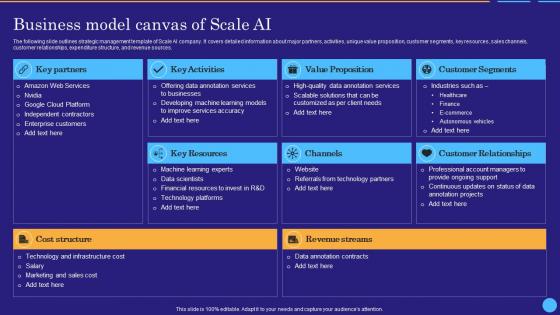
The following slide outlines strategic management template of Scale AI company. It covers detailed information about major partners, activities, unique value proposition, customer segments, key resources, sales channels, customer relationships, expenditure structure, and revenue sources.
People who downloaded this PowerPoint presentation also viewed the following :
Business Model Canvas Of Scale Ai Scale Ai Data Labeling And Annotation Platform AI SS with all 9 slides:
Use our Business Model Canvas Of Scale Ai Scale Ai Data Labeling And Annotation Platform AI SS to effectively help you save your valuable time. They are readymade to fit into any presentation structure.








FAQs for Business Model Canvas Of Scale Ai Scale Ai Data Labeling And Annotation
The Business Model Canvas for AI-driven companies includes value propositions centered on data-driven insights, key partnerships with data providers and technology vendors, revenue streams from AI services or products, key resources like datasets and algorithms, and customer segments seeking intelligent automation. These components work together by leveraging proprietary data, strategic AI capabilities, and scalable technology infrastructure, with many AI companies finding that successful models combine multiple revenue streams while maintaining strong data partnerships to deliver competitive advantages.
Scale AI leverages the Business Model Canvas by systematically mapping its AI training data services across key partnerships with tech companies, value propositions in data annotation and model optimization, and customer segments spanning autonomous vehicles, robotics, and enterprise AI. This strategic framework enables Scale AI to identify innovation opportunities, streamline resource allocation, and rapidly adapt its platform capabilities to emerging market demands, ultimately delivering scalable AI solutions.
AI service value propositions within a Business Model Canvas should focus on specific customer pain points, quantifiable outcomes like cost reduction or efficiency gains, and competitive advantages through automation capabilities. This framework enables organizations to clearly articulate how AI delivers faster decision-making, enhanced customer experiences, and operational streamlining, with many companies finding that positioning AI as a strategic enabler rather than just technology creates stronger market differentiation.
AI companies typically segment customers by data sophistication, technical integration capabilities, and AI readiness levels, while traditional businesses focus on demographics, geography, and purchasing behavior. These technology-driven segments enable AI companies to tailor solutions for early adopters, data-rich enterprises, and digitally mature organizations, ultimately delivering more targeted value propositions and scalable implementation strategies.
Key metrics include customer acquisition cost, lifetime value ratios, revenue per user, churn rates, and product-market fit indicators through user engagement data. These metrics enable AI startups to validate value propositions, optimize revenue streams, and refine customer segments, with many finding that combining financial performance with user behavior analytics ultimately delivers clearer strategic insights and sustainable competitive advantage.
Partnerships in the Business Model Canvas enhance AI development by providing access to specialized data, complementary technologies, distribution channels, and technical expertise. Through strategic alliances with cloud providers, industry specialists, and technology integrators, AI companies can accelerate product development, reduce infrastructure costs, and expand market reach, while partners gain access to innovative AI capabilities that enhance their existing offerings.
AI businesses generate revenue through subscription-based SaaS platforms, licensing intellectual property and algorithms, consulting and implementation services, data monetization, and transaction-based fees. These streams work together strategically, with many organizations finding that combining recurring subscriptions with professional services delivers sustainable growth while licensing AI models to partners creates scalable income without additional operational overhead.
AI companies can adapt their cost structure by transitioning from capital-heavy infrastructure to cloud-based services, implementing automated operations, and adopting subscription-based resource models. Through strategic partnerships with cloud providers and automation platforms, organizations streamline operational expenses, minimize fixed costs, and enhance scalability, with many finding that flexible cost structures ultimately deliver competitive pricing and faster market responsiveness.
Customer relationships within the Business Model Canvas reveal crucial insights about user interaction preferences, support requirements, personalization needs, and engagement patterns that directly shape AI product features and functionality. These insights enable AI developers to design more intuitive interfaces, automate appropriate customer touchpoints, and create personalized experiences, with many technology companies finding that relationship mapping significantly reduces development costs while enhancing user adoption rates.
Distribution channels for AI services emphasize digital platforms, API integrations, cloud-based delivery systems, and partner ecosystems, contrasting with conventional products' physical retail networks, distributors, and traditional sales channels. Through Software-as-a-Service models and marketplace platforms, AI companies streamline customer access while reducing infrastructure costs, with many organizations finding that automated deployment and scalable cloud architecture ultimately deliver faster market penetration and enhanced customer experiences.
Key activities in AI projects should emphasize data management, model development, algorithm training, continuous monitoring, and iterative improvement cycles. These activities require specialized workflows like data preprocessing, feature engineering, and model validation, with many technology companies finding that integrating automated testing and deployment pipelines ultimately delivers faster innovation cycles and more reliable AI solutions.
The Business Model Canvas reveals AI-specific risks across nine components, including data dependencies in key resources, algorithmic bias affecting value propositions, regulatory compliance impacting customer relationships, and talent acquisition challenges in key partnerships. This systematic visualization enables enterprises to proactively address vulnerabilities like ethical concerns, scalability limitations, and competitive threats, ultimately strengthening risk management strategies and operational resilience.
Customer feedback serves as a critical validation and refinement mechanism for AI Business Model Canvas elements, helping optimize value propositions, revenue streams, customer segments, and key partnerships through real-world usage data. This iterative feedback enables AI companies to pivot their models based on actual user experiences, market demands, and operational challenges, ultimately delivering more targeted solutions and sustainable competitive advantage in an increasingly data-driven marketplace.
Emerging AI trends influence Business Model Canvas components by reshaping value propositions through personalization, transforming customer relationships via chatbots and predictive analytics, and optimizing key activities through automation and data processing. Tech companies leveraging these capabilities enhance operational efficiency, reduce costs, and deliver superior customer experiences, with many organizations finding that AI integration across canvas elements creates sustainable competitive advantages in increasingly digital markets.
Companies like Spotify use AI for personalized recommendations while leveraging data partnerships and freemium models, Netflix employs machine learning for content curation and original programming strategies, and Salesforce integrates AI across customer relationship platforms through strategic acquisitions. These organizations demonstrate how the Business Model Canvas enables AI companies to identify key partnerships, optimize value propositions, and streamline revenue streams, ultimately delivering scalable growth and competitive advantage in increasingly data-driven markets.
-
No second thoughts when I’m looking for excellent templates. SlideTeam is definitely my go-to website for well-designed slides.
-
A fantastic collection of templates. I'll likely use this as my go-to resource for future templates and support.