

Business Model Car Manufacturer Company Profile CP SS V




Try Before you Buy Download Free Sample Product
 Impress Your
Audience
 100%
Editable
 Save Hours
of Time


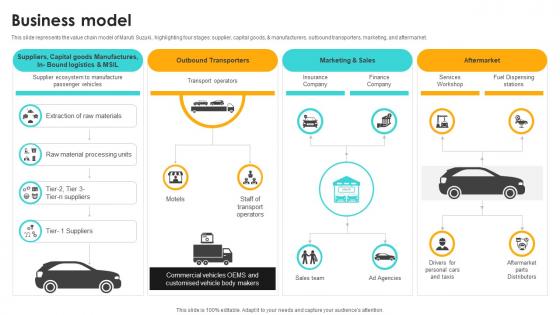
This slide represents the value chain model of Maruti Suzuki, highlighting four stages supplier, capital goods, and manufacturers, outbound transporters, marketing, and aftermarket.
People who downloaded this PowerPoint presentation also viewed the following :
Business Model Car Manufacturer Company Profile CP SS V with all 9 slides:
Use our Business Model Car Manufacturer Company Profile CP SS V to effectively help you save your valuable time. They are readymade to fit into any presentation structure.









FAQs for Business Model Car Manufacturer Company Profile
Key components include innovative product development, efficient manufacturing operations, strategic supply chain management, diverse revenue streams, and robust customer relationship systems. These elements work together by reducing production costs, accelerating time-to-market, and enhancing customer experiences, with many manufacturers finding that integrating digital technologies and sustainability initiatives ultimately delivers competitive advantage in an increasingly dynamic automotive landscape.
Electric vehicles have transformed car manufacturing by requiring massive investments in battery technology, charging infrastructure partnerships, and direct-to-consumer sales models, while shifting focus from engine expertise to software integration and sustainable supply chains. Many manufacturers like Tesla and Ford are adopting subscription services, over-the-air updates, and strategic alliances with tech companies, ultimately delivering enhanced customer experiences and competitive advantage in an increasingly electrified automotive landscape.
Sustainable manufacturing serves as a competitive differentiator and cost optimization strategy, encompassing renewable energy adoption, waste reduction initiatives, circular economy principles, and carbon-neutral production processes. These approaches enable automakers to meet regulatory requirements, attract environmentally conscious consumers, and reduce operational costs, with companies like Tesla and BMW finding that sustainable practices ultimately deliver enhanced brand reputation and long-term profitability.
Car manufacturers leverage technology to enhance operations through AI-powered predictive maintenance, IoT-enabled supply chain optimization, automation in production lines, digital twin modeling, and data analytics for demand forecasting. These technologies streamline manufacturing processes by reducing downtime, minimizing inventory costs, and accelerating product development cycles, with many automotive companies finding that integrated tech solutions ultimately deliver competitive advantage and improved operational efficiency.
Dynamic pricing, value-based pricing, subscription models, tiered pricing, and competitive pricing strategies dominate today's automotive landscape. These approaches enable manufacturers to respond to market fluctuations, customer segments, and technological advances, with many automakers finding that combining traditional ownership models with subscription services for electric vehicles ultimately delivers broader market reach and enhanced customer retention.
Supply chain disruptions force car manufacturers to restructure their business models through diversified supplier networks, increased inventory buffers, and strategic vertical integration. These disruptions drive automotive companies toward regional sourcing strategies, flexible manufacturing processes, and enhanced supplier partnerships, while many manufacturers increasingly invest in supply chain transparency technologies and predictive analytics, ultimately delivering greater operational resilience and competitive advantage.
Emerging automotive distribution channels include online direct sales platforms, mobile showrooms, pop-up retail locations, subscription-based services, and digital marketplace partnerships. These innovative approaches streamline customer acquisition by reducing overhead costs, enhancing personalization, and expanding geographic reach, with many manufacturers finding that omnichannel strategies ultimately deliver faster market penetration and improved customer experiences.
Car manufacturers can utilize data analytics to optimize supply chain efficiency, predict maintenance needs, personalize customer experiences, enhance product development, and improve operational performance across manufacturing processes. Through predictive analytics and IoT sensors, automotive companies streamline production workflows, reduce warranty costs, and deliver targeted services, with many manufacturers finding that data-driven insights ultimately enhance competitive advantage and customer satisfaction.
Transitioning from combustion engines to electric vehicles presents challenges including substantial R&D investments, supply chain restructuring, workforce retraining, charging infrastructure development, and shifting consumer perceptions. While these transformations require significant capital allocation and strategic realignment, manufacturers like Tesla and traditional automakers increasingly find that early adoption delivers competitive advantage, operational efficiency, and market positioning in an evolving automotive landscape.
Customer feedback influences car manufacturing through direct input on design preferences, performance requirements, safety concerns, and technology integration needs. Manufacturers like Tesla, Ford, and BMW leverage this data to refine vehicle features, adjust pricing strategies, and develop new service models, ultimately enhancing customer satisfaction while reducing development costs and accelerating market responsiveness.
Essential partnerships for car manufacturers include technology companies for software development, battery suppliers for electrification, semiconductor manufacturers for advanced systems, charging infrastructure providers, and mobility service platforms. These strategic collaborations enable automakers to accelerate innovation, reduce development costs, and access specialized expertise, with many manufacturers finding that such alliances deliver faster market entry and enhanced competitive positioning in an increasingly complex automotive landscape.
Government regulations significantly impact automotive business models by mandating safety standards, emissions requirements, fuel efficiency targets, and increasingly, electric vehicle adoption timelines. These regulations drive manufacturers like Tesla, Ford, and GM to restructure their production strategies, accelerate EV development, and invest heavily in sustainable technologies, ultimately reshaping competitive positioning and market opportunities.
After-sales service generates significant recurring revenue streams, builds customer loyalty, enhances brand reputation, and creates competitive differentiation for car manufacturers. This strategic component delivers higher profit margins than vehicle sales, with many manufacturers finding that service operations, warranty programs, and parts distribution ultimately account for 40-50% of total profitability while strengthening long-term customer relationships.
Car manufacturers balance cost reduction with quality through strategic supplier partnerships, lean manufacturing processes, economies of scale, and technology integration. These approaches streamline production by minimizing waste, optimizing resource allocation, and enhancing operational efficiency, with many automakers finding that investing in automation and quality management systems ultimately delivers lower long-term costs while maintaining superior product standards.
Global trade policies significantly impact automotive business models through tariffs affecting component costs, trade agreements influencing manufacturing location decisions, export-import regulations shaping market access strategies, and currency fluctuations altering profit margins. These policy changes drive manufacturers to diversify supply chains, establish regional production hubs, and develop flexible sourcing strategies, with many automakers finding that localized manufacturing and strategic partnerships ultimately deliver greater cost stability and competitive advantage in an increasingly complex regulatory environment.
-
Amazing product with appealing content and design.
-
Time saving slide with creative ideas. Help a lot in quick presentations..