

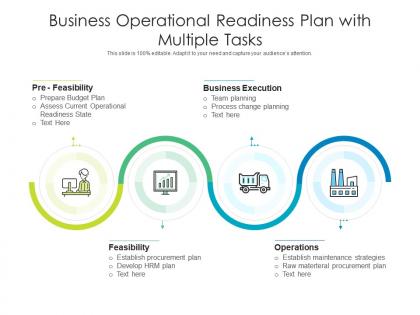
Business operational readiness plan with multiple tasks




Try Before you Buy Download Free Sample Product
 Impress Your
 Audience
 100%
100% Editable
 Save Hours
 of Time


Our Business Operational Readiness Plan With Multiple Tasks are topically designed to provide an attractive backdrop to any subject. Use them to look like a presentation pro.
People who downloaded this PowerPoint presentation also viewed the following :
Business operational readiness plan with multiple tasks with all 2 slides:
Use our Business Operational Readiness Plan With Multiple Tasks to effectively help you save your valuable time. They are readymade to fit into any presentation structure.
FAQs for Business operational readiness plan
Definitely focus on cycle time, throughput, and how well you're using your resources - those three will tell you everything about efficiency. Error rates matter too because quality problems will mess up all your other numbers (trust me on this one). Cost per unit is obviously huge, and on-time delivery if you've got customers breathing down your neck. Oh, and don't go crazy with like 15 different metrics right away. Pick maybe 3-4 that actually connect to whatever's driving you nuts operationally. You'll just get overwhelmed otherwise and won't act on any of it.
Honestly, you're probably wasting hours every week on stupid stuff like data entry and manual scheduling. Automation tools can knock out all that repetitive work so you can actually think strategically instead. Cloud systems are game-changers too - your whole team can work together from wherever, and you'll get real-time dashboards showing what's actually moving the needle. I'd start by picking your biggest time-suck (mine was always project tracking, ugh) and find one decent tool to fix that first. Don't try to overhaul everything at once.
Start by figuring out what's actually sitting in your warehouse collecting dust - that audit will shock you. ABC analysis helps you focus on your money-makers instead of worrying about every little widget. Demand forecasting isn't perfect but it beats guessing. Safety stock is smart, just don't go overboard or you'll tie up cash for no reason. Honestly, if you're still using spreadsheets you're making life way harder than it needs to be. Real-time tracking pays for itself. Build solid relationships with suppliers - they'll save your butt during disruptions. JIT works great for stuff that won't kill you if it's late.
Dude, training your team is seriously worth it - probably the best money you'll spend. Everything just flows better when people actually know their stuff. Fewer screwups, tasks get done faster, and you're not constantly putting out fires from dumb mistakes. Your employees get more confident too, so they stop bugging you with every little decision. I mean, nobody likes being micromanaged anyway, right? The productivity boost usually covers what you spent on training pretty fast. Just figure out where you're bleeding the most time/money first and tackle those problem areas.
Look, customer feedback is basically your reality check - it shows you where things are actually broken or working from the people who actually matter. Maybe you think your checkout process is seamless, but if everyone's complaining it's confusing? There's your problem. Don't just wait for angry emails though - that's rookie stuff. Set up surveys, quick follow-up calls, or simple feedback forms to catch patterns in what people are saying. The real trick is spotting those recurring themes and then actually doing something about them instead of just filing them away.
Honestly, it comes down to communication and not being annoying about it. Get decent project management software - trust me, buggy video calls will ruin your day. Daily or weekly check-ins work, but async updates are clutch if everyone's in different time zones. Don't micromanage hours; focus on what people actually deliver. Here's the thing though - you'll lose that office vibe fast without some casual interaction. We do one weekly video call that's just for hanging out, no work talk allowed. Sounds cheesy but it actually helps. Oh, and pick tools that don't crash during important meetings.
Look for the stupid stuff you're wasting money on first - that's honestly where most savings hide. Automate whatever repetitive tasks are eating up time, then hit up your suppliers about better deals. Energy upgrades save more than people think, plus remote work cuts overhead without touching product quality. Cross-training your team is clutch since versatile people mean you don't need as many specialized hires (and they usually like the variety anyway). Don't just slash everything randomly though. Map out your processes and spot the biggest time-wasters - those are your easiest wins.
Ugh, compliance is such a headache but you can't ignore it. It slows down everything - hiring takes longer, product launches get delayed, and don't even get me started on data handling. You'll need someone dedicated to tracking all the rule changes, plus money for audits and training. The fines for screwing up are brutal though, like business-ending brutal. Way better to bake it into your processes from day one instead of scrambling later. First step? Figure out which regulations actually hit your industry. Some don't apply despite what people think.
Honestly, the hardest part is getting everyone on board - people hate change, even when it'll make their lives easier. Mapping out your current processes is way more complicated than you'd think too. Integration with whatever ancient systems you're already using? Total nightmare. Oh, and the upfront costs will make your CFO cry a little. Your data needs to be super clean or the whole thing falls apart - garbage in, garbage out, you know? Start with just one simple process first. Get people excited about it early on. Document everything about how stuff currently works before you touch anything. Trust me on that last one.
Honestly, data analytics just turns your random guesses into stuff you can actually bank on. You'll stop making decisions based on hunches and start seeing real patterns - like why customers bail at checkout or where your team's getting stuck. Think of it as finally having clarity on what's actually making you money vs. what's a total waste. The cool part? You can test ideas without blowing your budget first. I'd probably pick one area where you're currently just winging it and track a few numbers for a month. Way better than crossing your fingers and hoping for the best.
Honestly, lean management is a game-changer for cutting waste and speeding things up. Your delivery times get way faster, costs drop, and quality actually improves because you're only doing stuff that matters to customers. Once your team gets the hang of spotting inefficiencies, they become obsessed with finding more - it's wild how much unnecessary crap most companies do. Employees love it too since they can actually suggest changes that get implemented. Oh, and don't go crazy right away. Pick one department to try it first, see how it goes, then expand from there.
Honestly, start with getting your team leads to actually talk - not just firing off status emails nobody reads. Set up one weekly sync between departments that work together most. From there, you can add more touchpoints as needed. Create dedicated project channels in Slack or Teams so everyone's looped in. I swear, most issues happen because someone assumes everyone else knows what's going on (they never do). Oh, and get some shared project tools going - makes tracking stuff way easier. The key is regular check-ins, not just hoping communication magically happens.
Honestly, just focus on what you actually need first - skip the flashy stuff you'll never touch. Can it handle growth? Does it play nice with what you're already running? The real costs add up fast when you factor in setup and getting everyone trained. Your team has to actually want to use this thing or you're screwed. I've seen too many expensive software graveyards because nobody bothered asking the actual users what they thought. Security and vendor stability aren't sexy but they'll save your ass later. Run demos with your real messy data and get your people involved early.
Honestly, your culture IS your operations - like, they're not separate things. When people trust each other and feel invested, decisions happen fast and departments actually talk to each other instead of playing phone tag for weeks. But in toxic places? Total nightmare. Everyone's hoarding info, scared to take risks, spending half their energy on office politics. I've seen companies blame their processes when really it's just that nobody wants to stick their neck out or collaborate. Short sentences work better sometimes. If things feel slow and bureaucratic, I'd bet money it's a people problem, not a systems one.
Look, sustainable stuff isn't just feel-good nonsense - it actually saves you money. Energy bills drop, waste fees shrink, and your whole operation gets more efficient. Customers dig eco-friendly businesses too, which is a nice bonus. Working with sustainable suppliers makes your supply chain way more reliable. Employees seem happier when they don't hate their company's values (who knew?). Just start small - maybe an energy audit or basic waste reduction. The savings typically cover costs within a couple years anyway, so it's honestly smart business regardless of the green angle.
-
Good research work and creative work done on every template.
-
Great designs, really helpful.
-
Unique and attractive product design.
-
Excellent work done on template design and graphics.