

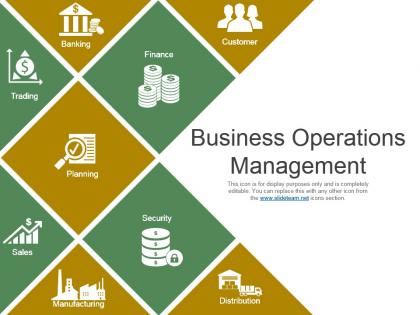
Business operations management powerpoint layout




Try Before you Buy Download Free Sample Product
 Impress Your
Audience
 100%
Editable
 Save Hours
of Time


Give them a gift they will cherish with our Business Operations Management Powerpoint Layout. Their growth will begin to flourish.
People who downloaded this PowerPoint presentation also viewed the following :
Business operations management powerpoint layout with all 5 slides:
Explain how counterfeits are created with our Business Operations Management Powerpoint Layout. Elaborate on examples of invalid documents.


FAQs for Business operations
Key components of effective business operations management include process optimization, resource allocation, quality control, supply chain management, and performance monitoring. These elements work together by streamlining workflows, minimizing waste, and enhancing productivity, with many organizations finding that strategic integration of these components ultimately delivers improved customer satisfaction and significant competitive advantage.
Data analytics enhances operations management decision-making by providing real-time visibility into performance metrics, predictive insights for demand forecasting, and identifying operational bottlenecks before they impact productivity. Through advanced analytics platforms, manufacturing companies streamline inventory management, retailers optimize supply chains, and service organizations improve resource allocation, ultimately delivering faster response times and significant cost reductions.
Technology streamlines business processes by automating repetitive tasks, integrating data across departments, enhancing communication workflows, and providing real-time analytics for decision-making. Through cloud platforms, AI-powered automation, and digital collaboration tools, organizations reduce manual errors, accelerate service delivery, and optimize resource allocation, ultimately delivering improved operational efficiency and competitive advantage in increasingly complex markets.
Organizations can measure operational efficiency through key performance indicators including throughput rates, resource utilization percentages, cost-per-unit metrics, cycle times, and quality scores. These measurements enable businesses to identify bottlenecks, optimize resource allocation, and streamline processes across departments, with many manufacturing and service companies finding that systematic tracking delivers improved productivity and competitive advantage.
Strategies to improve supply chain management include demand forecasting, supplier relationship optimization, inventory management automation, real-time tracking systems, and strategic partnerships. These approaches streamline operations by reducing costs, minimizing delays, and enhancing transparency, with many manufacturing and retail organizations finding that integrated digital platforms ultimately deliver greater operational efficiency and competitive advantage.
Employee training enhances operational effectiveness by improving skill proficiency, reducing error rates, and accelerating task completion times. Well-trained employees streamline workflows, enhance customer service quality, and adapt more quickly to new technologies, with manufacturing and healthcare organizations finding that comprehensive training programs ultimately deliver measurable productivity gains and competitive operational advantages.
Continuous improvement methodologies like Lean and Six Sigma are crucial for eliminating waste, reducing defects, and optimizing operational efficiency across organizations. These approaches enable companies to streamline processes, minimize costs, and enhance quality control, with manufacturing, healthcare, and financial services finding that systematic implementation ultimately delivers competitive advantage and sustainable performance gains.
Businesses can adapt their operations through agile planning, diversified supply chains, flexible workforce models, technology integration, and continuous market monitoring. These strategies enable organizations to pivot quickly during disruptions, with many companies in retail, manufacturing, and financial services finding that operational flexibility ultimately delivers competitive advantage and sustained resilience.
**INPUT**: What are the best practices for inventory management in operations? **OUTPUT**: Best practices for inventory management include demand forecasting, automated reordering systems, ABC analysis for prioritization, real-time tracking technology, and supplier relationship optimization. These approaches streamline operations by reducing carrying costs, minimizing stockouts, and enhancing cash flow, with many retail and manufacturing organizations finding that strategic inventory control ultimately delivers competitive advantage and improved customer satisfaction. [Word count: 58 words]
Effective communication improves operational workflows by eliminating information silos, reducing errors, and accelerating decision-making processes across departments. Through clear protocols and regular updates, organizations streamline coordination between teams, minimize costly miscommunications, and enhance project timelines, with many companies finding that transparent communication channels ultimately deliver faster execution and improved customer satisfaction.
Key performance indicators for operational performance include cycle time, throughput rates, quality scores, resource utilization, cost per unit, and customer satisfaction metrics. These measurements enable organizations to identify bottlenecks, optimize workflows, and enhance efficiency across departments, with many companies finding that consistent tracking delivers improved productivity, reduced operational costs, and stronger competitive positioning.
Business operations align with corporate strategy through strategic resource allocation, performance metrics integration, and cross-functional coordination that directly supports organizational objectives. Companies streamline operations by implementing processes that enhance competitive positioning, optimize cost structures, and accelerate service delivery, with many organizations finding that aligned operations ultimately deliver measurable improvements in market responsiveness and profitability.
Sustainability can be integrated into operations management through waste reduction initiatives, energy-efficient processes, sustainable supply chain partnerships, circular economy practices, and green technology adoption. These approaches streamline operations by minimizing resource consumption, reducing operational costs, and enhancing brand reputation, with many manufacturing and retail organizations finding that sustainable practices ultimately deliver competitive advantage and improved customer loyalty.
Companies face integration complexities with legacy systems, employee resistance to change, substantial upfront costs, and potential workflow disruptions during transition periods. These challenges require strategic change management, comprehensive training programs, and phased implementation approaches, with many organizations finding that careful planning and stakeholder engagement ultimately deliver enhanced efficiency and competitive advantage.
Project management principles enhance operational processes by establishing clear timelines, defining roles and responsibilities, implementing systematic monitoring frameworks, and creating structured communication protocols. These methodologies enable organizations to streamline workflows, reduce operational bottlenecks, and improve resource allocation, with many manufacturing and service companies finding that applying project-based approaches ultimately delivers greater efficiency and measurable performance improvements.
-
Excellent work done on template design and graphics.
-
Commendable slides with attractive designs. Extremely pleased with the fact that they are easy to modify. Great work!