


Business plan executive summary overview powerpoint graphics






Try Before you Buy Download Free Sample Product
 Impress Your
 Audience
 100%
100% Editable
 Save Hours
 of Time


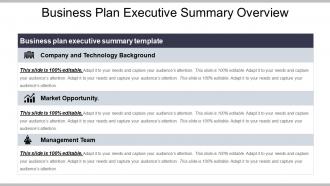
Design unique slideshows to display the executive summary of the business plan with our professionally drafted business plan executive summary overview PowerPoint graphics PPT template. PPT design is appropriate to display summarized business plan including company background, current and future market opportunities, and management team structure in a structured format. You can use this executive summary slide template for business planning and financing management especially for entrepreneurs in the high tech space. This executive summary entrepreneurship business plan PPT design can also be used for developing financing strategies, business plan and executive summary, identifying, targeting and engaging potential investors. You can easily display various elements of business plan with this powerful business plan template presentation design template. The design structure is amazing as it uses a wide range of high resolution graphics to highlight each business plan aspect. So, don’t wait for it, just download this amazing executive summary slide template and share with your team members to let them deliver their ideas in the most unique way. Act as if you are having a friendly chat with our Business Plan Executive Summary Overview Powerpoint Graphics. It allows you to be informal about it.
People who downloaded this PowerPoint presentation also viewed the following :
Business plan executive summary overview powerpoint graphics with all 5 slides:
Explain the innards of the car with our Business Plan Executive Summary Overview Powerpoint Graphics. Illustrate important automotive aspects.

FAQs for Business plan executive summary
So you'll want to cover five main things: your business idea and what makes it valuable, who you're selling to and how big that market is, what gives you an edge over competitors, your money projections plus how much funding you need, and your team's background. Honestly, most investors won't even bother reading past this part if it sucks, so make every word matter. Write it last but put it first - kinda like crafting a movie trailer where you tease the good stuff without spoiling everything. Keep it under two pages max, though closer to one is better.
Think of your exec summary like a movie trailer - hits the big moments but doesn't spoil everything. Cover your business concept, target market, competitive edge, financial projections, and what funding you need. It's honestly the toughest part to write because you're squeezing everything important into 1-2 pages. Someone should read just that section and get what your business does, why it'll work, and what you're asking for. I'd write it last, after finishing the full plan. That way you can pull the best stuff from each section instead of struggling with a blank page.
Here's what I've seen kill so many pitches: cramming everything into a novel-length executive summary. Keep it under 2 pages, seriously. Skip the technical jargon - investors aren't trying to become experts in your field overnight. Your financial projections? Be realistic. Nobody's buying that you'll grab 10% market share right out the gate (I learned this one the hard way). Don't just copy-paste your business plan either. Hit your strongest points only. Oh, and write your summary LAST - you can't summarize what doesn't exist yet. Trust me on this.
Keep it to 1-2 pages max, like 300-500 words tops. People's attention spans are garbage these days - most investors bail after page one anyway. You want them hooked enough to read your full plan, not drowning in details upfront. It's basically a movie trailer situation, you know? Hit your main value prop, the market opportunity, and key financial stuff. Oh and if you can't explain your business in two pages, that's probably a sign you need to simplify things first. Short punchy sentences work better than rambling paragraphs.
Honestly, visuals are a game-changer for exec summaries. Nobody wants to read through paragraphs of financial projections when you could just show a clean chart instead. Your business model makes way more sense as an infographic – investors get it instantly. I've seen so many founders skip this step and it's such a missed opportunity. Revenue graphs, market size pie charts, maybe an org chart if it's relevant. Keep it to 2-3 max though, or it starts looking like a middle school PowerPoint. The goal is breaking up all that text while highlighting your best points.
Dude, you absolutely have to tailor that thing. Investors want ROI numbers and market size right away - they're basically asking "will this make money?" Stakeholders though? They care about timelines and how it'll mess with their daily operations. I made this mistake once and sent identical summaries to both groups... awkward. Your exec summary is like an elevator pitch but written down, so speak their language. Hit what matters to them specifically. Short version: customize the metrics you emphasize based on what each group actually values.
Market analysis proves there's real demand for your product. Show investors you get your target market size and main competitors. It's your "why now" moment - honestly, nobody funds solutions hunting for problems. Keep things high-level since it's just the summary part. Hit them with your best market stats and trends that back up your business idea. The deep research rabbit hole comes later when you can really nerd out. Focus on what makes your timing and positioning actually matter. Short, punchy, and convincing - that's what works here.
Honestly, less is more here. Just hit the big numbers - your 3-year revenue projection, startup costs, and when you'll be profitable. Something like "We're projecting $2M by year three with 15% margins" does the trick. Don't bog them down with monthly breakdowns in this section (that detailed stuff goes in the appendix anyway). Two sentences max, maybe three if you're pushing it. Investors want the headline numbers first - they'll dig into your spreadsheets later if they're interested. Save yourself the headache of cramming everything upfront.
Honestly, just nail the money stuff first - how you're actually gonna make cash. Target market, what makes you different, why you'll beat competitors. Save the heavy financial spreadsheets for later though. Pricing strategy is huge, plus how you'll get customers and any big partnerships. I always think of it like explaining your business to someone over coffee in under two minutes. One sentence per point, keep it tight. Everything should connect back to "here's how we'll grow and make profit." That's literally all investors want to hear at this stage.
Start with the problem your customers are dealing with, then show how your business fixes it. Like a mini hero's journey - they're struggling, you help them win. Investors eat this stuff up way more than boring bullet points, trust me. Frame it as: here's what sucks for people → your cool solution → amazing results they get. Don't forget to throw in real numbers and market data though - you still need the meat behind your story. I probably sound weird calling it a "hero's journey" for business docs, but honestly it works.
For the exec summary, just mention 2-3 main competitors tops. Don't waste space on every player out there. State what makes you different in one clear sentence - that's your money shot right there. I'd skip trashing other companies though, makes you look petty. Just show you get the landscape and explain why customers will pick you instead. Be confident but don't oversell it, investors can smell BS from miles away. Then jump straight into your numbers since that's what they really want to see anyway. Save the detailed competitor breakdown for later sections where you have more room.
Honestly, most exec summaries are boring as hell because they all sound the same. Put your differentiator right at the top - literally the first sentence. What problem do you solve that nobody else can? Skip the "innovative solutions" garbage and get specific about it. I'd avoid burying your unique thing in paragraph three where people might miss it completely. After you hook them with what makes you different, then explain why you're the one to pull it off. Make it so clear that readers can't possibly mix you up with your competitors. Think elevator pitch but on paper, you know?
Don't just slap your mission and vision statements in there like bullet points. Show the problem first, then let your mission flow naturally as your "why." Your vision should paint where you're headed - but honestly, investors care way more about authentic reasoning than polished corporate jargon. Make them short and industry-specific. The whole thing needs to feel like one connected story, not random pieces thrown together. Oh, and definitely read it out loud afterward - if it sounds weird when you say it, it'll sound worse to investors.
Look, you need to nail your value prop and numbers right away - that's what matters. Break up dense stuff with bullets so people can actually read it. Pretend you're stuck in an elevator with an investor for 30 seconds. Every sentence should either grab them or back up your claims with real data. Honestly, most people pack way too much fluff about industry trends. Cut that. Your investors care about one thing: will this make money? Read it out loud - if you're stumbling over words, they'll tune out. One page max. And seriously, test it on your neighbor or something first.
The exec summary is basically your whole business plan squeezed into 1-2 pages. Write it last even though it goes first - you'll need to pull the best bits from your market research, financials, marketing plan, all that stuff. Most investors only read this part to decide if they want the full thing, so don't mess it up. Think movie trailer but actually accurate lol. Hit your key points from every section and make it compelling. Oh and whatever you do, don't contradict what's in the rest of your plan - that's an instant red flag.
-
Really like the color and design of the presentation.
-
Awesome use of colors and designs in product templates.