

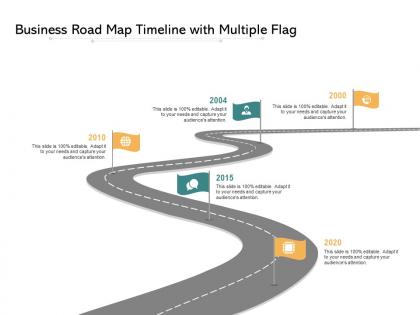
Business road map timeline with multiple flag





Try Before you Buy Download Free Sample Product
 Impress Your
 Audience
 100%
100% Editable
 Save Hours
 of Time


Our Business Road Map Timeline With Multiple Flag guarantee an interesting journey. Experience excitement from beginning to end.
People who downloaded this PowerPoint presentation also viewed the following :
Business road map timeline with multiple flag with all 2 slides:
Experience excitement from beginning to end due to our Business Road Map Timeline With Multiple Flag. It guarantees an interesting journey.
FAQs for Business road map timeline
Key milestones include market launch dates, revenue targets, product development phases, funding rounds, and strategic partnerships. These benchmarks enable organizations to track progress systematically, allocate resources effectively, and maintain stakeholder alignment, with many companies finding that clearly defined milestones enhance accountability, streamline decision-making, and ultimately deliver measurable competitive advantage.
A business roadmap timeline enhances strategic planning by providing visual clarity on goal sequencing, resource allocation milestones, and dependency management across departments. This structured approach enables organizations to identify potential bottlenecks early, coordinate cross-functional initiatives more effectively, and maintain accountability through measurable checkpoints, ultimately delivering improved execution speed and strategic alignment throughout the organization.
Best practices for visualizing business roadmap timelines include using clear milestone markers, color-coded phases, realistic timeframes, progress indicators, and stakeholder-specific views. These visualization techniques streamline strategic planning by enhancing transparency, facilitating cross-team alignment, and enabling dynamic updates, with many organizations finding that well-designed timeline visuals ultimately deliver improved project coordination and stakeholder buy-in across complex initiatives.
Businesses should update their roadmap timelines quarterly for strategic reviews and monthly for tactical adjustments, with immediate updates during significant market shifts or internal changes. This balanced approach enables organizations to maintain strategic direction while adapting to evolving customer needs, competitive pressures, and operational realities, ultimately delivering agility without sacrificing long-term planning effectiveness.
Recommended tools include Microsoft Project, Asana, Trello, Roadmunk, and ProductPlan, each offering unique features for timeline visualization and collaboration. These platforms streamline project management by enabling real-time updates, stakeholder communication, and milestone tracking, with many organizations finding that integrated dashboard capabilities ultimately deliver enhanced operational efficiency and strategic alignment across teams.
Project management methodologies significantly influence roadmap structure by determining milestone frameworks, resource allocation phases, and timeline flexibility approaches. Agile methodologies create iterative sprint-based roadmaps with shorter delivery cycles, while Waterfall approaches establish sequential phase dependencies, and hybrid models enable organizations to balance structured planning with adaptive execution, ultimately delivering more realistic timelines and enhanced stakeholder alignment.
Stakeholder feedback serves as a critical input for prioritizing roadmap initiatives, validating assumptions, and adjusting timelines based on market realities and resource constraints. Through regular feedback loops, organizations can identify potential roadblocks early, realign priorities with customer needs, and ensure timeline feasibility, ultimately delivering more achievable milestones and sustainable business growth.
Startup roadmaps typically feature shorter sprints, rapid pivots, and aggressive growth targets with 3-6 month planning cycles, while established companies operate with longer-term strategic horizons, annual planning cycles, and more structured milestone progression. Startups prioritize speed and market validation through iterative releases, whereas established organizations focus on sustainable scaling, risk mitigation, and coordinated cross-departmental initiatives.
Roadmap timeline success metrics include milestone completion rates, resource utilization efficiency, stakeholder satisfaction scores, budget adherence percentages, and strategic objective achievement levels. These measurements enable organizations to assess project velocity, identify bottlenecks, and optimize future planning cycles, with many companies finding that balanced scorecards ultimately deliver enhanced accountability and competitive advantage.
Businesses prioritize roadmap initiatives by evaluating strategic alignment, resource requirements, market impact, and dependency relationships. Through frameworks like value-versus-effort matrices and stakeholder input sessions, organizations can sequence high-impact projects while balancing quick wins with long-term objectives, ultimately delivering measurable progress and maintaining competitive momentum throughout their transformation journey.
Common pitfalls include overestimating capacity, underestimating dependencies, setting unrealistic milestones, ignoring market volatility, and inadequate stakeholder alignment. These challenges often derail strategic initiatives across industries, with many organizations finding that building buffer time, regular milestone reviews, and flexible frameworks ultimately delivers more achievable timelines and sustainable competitive advantage.
Businesses can align roadmap timelines with market demands by conducting regular competitive analysis, monitoring customer feedback, tracking emerging technologies, and maintaining flexible milestone structures. Through quarterly market assessments and agile planning methodologies, organizations in sectors like retail and financial services accelerate product launches, pivot strategies based on consumer behavior, and ultimately deliver more relevant solutions while maintaining competitive advantage.
Gantt chart formats for business roadmap timelines offer visual clarity, dependency tracking, resource allocation oversight, progress monitoring capabilities, and stakeholder alignment benefits. These visual tools streamline project management by displaying task sequences, identifying potential bottlenecks, and enabling real-time adjustments, with many organizations finding that Gantt-based roadmaps enhance team coordination and ultimately deliver improved project outcomes and operational efficiency.
A business roadmap timeline facilitates cross-departmental collaboration by establishing shared objectives, synchronized milestones, and clear accountability across teams, while providing transparent visibility into interdependencies and resource requirements. Through strategic alignment tools, departments streamline communication, coordinate deliverables, and minimize conflicts, with many organizations finding that unified timelines ultimately enhance operational efficiency and accelerate project completion rates.
Resource allocation should be integrated into business roadmap timelines through dedicated resource tracks, milestone-based budget breakdowns, and capacity planning indicators that align team availability with project phases. Many organizations find that visualizing resource commitments alongside deliverables prevents bottlenecks, enables strategic prioritization, and ultimately delivers more realistic timelines while maximizing operational efficiency across departments.
No Reviews