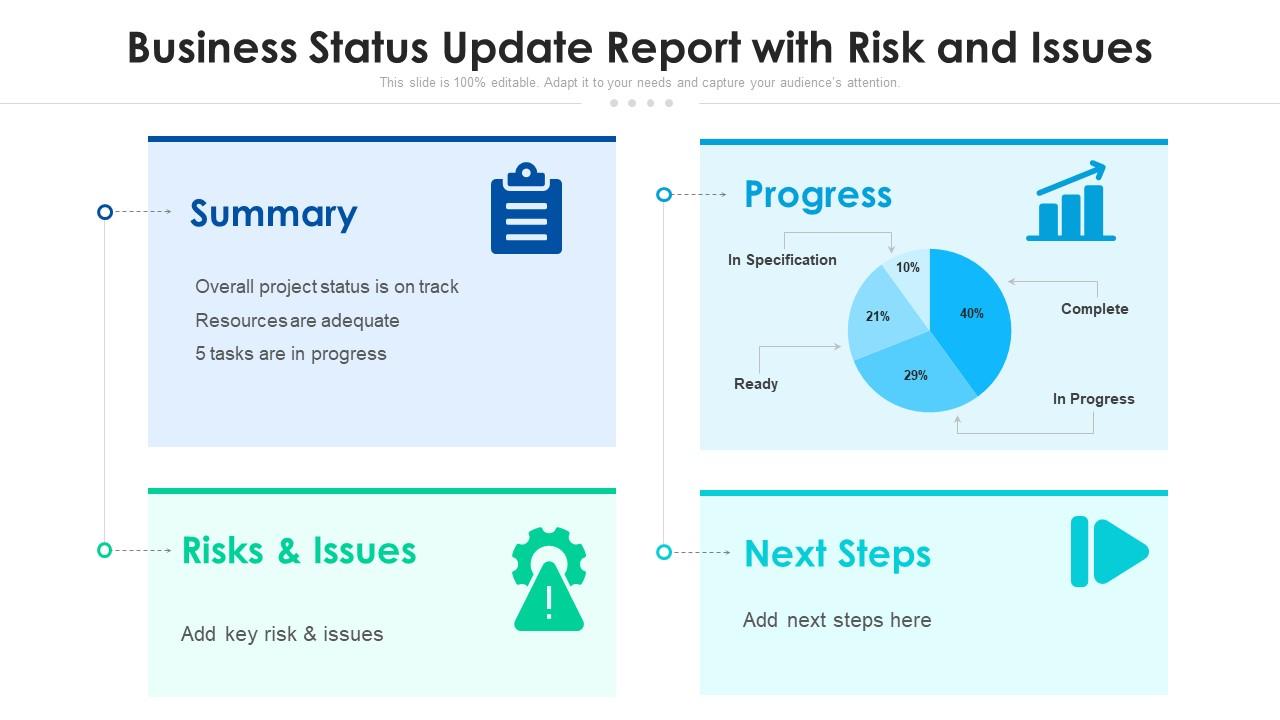
Business status update report with risk and issues
Try Before you Buy Download Free Sample Product
Audience
Editable
of Time
Our Business Status Update Report With Risk And Issues are topically designed to provide an attractive backdrop to any subject. Use them to look like a presentation pro.
People who downloaded this PowerPoint presentation also viewed the following :
Business status update report with risk and issues with all 2 slides:
Use our Business Status Update Report With Risk And Issues to effectively help you save your valuable time. They are readymade to fit into any presentation structure.
FAQs for Business status update report with
Start with your biggest number - revenue, users, whatever moves the needle most for your people. Then pick like 3-4 other things that actually matter: customer acquisition, retention rates, major launches or partnerships. I always include team stuff too since investors get weird about headcount changes. Cash flow is huge if you're fundraising obviously. Honestly, the hardest part is not dumping everything on them. Pick the metrics that tell a real story instead of just throwing numbers at the wall. Lead with what they care about most, then connect the dots. Keep it short or people zone out.
Definitely lead with the "why" - like what market stuff is pushing this change before you get into the nitty-gritty details. People absolutely hate being blindsided by direction changes, so give them tons of context upfront. Be super transparent about your reasoning. Concrete examples work way better than vague corporate speak (honestly, skip that entirely). Give real timelines so it doesn't feel pie-in-the-sky. Talk plainly about what this actually means for each team - they're probably already wondering how it'll affect them. Wrap up with clear next steps and make sure people know how to ask questions later.
Dude, visuals are seriously a lifesaver for status updates. Nobody wants to read through paragraphs of boring metrics - I learned this the hard way at my last job. Charts and graphs let people understand trends instantly instead of decoding walls of text. Even something basic like progress bars or before/after screenshots makes a huge difference. Your brain just processes visual stuff way better than text alone. Plus it actually makes people want to read your updates instead of skipping them. Honestly, it's one of those simple changes that'll make you look way more professional without much extra work.
Monthly updates are a solid baseline, but honestly it depends on who you're dealing with. Investors and board members? They'll want weekly or bi-weekly during crunch time. Other stakeholders can probably handle quarterly when things are cruising along. I've learned that people get way more annoyed by silence than by too much communication - nobody likes feeling out of the loop. Pick a schedule and actually stick to it. Share the good stuff AND the messy parts. Even when there's not much happening, send something. Trust me on this one.
Honestly, employee surveys are your best starting point - people will tell you straight up what's broken. Pull your financial reports too since numbers don't lie. Customer feedback is huge, whether that's through reviews or just reaching out directly. Those informal coffee chats with key people? Sometimes that's where you get the real tea. I always mix the hard data with the softer feedback - gives you the complete picture. Oh, and don't wait until the last minute. Give yourself at least two weeks to actually collect everything properly.
Don't just dump numbers on people - turn them into stories they actually care about. So instead of "sales up 15%," explain WHY it happened and what it means. Charts help too (way better than paragraphs of text, trust me). The real trick? Focus on the "so what" part. Like, that 15% boost means you can finally get budget approval for another developer. People need to see how the data connects to stuff that actually matters to them. Numbers alone are boring but outcomes hit different.
Honestly, just track the basics: how much work you're actually finishing vs what you planned, error rates, and whether deadlines are getting hit. Those tell the real story. I'd add some early warning stuff too - like how fast tasks are moving and what roadblocks pop up. That way you catch problems before they blow up. Don't get sucked into tracking a million things that sound impressive but are basically useless. Stick to maybe 3-4 metrics that actually matter for what your team's trying to accomplish right now.
Just tell them what's really going on - no corporate BS. Your stakeholders aren't idiots, they can handle bad news way better than vague nonsense. Tell them what you're actually doing to fix things and when they can expect to see changes (realistic timelines, not wishful thinking). Keep updating them regularly even if nothing's changed. Honestly, I've seen way too many people try to sugarcoat problems and it always blows up later. If you don't know something yet, just say so. Sounds counterintuitive but admitting you're figuring it out builds more trust than pretending you've got everything handled.
Start with the good stuff - seriously, people's attention spans are terrible these days. Throw in real numbers whenever you can because "we did great" means nothing but "sales up 15%" actually lands. When you get to the messy parts, call them "priorities" or whatever sounds less doom-and-gloom. Here's what works: tie your wins to the fix-it areas. Like "Q3 crushed our targets by 15%, so now we're working on faster shipping to keep up." Don't just dump problems on people. Always wrap up with actual next steps and dates so they know you're not just complaining into the void.
Oh man, this is like speaking two totally different languages! With investors, you gotta hit them with the money stuff first - ROI, growth numbers, all that financial jazz. But your team? They just want to know if their jobs are safe and how this affects their actual work day. I learned this the hard way honestly. Same info, but I basically rewrite everything depending on who's reading it. Investors get the "strategic business decisions" angle while employees get the "here's what changes for you" version. Just list your main points first, then flip the script for each audience.
Start with your biggest wins right up front - people need the headline first. I do achievements, then challenges, then what's coming next. Honestly, keep slides super visual because nobody wants to read while you're talking. Tell a story connecting your wins to actual business impact, not just vanity numbers. I always include one "this almost went sideways" moment because it keeps everyone awake and shows you're being honest about the messy parts. End with concrete next steps and what you actually need from them. Make it conversational - you want discussion, not everyone staring at their phones.
Honestly, automation is your best friend here. I'd start with project management tools like Asana or Monday - they pull real-time metrics without you having to dig around for data. Dashboard software like Tableau creates instant visual summaries too. Templates are clutch - set them up in Notion or even basic Google Sheets so your KPIs auto-populate. AI writing tools can draft the wordy parts if you're feeling lazy. The trick is connecting everything so you're not scrambling for numbers every single week. Oh, and identify your most-reported metrics first, then find tools that track those automatically. Trust me, it's worth the initial setup time.
Honestly, the worst thing you can do is bury your main points under a bunch of setup - just lead with what matters. Skip the vague stuff like "we're making progress" without any real numbers or dates. People hate that. Also don't sugarcoat everything - stakeholders will call you out if you're only sharing wins and hiding problems. Keep it short too, nobody wants to read a dissertation. Oh, and always end with actual next steps and deadlines so there's no confusion about what's happening when.
Shoot them a follow-up email within a day or two - recap the main points and decisions so nothing gets lost. Instead of that useless "any questions?" thing, ask about specific stuff that seemed confusing during your presentation. If you saw puzzled faces or pushback, grab those key people for quick one-on-ones. Oh, and definitely nail down next steps with actual owners and deadlines, otherwise it'll just fizzle out. I've seen so many good presentations die because people didn't follow through fast enough. You've got their attention now - don't waste it.
Here's the thing - when you use your brand colors and logo consistently in those business updates, people spot your stuff instantly. Even if they're scrolling fast. It makes you look way more legit too, especially when you're announcing big news or changes. Honestly, I think it's one of those small things that makes a huge difference. Your posts will probably perform better since social platforms love consistent branding (though who knows how their algorithms actually work). Just make a simple template with your colors and use it every time. Don't overcomplicate it.
-
Top Quality presentations that are easily editable.
-
Informative presentations that are easily editable.
-
Innovative and attractive designs.