


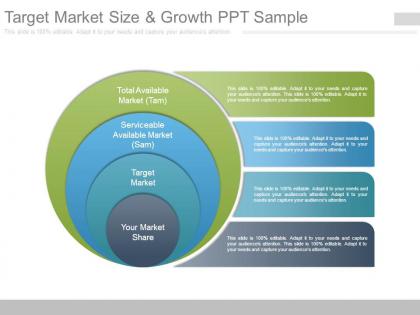
69707064 style cluster stacked 4 piece powerpoint presentation diagram infographic slide




Try Before you Buy Download Free Sample Product
 Impress Your
 Audience
 100%
100% Editable
 Save Hours
 of Time


Build belief that you can do it with our Target Market Size And Growth Ppt Sample. They are equipped with all the facilities.
69707064 style cluster stacked 4 piece powerpoint presentation diagram infographic slide with all 7 slides:
Elaborate on different ingredients with our Target Market Size And Growth Ppt Sample. Explain how to follow a balanced diet.
FAQs for 69707064 style cluster stacked 4 piece powerpoint presentation
Key demographics include age, gender, income level, education, geographic location, occupation, and family status, as these factors directly influence purchasing behavior and product preferences. Understanding these characteristics enables businesses to tailor their marketing strategies, product features, and pricing models effectively, with companies across retail, healthcare, and financial services finding that precise demographic targeting significantly enhances customer acquisition and retention rates.
Psychographic profiling enhances customer understanding by analyzing values, attitudes, lifestyles, interests, and personality traits beyond basic demographics. This deeper insight enables businesses to craft more targeted messaging, develop relevant products, and create personalized experiences that resonate emotionally, with many companies finding that psychographic data significantly improves conversion rates and customer loyalty.
Competitor analysis reveals market gaps, customer pain points, underserved segments, pricing strategies, and positioning opportunities that help define your ideal target market. By examining competitors' strengths and weaknesses across different customer segments, businesses can identify profitable niches, refine their value propositions, and strategically position themselves, ultimately delivering competitive advantage and enhanced market penetration.
Market segmentation strategies enhance marketing effectiveness by enabling personalized messaging, optimizing resource allocation, identifying high-value customer groups, and improving conversion rates through targeted campaigns. By dividing markets into distinct segments based on demographics, behavior, and preferences, companies like retail chains and financial services providers deliver more relevant experiences, reduce acquisition costs, and ultimately achieve higher ROI on marketing investments.
Target market research methods include surveys, focus groups, social media analytics, competitor analysis, and customer interviews. These approaches streamline market understanding by capturing consumer preferences, identifying behavioral patterns, and revealing market gaps, with many organizations finding that combining multiple methods delivers comprehensive insights and competitive advantage in increasingly dynamic markets.
Consumer behavior trends significantly influence target market analysis by revealing shifting preferences, purchasing patterns, digital engagement habits, and demographic priorities that reshape market segments. These evolving behaviors enable businesses to refine their targeting strategies, identify emerging opportunities, and adapt messaging approaches, with many companies finding that real-time behavioral insights deliver more precise market positioning and enhanced competitive advantage.
B2B target market analysis focuses on organizational needs, decision-making processes, company size, industry verticals, and procurement cycles, while B2C approaches emphasize individual demographics, psychographics, purchasing behaviors, and emotional triggers. B2B analysis requires deeper stakeholder mapping and longer sales cycle considerations, with companies like software providers analyzing enterprise requirements, whereas B2C brands examine consumer lifestyle patterns, ultimately delivering more targeted messaging and strategic market positioning.
Online analytics tools aid target market identification by tracking user demographics, behavioral patterns, engagement metrics, conversion data, and geographic distributions across digital touchpoints. These platforms enable businesses to segment audiences, analyze customer journeys, and identify high-value prospects through real-time data insights, ultimately delivering more precise marketing strategies and improved ROI for sustained competitive advantage.
Cultural factors significantly influence target market segmentation by shaping consumer preferences, purchasing behaviors, communication styles, and product perceptions across different demographic groups. These cultural dimensions enable businesses to create more targeted marketing strategies, develop culturally relevant products, and enhance customer engagement, with companies in retail, food services, and consumer goods finding that culturally-informed segmentation delivers higher conversion rates and stronger brand loyalty.
Businesses can effectively adjust their messaging by conducting thorough demographic research, analyzing cultural preferences, adapting communication channels, and personalizing value propositions for each segment. Through strategic market segmentation, companies in sectors like retail and financial services enhance customer engagement, improve conversion rates, and build stronger brand loyalty, ultimately delivering competitive advantage and increased market share.
Common mistakes include relying on assumptions rather than data, focusing too narrowly on demographics while ignoring psychographics, conducting one-time analysis instead of ongoing research, and failing to validate findings through customer feedback. These oversights can lead to misallocated resources and ineffective marketing strategies, with many companies finding that systematic, data-driven approaches ultimately deliver better customer insights and competitive positioning.
Social media insights refine target market profiles by revealing actual customer behaviors, preferences, demographics, engagement patterns, and content interactions across platforms. Through analytics tools and social listening, businesses can identify unexpected audience segments, track competitor followers, and discover emerging trends, ultimately enabling more precise targeting strategies and personalized marketing campaigns that resonate with authentic customer interests.
Validating target market hypotheses prevents costly campaign missteps by confirming audience preferences, messaging resonance, and channel effectiveness through testing and research. This strategic validation enables businesses to refine positioning, optimize resource allocation, and minimize risks, with many companies finding that pre-launch validation significantly improves campaign ROI and accelerates market penetration.
Geographical factors influence targeting strategy by affecting consumer preferences, purchasing power, climate-related needs, cultural practices, and distribution logistics. Through location-based data analysis, businesses can customize product offerings, pricing strategies, and marketing messages for specific regions, while optimizing supply chains and retail presence, ultimately delivering more relevant customer experiences and competitive market positioning.
Key metrics include conversion rates, customer acquisition cost, lifetime value, engagement rates, and return on ad spend. These indicators enable businesses to evaluate campaign performance, optimize resource allocation, and refine audience segmentation strategies, with many organizations finding that continuous monitoring across multiple touchpoints ultimately delivers improved ROI and sustainable competitive advantage.
-
Unique research projects to present in meeting.
-
Use of different colors is good. It's simple and attractive.