


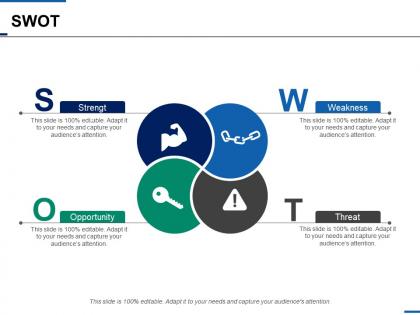
90350666 style concepts 1 strength 4 piece powerpoint presentation diagram infographic slide




Try Before you Buy Download Free Sample Product
 Impress Your
Audience
 100%
Editable
 Save Hours
of Time


Our Swot Opportunity Ppt Inspiration Professional put your success first and foremost. Your achievements are their abiding concern.
90350666 style concepts 1 strength 4 piece powerpoint presentation diagram infographic slide with all 5 slides:
Our Swot Opportunity Ppt Inspiration Professional leave your brain free to think. They absorb every other burden.


FAQs for 90350666 style concepts 1 strength 4 piece powerpoint presentation
SWOT analysis includes Strengths, Weaknesses, Opportunities, and Threats that organizations assess to develop strategic direction. These components interrelate by enabling businesses to leverage internal strengths against external opportunities, address weaknesses before they become vulnerabilities, and mitigate threats, with many companies finding that this strategic combination ultimately delivers competitive advantage and informed decision-making.
Organizations effectively identify internal strengths through comprehensive resource audits, employee feedback surveys, performance metric analysis, competitive benchmarking, and stakeholder interviews. This systematic approach enables companies across sectors like manufacturing, healthcare, and financial services to uncover competitive advantages in operations, talent, technology, and market position, ultimately delivering strategic clarity and enhanced resource allocation for sustainable growth.
Businesses can leverage weaknesses by conducting thorough assessments, implementing targeted training programs, reallocating resources strategically, and forming partnerships to address capability gaps. This systematic approach transforms operational deficiencies into competitive advantages, with many organizations finding that addressing internal challenges through strategic planning ultimately enhances market positioning and operational efficiency.
External opportunities within SWOT frameworks serve as catalysts for strategic expansion, market entry, technological adoption, partnership formation, and competitive positioning decisions. These opportunities, whether emerging in new markets, regulatory changes, or industry shifts, enable organizations to leverage their strengths while addressing weaknesses, with many companies finding that systematic opportunity assessment ultimately delivers accelerated growth and sustainable competitive advantage.
Companies should address SWOT threats through proactive risk mitigation strategies, competitive positioning adjustments, and strategic planning modifications that transform challenges into opportunities. By developing contingency plans, strengthening core competencies, and leveraging identified strengths, organizations can minimize threat impact while building resilience, ultimately delivering enhanced market positioning and sustained competitive advantage in increasingly dynamic business environments.
SWOT analysis proves highly beneficial for startups by identifying internal strengths and weaknesses alongside external opportunities and threats, enabling strategic resource allocation and risk mitigation. Startups should approach it by conducting regular quarterly assessments, involving diverse team perspectives, and using insights to pivot business models, secure funding, and establish competitive positioning in rapidly evolving markets.
Organizations should conduct comprehensive SWOT analyses annually, with quarterly reviews of key findings and immediate assessments during major market shifts, mergers, or strategic pivots. This strategic combination enables businesses to adapt swiftly to competitive pressures, regulatory changes, and emerging opportunities, with many industry leaders finding that regular analysis ultimately delivers enhanced agility and sustained competitive advantage.
Common SWOT analysis pitfalls include being overly subjective, focusing only on internal perspectives, using vague generalities, failing to prioritize findings, and conducting analysis without sufficient data. Organizations increasingly find that involving diverse stakeholders, validating assumptions with market research, and translating insights into actionable strategies helps avoid these mistakes, ultimately delivering more strategic value and competitive advantage.
Visual aids like presentation templates enhance SWOT analysis clarity by organizing complex information into structured quadrants, using color coding for immediate recognition, and incorporating charts that highlight key strategic insights. These templates enable teams to present findings more effectively to stakeholders, streamline decision-making processes, and create compelling narratives around strategic positioning, with many organizations finding that visual presentations significantly improve comprehension and strategic alignment.
Industries with complex competitive landscapes benefit most from detailed SWOT analysis, including healthcare, financial services, technology, retail, manufacturing, and telecommunications. These sectors face rapid market changes, regulatory pressures, and intense competition, with many organizations finding that comprehensive SWOT analysis enables strategic pivoting, identifies emerging opportunities, and strengthens competitive positioning in increasingly dynamic business environments.
SWOT analysis focuses internally on organizational strengths and weaknesses while examining external opportunities and threats, whereas PESTLE analyzes broader macro-environmental factors and Porter's Five Forces evaluates competitive industry dynamics. While PESTLE helps organizations understand political, economic, and social landscapes, and Porter's framework assesses competitive positioning, SWOT delivers a comprehensive internal-external perspective that enables strategic alignment, ultimately providing businesses with actionable insights for resource allocation and competitive advantage.
Teams can collaborate effectively during SWOT analysis through structured brainstorming sessions, cross-functional workshops, anonymous input collection, and rotating discussion leadership to ensure balanced participation. These approaches enable organizations to capture comprehensive insights from sales, operations, finance, and customer service perspectives, while digital collaboration tools facilitate real-time input gathering, ultimately delivering more strategic and actionable analysis outcomes.
Actionable SWOT strategies include leveraging strengths to exploit opportunities, addressing weaknesses through training or technology upgrades, using strengths to mitigate threats, and converting weaknesses into opportunities through strategic partnerships. For example, a retail company might use strong brand recognition to enter new markets, while banks often address cybersecurity weaknesses by implementing advanced threat detection systems, ultimately delivering competitive advantage and operational resilience.
Technology tools streamline SWOT analysis by automating data collection, enabling real-time collaboration, and providing visual dashboards for strategic insights. Through cloud-based platforms and AI-powered analytics, organizations enhance decision-making speed, improve cross-departmental input accuracy, and generate comprehensive reports, with many enterprises finding that digital SWOT tools deliver faster strategic planning and competitive advantage.
SWOT analysis supports long-term strategic planning by providing a comprehensive framework for evaluating internal strengths, weaknesses, external opportunities, and threats over extended timeframes. This systematic approach enables organizations to develop multi-year strategies, anticipate market shifts, allocate resources strategically, and establish measurable goals, with many enterprises finding that regular SWOT reviews enhance competitive positioning and sustainable growth planning.
No Reviews