


Cloud Based Services Cloud Computing In Finance Industry Ppt Summary Smartart





Try Before you Buy Download Free Sample Product
 Impress Your
Audience
 100%
Editable
 Save Hours
of Time


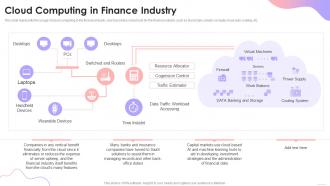
This slide represents the usage of cloud computing in the finance industry, and it provides many tools for the finance industry such as blockchain, elastic compute cloud auto-scaling, etc.
Cloud Based Services Cloud Computing In Finance Industry Ppt Summary Smartart with all 6 slides:
Use our Cloud Based Services Cloud Computing In Finance Industry Ppt Summary Smartart to effectively help you save your valuable time. They are readymade to fit into any presentation structure.





FAQs for Cloud Based Services Cloud Computing In Finance Industry
Cloud computing delivers enhanced scalability, cost reduction, improved security, regulatory compliance, and accelerated innovation for financial institutions. Through cloud infrastructure, banks and investment firms streamline operations, enable real-time data analytics, and provide faster customer services, while reducing IT overhead costs and maintaining robust cybersecurity, ultimately delivering competitive advantage in an increasingly digital financial landscape.
Cloud computing enhances financial data security through advanced encryption, multi-factor authentication, automated threat detection, and continuous monitoring systems that exceed traditional on-premise capabilities. These cloud-based security frameworks enable banks and financial institutions to achieve regulatory compliance more efficiently, reduce operational costs, and deliver faster, more secure customer services while maintaining the stringent data protection standards required in today's increasingly regulated financial landscape.
Cloud solutions enhance customer experience in banking through real-time transaction processing, personalized mobile applications, 24/7 service availability, seamless omnichannel interactions, and instant account access across devices. These technologies streamline operations by reducing system downtime, accelerating loan approvals, and enabling faster payment processing, with many financial institutions finding that cloud infrastructure ultimately delivers improved response times and more intuitive customer touchpoints.
Financial organizations face challenges including regulatory compliance complexities, data security concerns, legacy system integration difficulties, cost management issues, and staff training requirements when migrating to cloud platforms. While these obstacles require careful planning and strategic investment, many banks and financial institutions find that phased migration approaches, robust security frameworks, and comprehensive staff development programs ultimately deliver enhanced operational efficiency, reduced infrastructure costs, and improved customer experiences in an increasingly digital financial landscape.
Cloud computing supports finance operations scalability by providing elastic infrastructure, automated resource allocation, and on-demand processing power that adapts to fluctuating workloads, transaction volumes, and regulatory requirements. Through cloud platforms, financial institutions streamline operations during peak periods like month-end reporting or market volatility, while minimizing costs during lower-demand cycles, ultimately delivering enhanced operational efficiency and competitive responsiveness.
Cloud computing serves as the foundational infrastructure enabling fintech innovations through scalable data processing, real-time analytics, API integrations, and rapid deployment capabilities. These technologies streamline financial services by reducing development costs, accelerating time-to-market, and enhancing security protocols, with many fintech startups finding that cloud platforms ultimately deliver competitive advantages and seamless customer experiences.
Cloud computing facilitates real-time analytics by providing scalable processing power, instant data access, and automated computational resources that traditional systems cannot match. Through cloud infrastructure, financial institutions can analyze market data, assess risk portfolios, and execute trades within milliseconds, while reducing operational costs and enhancing competitive positioning in volatile markets.
Cloud technology significantly reduces operational costs in financial services by eliminating expensive on-premise infrastructure, enabling pay-as-you-scale models, and streamlining maintenance expenses. Banks and investment firms increasingly find that cloud adoption delivers 20-30% cost reductions through automated processes, reduced IT overhead, and enhanced resource efficiency, ultimately freeing capital for strategic growth initiatives.
Cloud computing transforms financial regulatory compliance by enabling real-time monitoring, automated reporting, and enhanced data transparency across institutions. Through cloud-based regulatory technology solutions, banks and financial services streamline audit processes, accelerate compliance reporting, and maintain comprehensive transaction records, while reducing operational costs and improving regulatory responsiveness in an increasingly complex landscape.
Financial firms can ensure cloud resilience through multi-cloud deployment, automated failover systems, real-time monitoring, regular disaster recovery testing, and geographically distributed data centers. These strategies enable banks and investment firms to maintain continuous operations during outages, minimize service disruptions, and deliver consistent customer experiences, while ultimately reducing downtime costs and strengthening competitive positioning in increasingly digital financial markets.
Cloud-based platforms modernize finance by replacing outdated infrastructure with scalable, flexible architectures that integrate seamlessly with existing workflows, reduce maintenance costs, and enable real-time data processing. Banks and financial institutions leverage these solutions to accelerate digital transformation, enhance regulatory compliance, and deliver faster customer services, ultimately gaining competitive advantage in an increasingly digital marketplace.
Cloud computing transforms financial risk management by enabling real-time data analytics, automated compliance monitoring, enhanced cybersecurity protocols, and scalable disaster recovery systems. While presenting data sovereignty and regulatory compliance challenges, it ultimately delivers faster threat detection, improved operational resilience, and cost-effective risk mitigation, with many financial institutions finding that cloud-based solutions significantly enhance their ability to respond to emerging risks.
Traditional banks approach cloud adoption cautiously due to regulatory compliance, legacy system integration, and risk management concerns, often implementing hybrid solutions gradually. Fintech companies embrace cloud-first strategies from inception, leveraging scalability and agility for rapid innovation, with many finding that this technological advantage enables faster product development, reduced operational costs, and enhanced customer experiences in competitive markets.
The finance industry should prepare for multi-cloud strategies, edge computing, serverless architectures, AI-powered cloud services, and enhanced regulatory compliance tools. These emerging trends enable financial institutions to achieve greater operational flexibility, reduce latency in trading systems, and streamline customer experiences, while maintaining robust security standards and ultimately delivering competitive advantages in an increasingly digital financial landscape.
Cloud technologies enable financial institutions to collaborate through shared platforms, real-time data exchange, standardized APIs, secure multi-party networks, and integrated compliance frameworks. These solutions streamline joint ventures, regulatory reporting, and cross-institutional services by reducing operational silos, accelerating transaction processing, and enhancing transparency, with many banks and credit unions finding that cloud-based partnerships deliver faster innovation and improved customer experiences.
-
SlideTeam has helped me take my presentation to the next level. Everyone at the office is impressed! I’ll be using their designs for a long-long time.
-
Use of icon with content is very relateable, informative and appealing.