

BYOD Lost Stolen Hacked Or Damaged Equipment Information Technology Policy




Try Before you Buy Download Free Sample Product
 Impress Your
Audience
 100%
Editable
 Save Hours
of Time


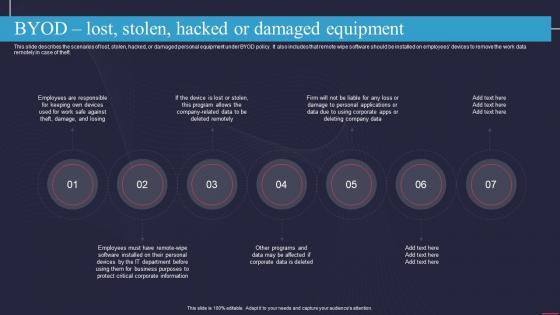
This slide describes the scenarios of lost, stolen, hacked, or damaged personal equipment under BYOD policy. It also includes that remote wipe software should be installed on employees devices to remove the work data remotely in case of theft.
People who downloaded this PowerPoint presentation also viewed the following :
BYOD Lost Stolen Hacked Or Damaged Equipment Information Technology Policy with all 6 slides:
Use our BYOD Lost Stolen Hacked Or Damaged Equipment Information Technology Policy to effectively help you save your valuable time. They are readymade to fit into any presentation structure.






FAQs for BYOD Lost Stolen Hacked Or Damaged Equipment
Effective BYOD policies include device security requirements, data encryption standards, access controls, acceptable use guidelines, and incident response procedures. These components work together by establishing clear boundaries for personal device usage, protecting sensitive organizational data, and ensuring compliance with industry regulations, ultimately enabling workforce flexibility while maintaining robust security and operational control.
Organizations ensure BYOD data security through mobile device management (MDM) solutions, encryption protocols, multi-factor authentication, and network segmentation. These technologies enable IT teams to remotely monitor device compliance, enforce security policies, and isolate corporate data from personal applications, with many financial services and healthcare institutions finding that strategic implementation delivers enhanced productivity while maintaining regulatory compliance and minimizing breach risks.
Employee training plays a critical role in BYOD policy success by ensuring employees understand security protocols, acceptable usage guidelines, data protection requirements, and compliance standards. Comprehensive training programs help organizations minimize security breaches, reduce policy violations, and maintain regulatory compliance, with many companies finding that well-trained employees become active partners in protecting corporate data while maximizing productivity benefits.
Businesses balance BYOD productivity and security through comprehensive mobile device management (MDM), clear usage policies, network segmentation, and regular security training. Strategic implementation includes containerizing corporate data, enforcing encryption protocols, and establishing remote wipe capabilities, with many organizations finding that this balanced approach enhances employee satisfaction while maintaining robust data protection and operational efficiency.
BYOD policies present both legal challenges and opportunities regarding employee privacy, including data ownership disputes, monitoring boundaries, consent requirements, compliance with privacy regulations, and liability concerns during security breaches. While organizations must balance legitimate business interests with employee rights, many companies find that transparent policies, clear consent frameworks, and strategic legal guidance ultimately deliver stronger compliance and employee trust.
Organizations should establish structured protocols for device registration, security app installation, policy acknowledgment, and network access configuration during onboarding, while ensuring complete data removal, access revocation, and compliance verification during offboarding. These comprehensive processes streamline device management by automating security configurations, maintaining detailed audit trails, and protecting corporate data, with many enterprises finding that standardized workflows ultimately reduce IT overhead while ensuring regulatory compliance.
**INPUT**: What technologies can support the management of personal devices in the workplace? **OUTPUT**: Technologies supporting workplace personal device management include Mobile Device Management (MDM), Mobile Application Management (MAM), Enterprise Mobility Management (EMM), cloud-based security platforms, and zero-trust network access solutions. These technologies streamline device oversight by automating security updates, controlling app access, and monitoring compliance across diverse operating systems, with many organizations finding that integrated EMM platforms ultimately deliver enhanced productivity while maintaining robust data protection and operational efficiency. [Word count: 60 words]
A BYOD policy significantly enhances employee morale by providing flexibility, convenience, and familiarity with personal devices, while reducing frustration from restrictive IT environments. Through strategic implementation, organizations enable greater work-life balance, faster task completion, and increased autonomy, with many companies finding that employees report higher job satisfaction and engagement levels, ultimately delivering improved retention and productivity.
Organizations should implement remote wipe capabilities, mandatory device encryption, multi-factor authentication, and automatic screen locks with short timeout periods. These security measures work alongside employee training programs and incident reporting protocols, with many companies finding that combining technical safeguards with clear response procedures significantly reduces data exposure risks while maintaining operational continuity.
Companies address compatibility issues through mobile device management (MDM) solutions, cloud-based applications, virtual desktop infrastructure, and standardized app stores. These technologies streamline integration by ensuring consistent security protocols, enabling cross-platform access, and providing centralized application delivery, with many organizations finding that hybrid approaches ultimately deliver seamless user experiences while maintaining operational efficiency.
BYOD policies should include device registration requirements, mandatory security software installation, data encryption standards, regular security updates, and clear data access controls. These practices ensure regulatory compliance by establishing audit trails, protecting sensitive information, and defining incident response procedures, with many organizations finding that comprehensive policies reduce security risks while maintaining employee productivity and operational flexibility.
A BYOD policy significantly transforms IT support by requiring expanded device management, enhanced security protocols, and diversified technical expertise across multiple platforms and operating systems. While this initially increases support complexity and resource allocation, organizations ultimately streamline operations through automated management tools and self-service portals, with many enterprises finding reduced hardware costs and improved employee satisfaction offset the additional support investments.
Common BYOD misconceptions include believing it eliminates all security risks, reduces IT costs immediately, requires minimal management oversight, works equally well for all industries, and automatically boosts productivity. While BYOD delivers flexibility and employee satisfaction, organizations must invest in robust security frameworks, comprehensive device management platforms, and ongoing training programs, with many enterprises finding that strategic implementation ultimately enhances operational efficiency and competitive advantage.
Businesses can measure BYOD policy effectiveness through security metrics like incident rates and compliance scores, productivity indicators such as employee satisfaction and task completion times, and cost analyses comparing device expenses and IT support requirements. Regular surveys, security audits, and performance tracking enable organizations to identify areas for improvement, optimize resource allocation, and demonstrate ROI while ensuring policies evolve with changing technology needs.
Industry standards like ISO 27001, NIST frameworks, and GDPR compliance requirements provide foundational security guidelines, data protection protocols, and risk management structures that organizations integrate into comprehensive BYOD policies. These standards enable companies to establish consistent device management, encryption requirements, and access controls across sectors like healthcare, finance, and retail, ultimately delivering regulatory compliance and competitive security positioning.
-
SlideTeam is my one-stop destination for templates. Highly recommended!
-
Fantastic collection of visually appealing PowerPoint templates. They certainly uplift the look of the presentation.