

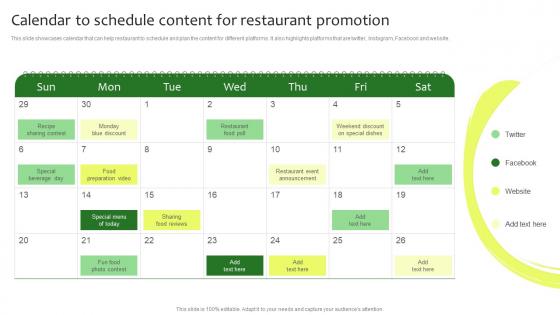
Calendar To Schedule Content For Restaurant Promotion Online Promotion Plan For Food Business




Try Before you Buy Download Free Sample Product
 Impress Your
 Audience
 100%
100% Editable
 Save Hours
 of Time


This slide showcases calendar that can help restaurant to schedule and plan the content for different platforms. It also highlights platforms that are twitter, Instagram, Facebook and website.
People who downloaded this PowerPoint presentation also viewed the following :
Calendar To Schedule Content For Restaurant Promotion Online Promotion Plan For Food Business with all 6 slides:
Use our Calendar To Schedule Content For Restaurant Promotion Online Promotion Plan For Food Business to effectively help you save your valuable time. They are readymade to fit into any presentation structure.





FAQs for Calendar To Schedule Content For Restaurant Promotion Online Promotion Plan
Key components of an effective content calendar include content themes, publishing schedules, platform specifications, audience targeting parameters, and performance tracking metrics. These elements work together by streamlining content planning, ensuring consistent brand messaging, and optimizing resource allocation, with many marketing teams finding that strategic calendar implementation ultimately delivers improved engagement rates and measurable ROI across channels.
Content calendars should be reviewed weekly for immediate adjustments and updated monthly for strategic planning, with quarterly comprehensive reviews ensuring long-term alignment with business goals. Many marketing teams find that this tiered approach enables them to respond quickly to trending topics, seasonal opportunities, and campaign performance data, while maintaining strategic consistency and ultimately delivering more engaging, timely content that drives better audience engagement.
Content calendar management tools include Hootsuite, Buffer, CoSchedule, Asana, Trello, Monday.com, and Sprout Social, each offering scheduling capabilities, collaborative workflows, and analytics integration. These platforms streamline operations by automating posting schedules, enabling team collaboration, and providing performance tracking, with many marketing teams finding that centralized calendar management ultimately delivers improved content consistency and enhanced campaign coordination across multiple channels.
A content calendar improves marketing strategy by ensuring consistent messaging, optimizing resource allocation, and enabling strategic campaign alignment across multiple channels and touchpoints. Through systematic content planning, organizations streamline their marketing operations, enhance audience engagement, and maximize campaign effectiveness, with many companies finding that coordinated content scheduling ultimately delivers measurable ROI improvements and stronger brand positioning.
A diverse content calendar should include educational blog posts, engaging social media content, video tutorials, case studies, infographics, webinars, and email newsletters. These content types work together by addressing different audience preferences, learning styles, and engagement patterns, with many organizations finding that this strategic combination enhances brand visibility, drives customer engagement, and ultimately delivers stronger market positioning.
Seasonal events significantly influence content calendar planning by driving timing strategies, campaign themes, audience engagement patterns, and resource allocation priorities. Many organizations align their content with holidays, industry conferences, back-to-school periods, and fiscal year cycles, ultimately delivering higher engagement rates and stronger market relevance while maximizing seasonal purchasing behaviors and audience attention peaks.
Audience engagement serves as a critical foundation for content calendar creation, informing content themes, posting frequency, optimal timing, and platform selection based on when and how your audience interacts. By analyzing engagement patterns, comments, shares, and response rates, content creators can strategically schedule posts during peak activity periods, ultimately delivering higher visibility, stronger community building, and improved content performance across all channels.
**INPUT**: How can I effectively schedule multimedia content alongside written articles? **OUTPUT**: Effective multimedia scheduling involves mapping content types to audience engagement patterns, platform algorithms, and production timelines, while maintaining consistent messaging across formats. Strategic sequencing, such as teaser videos before article releases or infographic summaries afterward, amplifies reach and reinforces key messages, with many organizations finding that coordinated multimedia campaigns deliver significantly higher engagement rates. **Word count: 58 words**
Common content calendar pitfalls include overambitious scheduling, neglecting audience preferences, ignoring seasonal trends, lacking content variety, and failing to allocate buffer time for revisions. Many marketing teams find that rigid planning without flexibility, insufficient collaboration between departments, and overlooking performance analytics ultimately leads to inconsistent messaging and missed engagement opportunities across campaigns.
Align your content calendar with business goals by mapping content themes to specific objectives, tracking relevant KPIs, incorporating seasonal campaigns and product launches, and regularly reviewing performance metrics. Through strategic planning, businesses streamline marketing efforts, enhance brand messaging consistency, and drive measurable outcomes like lead generation and customer engagement, ultimately delivering improved ROI and competitive advantage.
Key metrics include engagement rates, website traffic, lead generation, conversion rates, and audience growth across platforms. These measurements enable organizations to optimize content strategy by identifying high-performing topics, refining posting schedules, and allocating resources more effectively, with many businesses finding that consistent tracking ultimately delivers improved ROI and stronger competitive positioning.
A content calendar enhances team collaboration by centralizing project timelines, assigning clear responsibilities, tracking content progress, and establishing unified deadlines across departments. Through shared visibility and structured workflows, marketing teams, designers, and content creators can coordinate seamlessly, avoid duplicated efforts, and maintain consistent messaging, ultimately delivering more cohesive campaigns and improved productivity.
Content repurposing strategies include transforming blog posts into social media series, converting webinars into podcast episodes, breaking down comprehensive guides into infographic sequences, and adapting presentations into video tutorials. These approaches streamline content production by maximizing each asset's value across multiple channels, with many marketing teams finding that strategic repurposing reduces creation time while expanding audience reach and engagement.
Incorporate user-generated content by scheduling dedicated UGC campaigns, featuring customer testimonials, showcasing social media mentions, running hashtag contests, and highlighting product reviews within your calendar framework. This strategic approach enhances authenticity and engagement while reducing content creation workload, with many brands finding that UGC drives significantly higher conversion rates and builds stronger community connections.
Visual content calendars enhance planning through drag-and-drop functionality, color-coded categorization, real-time collaboration features, and intuitive timeline views that traditional spreadsheets cannot match. These visual tools streamline workflow management by enabling faster content adjustments, clearer campaign visualization, and improved team coordination, with many marketing teams finding that visual calendars reduce planning time while delivering better strategic oversight.
-
Visually stunning presentation, love the content.
-
Helpful product design for delivering presentation.