

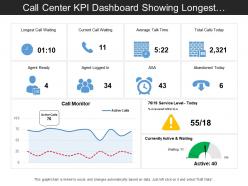
Call center kpi dashboard showing longest call waiting and average talk time





Try Before you Buy Download Free Sample Product
 Impress Your
Audience
 100%
Editable
 Save Hours
of Time


Our Call Center Kpi Dashboard Showing Longest Call Waiting And Average Talk Time keep it crackling. Everyone will be bubbling with excitement.
People who downloaded this PowerPoint presentation also viewed the following :
Call center kpi dashboard showing longest call waiting and average talk time with all 6 slides:
Our Call Center Kpi Dashboard Showing Longest Call Waiting And Average Talk Time excel at giving good cues. Ensure you don't forget important elements.


FAQs for Call center kpi dashboard showing longest call waiting and
Honestly, just focus on four key ones to start. First Call Resolution shows if your team's actually fixing stuff, not just taking calls. Customer Satisfaction is obvious - gotta know if people are happy. Average Handle Time keeps things moving without making agents rush through calls like they're at a drive-thru. And Service Level tells you if you're picking up fast enough that customers aren't hanging up pissed off. Those four will give you a really solid picture of what's happening. You can always add more metrics later once you've got these down pat.
Yeah so AHT and FCR are always fighting each other, but they both mess with your customer satisfaction big time. Rush through calls to hit lower AHT? Your first call resolution goes to hell because agents aren't actually solving anything. Take too long though and customers sit there thinking you're incompetent or whatever. I've seen teams obsess over just one metric and it backfires every time. You want agents spending enough time to actually fix the problem on round one - nobody wants to call support three times for the same stupid issue. Coach them to be quick but thorough, and definitely track both metrics together.
CSAT's basically your gut check on whether customers actually liked dealing with your agents. Sure, you might have killer handle times and resolution rates, but if people hang up pissed off? Those numbers are pretty useless. What I love about it is it captures the human stuff - was your agent actually helpful, did they get it, could they fix the problem without being a robot about it. Most places shoot for 80%+ but honestly that feels low to me. Track it with your other metrics and when it dips, dig into what went wrong. Usually reveals some good coaching moments.
Track the obvious stuff first - calls per hour, handle time, first-call resolution. But here's the thing: those numbers can totally fool you if agents are just rushing people off the phone. You need customer satisfaction scores too, plus quality ratings from supervisors. I learned this the hard way at my last job - our "top performer" had amazing speed but customers hated him. Set up real-time dashboards so people can see their own stats. Way better for coaching than waiting for monthly reviews to drop the bad news on them.
So NPS measures if customers would recommend your service after calling in. Scale goes from -100 to +100 - anything over 50 is pretty good. The cool thing? It captures the emotional stuff, not just whether you solved their problem. Like, did they actually feel good about the experience or whatever. You can track which agents are creating fans versus people who hate you. Honestly, it's way more useful than those basic satisfaction surveys. Just measure it consistently after calls and you'll see patterns in how your team's really performing. Short answer: it shows actual customer loyalty.
Honestly, the trick is picking KPIs that don't make everyone miserable. Skip the call volume stuff - that just creates panic. Focus on quality scores and customer satisfaction instead since those actually show your team they're doing meaningful work. Make everything visible on team dashboards so people can track their own progress and celebrate together when things go well. Oh, and definitely get your agents involved in setting the targets. When people understand what they're being measured on AND feel like they can actually control those numbers, that's when you'll see real engagement. It's pretty simple but works.
Data silos are gonna be your biggest headache - nothing talks to each other properly. Plus everyone defines "resolved" differently, which is super annoying when you're trying to get consistent numbers. Oh, and agents will totally game the system once they figure out what you're tracking (honestly can't blame them though). Start by auditing where your data actually lives right now. Get all your platforms talking to each other somehow. Define your KPIs really clearly so there's no confusion. Here's the thing - if you involve agents in why you're measuring stuff, they're way less likely to mess with it. Focus on outcomes, not just busy work metrics.
So SLAs are basically the promises you make to customers - like "we'll answer 80% of calls in 20 seconds." KPIs track if you're actually hitting those targets. Your average speed of answer, first call resolution, abandon rate? They all connect back to whatever you committed to. Missing SLA targets sucks because customers definitely notice when you're not delivering. I learned this the hard way at my last job - we got complacent about monitoring our metrics. Track your KPIs constantly so you catch problems early before they snowball into bigger issues.
Honestly, data analytics is a game-changer for tracking KPIs. Instead of waiting around for those end-of-day reports, you get real-time dashboards that show what's happening right now. Super helpful for catching weird patterns - like when your handle times randomly spike every Tuesday at 2pm (trust me, these things happen). You can actually dig into the "why" behind your numbers and see how different metrics connect. Set up alerts when things hit certain levels so you're not constantly watching screens. My advice? Don't go crazy trying to implement everything at once. Pick one or two tools first.
Yeah, there's definitely a connection there - when abandonment rates spike, customer satisfaction basically falls off a cliff. People hate waiting on hold forever, so they hang up pissed off and ready to blast you in reviews or jump ship to competitors. The numbers are pretty brutal too: every 1% bump in abandonment usually kills your satisfaction scores by 2-3%. Plus you're missing all those chances to actually fix their problems, which just makes everything worse later. I'd say keep it under 5% if you can swing it. Oh, and track both metrics together - you'll see exactly how bad the damage gets.
Honestly, ditch the annual averages and go seasonal instead. Peak times? Focus on abandonment rates and queue times - handle time will naturally be longer anyway since customers are stressed and calls get messy. Holidays are the absolute worst for this stuff. When things slow down though, that's when you can be pickier about quality scores and actually get some training done. I'd create different scorecards for each season so you're not comparing December madness to quiet February. Oh, and start tracking these patterns now if you aren't already - you'll need that data to set targets that don't make everyone miserable.
Honestly, tech upgrades usually boost your KPIs pretty well once everything settles. Handle times drop with better CRM systems, first-call resolution jumps like 15-30% typically. Customer satisfaction goes up too since agents actually have decent tools to work with. But here's the thing - during rollout, your metrics will probably look terrible for a bit. Everyone's learning the new system and fumbling around. I'd wait about 3 months before setting new benchmarks instead of freaking out over the temporary dip. Oh, and knowledge bases make a huge difference too.
Dude, forget just tracking speed - you need industry-specific stuff. Healthcare? Track patient satisfaction, HIPAA compliance, clinical accuracy. Finance means watching regulatory stuff, fraud detection, how fast you solve account issues. Call volume still matters but honestly it's pretty worthless without the specialized metrics. Here's the thing - compliance violations will cost you way more than slow call times ever will. Weight those compliance numbers heavily on your dashboard. Oh, and start with your industry's top 3 regulatory requirements. Build everything around those first.
Honestly, getting too obsessed with specific KPIs can backfire hard. Your agents start rushing people off calls to hit their average handle time - but then customers don't actually get helped, which is kinda the opposite of what you want. I've seen teams where people just game the system instead of focusing on real work. It creates this weird tunnel vision too. They're so focused on one number that customer satisfaction goes out the window. The trick is tracking multiple things at once and actually checking if your metrics are pushing people toward the right behaviors. Otherwise you're just measuring for the sake of measuring.
Dude, this is huge and so many managers totally miss it. Your team will either game the system or just ignore the numbers if they don't get what they mean. I've watched call centers where agents obsessed over volume while customers got increasingly pissed - nobody bothered explaining how everything connects. Monthly KPI sessions work well. Walk through the trends, explain why each metric matters for the bigger picture. Let people ask questions about their numbers too. Otherwise you'll have staff hitting targets that don't actually help the business at all.
-
Graphics are very appealing to eyes.
-
Great quality product.