

Campaign sessions and conversion performance dashboard reshaping product marketing campaign




Try Before you Buy Download Free Sample Product
 Impress Your
 Audience
 100%
100% Editable
 Save Hours
 of Time


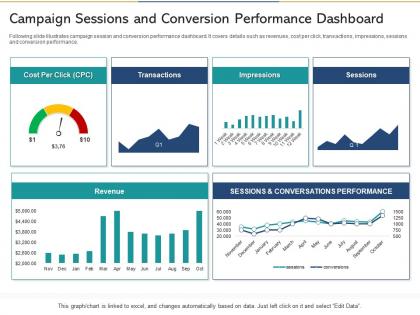
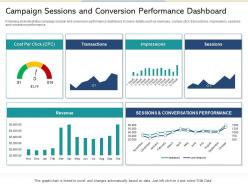
Following slide illustrates campaign session and conversion performance dashboard. It covers details such as revenues, cost per click, transactions, impressions, sessions and conversion performance.
People who downloaded this PowerPoint presentation also viewed the following :
Campaign sessions and conversion performance dashboard reshaping product marketing campaign with all 2 slides:
Use our Campaign Sessions And Conversion Performance Dashboard Reshaping Product Marketing Campaign to effectively help you save your valuable time. They are readymade to fit into any presentation structure.
FAQs for Campaign sessions and conversion performance dashboard reshaping
A comprehensive campaign performance dashboard should include conversion rates, click-through rates, cost per acquisition, return on ad spend, and engagement metrics across channels. These metrics enable marketing teams to optimize budget allocation, identify high-performing segments, and adjust targeting strategies in real-time, ultimately delivering improved ROI and more effective customer acquisition campaigns.
Real-time data visualization enhances campaign management decision-making by providing instant performance insights, identifying emerging trends, and enabling rapid strategic adjustments through interactive dashboards and automated alerts. Marketing teams can quickly pivot underperforming campaigns, reallocate budgets to high-converting channels, and optimize messaging in real-time, ultimately delivering improved ROI and competitive advantage.
Marketing automation platforms like HubSpot and Marketo, analytics tools including Google Analytics and Adobe Analytics, social media management systems, CRM platforms, and business intelligence software can integrate seamlessly into campaign performance dashboards. These integrations streamline data collection, enhance real-time visibility, and automate comprehensive reporting across channels, ultimately delivering faster insights and improved campaign optimization for marketing teams.
The ideal frequency depends on campaign duration, budget velocity, and stakeholder needs, with real-time updates for high-spend campaigns and daily or weekly updates for longer initiatives. Many marketing teams find that aligning dashboard refresh rates with decision-making cycles—hourly for active optimizations, daily for budget adjustments—ultimately delivers better resource allocation and faster campaign pivots.
Marketers face challenges including data fragmentation across multiple platforms, attribution complexity in multi-touch customer journeys, real-time processing delays, and metric overload leading to analysis paralysis. These obstacles can obscure actionable insights, with many marketing teams finding that inconsistent data definitions and cross-channel integration issues ultimately hinder strategic decision-making and campaign optimization efforts.
A/B testing results can be effectively showcased through comparative visualizations displaying conversion rates, engagement metrics, statistical significance indicators, and audience segment breakdowns across test variants. These dashboard elements enable marketing teams to quickly identify winning strategies, optimize campaign elements, and scale successful approaches, with many organizations finding that clear A/B test reporting accelerates decision-making and improves overall campaign performance.
Audience segmentation enables marketers to analyze campaign performance across distinct demographic, behavioral, and geographic groups, revealing which segments respond most effectively to specific messaging and creative approaches. Through segmented analysis, organizations can identify high-performing audience clusters, optimize budget allocation toward profitable segments, and refine targeting strategies, ultimately delivering improved ROI and more personalized customer experiences.
Predictive analytics can be incorporated through machine learning algorithms, historical data modeling, trend analysis, and automated forecasting tools that analyze past campaign metrics. These technologies enable marketers to anticipate conversion rates, budget optimization needs, and audience engagement patterns, with many organizations finding that predictive dashboards deliver significantly improved ROI planning and strategic campaign adjustments.
**INPUT**: What design best practices ensure that a campaign performance dashboard is user-friendly and intuitive? **OUTPUT**: Best practices include clear visual hierarchy, consistent color coding, intuitive navigation flows, responsive layouts, and strategic white space utilization. These design principles enhance user experience by minimizing cognitive load, accelerating data interpretation, and streamlining decision-making processes, with marketing teams finding that well-designed dashboards ultimately deliver faster campaign optimizations and improved performance outcomes. **Word count: 54 words**
Cross-channel performance can be visualized effectively through unified metrics views, channel comparison charts, attribution flow diagrams, conversion funnel analyses, and real-time performance heatmaps. These visualizations enable marketers to track customer journeys across email, social media, paid search, and display advertising simultaneously, while identifying top-performing channels and optimizing budget allocation for maximum ROI.
Common pitfalls include overcomplicating the interface with excessive metrics, failing to align KPIs with business objectives, neglecting mobile optimization, and creating dashboards without stakeholder input. These issues can be avoided by focusing on actionable insights, establishing clear data governance protocols, and ensuring real-time accuracy, with many marketing teams finding that simplified, goal-oriented dashboards ultimately deliver better decision-making and campaign optimization.
**INPUT**: How can you ensure data accuracy and consistency across various sources used in the dashboard? **OUTPUT**: Data accuracy and consistency across campaign dashboard sources requires implementing automated data validation protocols, establishing standardized metrics definitions, regular source audits, and real-time monitoring systems. Through integrated data management platforms, organizations streamline cross-channel reporting, minimize discrepancies, and enhance decision-making capabilities, with many marketing teams finding that centralized governance ultimately delivers more reliable insights and improved campaign optimization.
Comparing historical and current campaign performance reveals trends in audience engagement, seasonal patterns, channel effectiveness, budget optimization opportunities, and ROI fluctuations across different time periods. These insights enable marketers to identify successful strategies worth repeating, adjust underperforming tactics, and allocate resources more strategically, ultimately delivering improved campaign outcomes and competitive advantage.
KPI selection fundamentally shapes the dashboard narrative by determining which aspects of campaign success are highlighted, from brand awareness and engagement metrics to conversion rates and revenue attribution. Strategic KPI choices enable marketers to tell compelling stories about customer journeys, campaign ROI, and market penetration, with many organizations finding that balanced scorecards combining leading and lagging indicators deliver more actionable insights and stakeholder alignment.
Stakeholder collaboration ensures campaign performance dashboards deliver relevant insights by aligning metrics with diverse business objectives, facilitating cross-functional data sharing, and establishing unified reporting standards. Through collaborative input from marketing, sales, and executive teams, organizations create more comprehensive tracking systems that enhance decision-making speed, improve resource allocation, and ultimately drive stronger campaign ROI across departments.
-
Excellent design and quick turnaround.
-
Awesomely designed templates, Easy to understand.
-
Easy to edit slides with easy to understand instructions.
-
Graphics are very appealing to eyes.