

Candidate Applicant Tracking System KPI Dashboard Adopting Digital Transformation DT SS





Try Before you Buy Download Free Sample Product
 Impress Your
Audience
 100%
Editable
 Save Hours
of Time


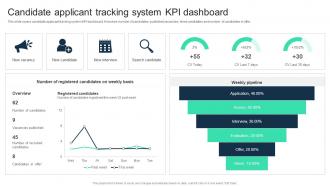
This slide covers candidate applicant tracking system KPI dashboard. It involves number of candidates, published vacancies, hired candidates and number of candidates in offer.
People who downloaded this PowerPoint presentation also viewed the following :
Candidate Applicant Tracking System KPI Dashboard Adopting Digital Transformation DT SS with all 10 slides:
Use our Candidate Applicant Tracking System KPI Dashboard Adopting Digital Transformation DT SS to effectively help you save your valuable time. They are readymade to fit into any presentation structure.









FAQs for Candidate Applicant Tracking System KPI Dashboard Adopting Digital
A candidate applicant tracking system should include automated resume screening, integrated job posting across multiple platforms, collaborative candidate evaluation tools, interview scheduling automation, and comprehensive analytics dashboards. These features streamline recruitment by reducing manual tasks, accelerating candidate assessment, and enabling data-driven hiring decisions, with many organizations finding that strategic ATS implementation significantly enhances talent acquisition efficiency and competitive positioning.
Applicant tracking systems integrate with other HR tools through APIs, data synchronization, and unified platforms that connect recruitment, onboarding, payroll, and performance management systems. This strategic combination streamlines workflows by automatically transferring candidate data, synchronizing employee records, and enabling seamless transitions from hiring to human resource management, ultimately delivering enhanced operational efficiency and better employee experiences across organizations.
AI-driven candidate matching algorithms provide enhanced screening accuracy, automated skill assessments, bias reduction capabilities, faster processing times, and improved candidate ranking systems. These technologies streamline recruitment by analyzing resumes against job requirements, predicting candidate success rates, and identifying top talent more efficiently, with many HR departments finding that automated matching reduces hiring time by 40-50% while improving quality of hires.
A candidate applicant tracking system improves the hiring experience by providing transparent communication, streamlined application processes, automated status updates, and self-service portals for document submission. Through mobile-friendly interfaces and real-time feedback mechanisms, candidates in sectors like healthcare, technology, and finance experience faster response times, clearer expectations, and more professional interactions, ultimately enhancing employer brand perception.
Organizations should track time-to-hire, cost-per-hire, candidate experience scores, source effectiveness, and hiring manager satisfaction to measure ATS effectiveness. These metrics enable companies to streamline recruitment processes, optimize resource allocation, and enhance talent acquisition strategies, with many finding that comprehensive tracking ultimately delivers faster hiring cycles and improved candidate quality.
Data analytics in applicant tracking systems influences hiring decisions by identifying top candidates through resume screening algorithms, predicting job performance based on historical data, reducing bias through standardized evaluation metrics, and tracking recruitment funnel efficiency. Through predictive modeling and pattern recognition, organizations streamline candidate selection, minimize time-to-hire, and enhance hiring quality, with many companies finding that data-driven approaches ultimately deliver better talent acquisition outcomes and competitive advantage.
Customizable workflows in an applicant tracking system streamline recruitment by automating candidate screening, standardizing interview scheduling, and enabling tailored approval processes for different roles and departments. These automated sequences reduce manual administrative tasks, ensure consistent candidate experiences across hiring teams, and accelerate decision-making timelines, with many organizations finding that structured workflows decrease time-to-hire by up to 40%.
Compliance ensures applicant tracking systems adhere to employment laws, data protection regulations, and accessibility standards through automated record-keeping, standardized processes, and audit trails. These systems streamline EEOC reporting, maintain candidate data security, and enforce consistent hiring practices across organizations, with many companies finding that robust compliance features minimize legal risks while enhancing recruitment transparency and operational efficiency.
Employers can ensure diversity and inclusion through their ATS by implementing bias-free job descriptions, removing identifying information during initial screenings, tracking demographic data, and using structured interview processes. These systems enable organizations to monitor hiring patterns across different groups, identify potential bottlenecks in recruitment pipelines, and ultimately deliver more equitable hiring practices while expanding talent pools for competitive advantage.
Companies face challenges including data migration complexities, user adoption resistance, integration difficulties with existing HR systems, workflow disruptions, and staff training requirements. While these implementation hurdles can temporarily impact recruitment efficiency, organizations that invest in comprehensive change management and phased rollouts ultimately streamline their hiring processes, reduce time-to-fill metrics, and enhance candidate experiences significantly.
Mobile accessibility enhances ATS usability by enabling candidates to apply instantly from any device, complete profiles on-the-go, and receive real-time notifications about application status. For recruiters, mobile platforms streamline candidate review during travel, facilitate quick communication through in-app messaging, and accelerate decision-making processes, with many organizations finding that mobile-optimized systems significantly improve candidate engagement and reduce time-to-hire.
Best practices for training staff on applicant tracking systems include comprehensive role-based training modules, hands-on practice sessions, clear workflow documentation, regular refresher workshops, and establishing system champions within each department. These training approaches streamline recruitment processes by ensuring consistent candidate evaluation, reducing time-to-hire, and improving collaboration between hiring managers and HR teams, ultimately delivering enhanced recruitment efficiency and better candidate experiences.
Applicant tracking systems reduce time-to-hire by automating resume screening, streamlining candidate communication, and centralizing interview scheduling processes. These platforms enable HR teams to quickly identify qualified candidates, eliminate manual administrative tasks, and accelerate decision-making workflows, with many organizations finding that automated filtering and integrated collaboration tools ultimately deliver faster placements and improved recruitment efficiency.
Cloud-based ATS solutions typically involve lower upfront costs through subscription models, while on-premise systems require significant initial investments in hardware, software licenses, and IT infrastructure. However, cloud systems present ongoing monthly fees and potential data migration costs, whereas on-premise solutions offer long-term cost predictability, with many organizations finding that cloud-based systems ultimately deliver faster implementation and reduced IT maintenance expenses.
Security features in applicant tracking systems protect candidate data through encrypted data storage, secure access controls, compliance monitoring, and regular security audits. These comprehensive protections enable organizations to safeguard sensitive personal information, maintain GDPR and privacy regulation compliance, and build candidate trust, while ultimately delivering competitive hiring advantages through enhanced data security and streamlined recruitment processes.
-
I can say with full confidence that all your business, academic, or professional work requirements will be sufficed with SlideTeam. Their gallery is as rich as 2Million+!!
-
Kudos to SlideTeam for achieving the high success rate in delivering the top-notch slides.