

Capability maturity model with optimizing




Try Before you Buy Download Free Sample Product
 Impress Your
 Audience
 100%
100% Editable
 Save Hours
 of Time


Identify issues that jar with our Capability Maturity Model With Optimizing. Eliminate any cause for disagreement.
People who downloaded this PowerPoint presentation also viewed the following :
Capability maturity model with optimizing with all 5 slides:
Eliminate any cause for disagreement with our Capability Maturity Model With Optimizing. Identify issues that jar.




FAQs for Capability maturity
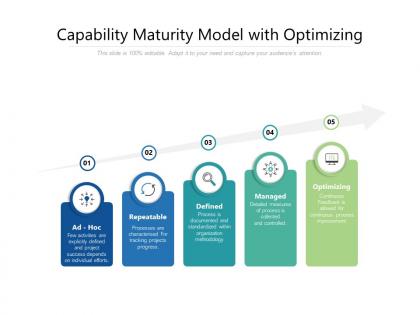
The Capability Maturity Model features five progressive stages: Initial (ad-hoc processes), Repeatable (basic project management), Defined (standardized processes), Managed (quantitative measurement), and Optimizing (continuous improvement). These stages correlate directly with organizational growth, as companies advancing through higher maturity levels achieve greater operational efficiency, predictable outcomes, and competitive advantage, with many enterprises finding that systematic capability development ultimately delivers scalable processes and enhanced performance metrics.
Organizations can assess their current maturity level through comprehensive process audits, stakeholder interviews, performance metrics analysis, gap identification workshops, and benchmarking against industry standards. These assessment methods enable systematic evaluation by examining documentation quality, process consistency, and outcome predictability, with many organizations finding that third-party evaluations provide objective insights, ultimately delivering clear roadmaps for strategic capability advancement.
Data analytics enhances CMM processes by providing quantitative insights into process performance, identifying improvement opportunities, and enabling data-driven decision making across maturity levels. Through advanced analytics, organizations can track key performance indicators, predict process bottlenecks, and measure the effectiveness of process improvements, ultimately accelerating their journey toward higher maturity levels while reducing implementation costs.
Companies identify capability gaps using CMM through systematic assessment against defined maturity levels, process documentation reviews, performance metric analysis, and stakeholder feedback collection. This structured evaluation enables organizations to pinpoint specific areas needing improvement, such as inconsistent processes in manufacturing or inadequate quality controls in software development, ultimately delivering targeted optimization strategies and competitive advantage.
Best practices for implementing a Capability Maturity Model include conducting thorough baseline assessments, securing executive sponsorship, establishing cross-functional improvement teams, defining clear process documentation, and creating measurable performance metrics. These approaches streamline organizational transformation by standardizing workflows, enhancing quality control, and building sustainable improvement cultures, with many enterprises finding that systematic CMM implementation ultimately delivers reduced operational costs, improved project success rates, and significant competitive advantage in increasingly complex business environments.
The Capability Maturity Model aligns with agile methodologies by emphasizing continuous improvement, iterative processes, and systematic quality management throughout development cycles. While CMM provides structured maturity frameworks for organizational processes, agile delivers flexibility and rapid adaptation, with many software organizations finding that combining both approaches enhances project predictability, reduces development risks, and ultimately delivers faster time-to-market while maintaining quality standards.
Organizations face challenges including resistance to change, inadequate resource allocation, skills gaps, lack of leadership commitment, and difficulty measuring progress effectively. These obstacles often stem from entrenched processes and cultural barriers, with many companies finding that successful maturity elevation requires strategic change management, comprehensive training programs, and sustained executive support to ultimately deliver improved operational efficiency and competitive advantage.
Leadership can effectively drive CMM optimization by establishing clear governance structures, allocating dedicated resources for process improvement initiatives, and fostering a culture of continuous learning and measurement. Through regular assessments and strategic investments in training, leaders enable their organizations to systematically advance through maturity levels, ultimately delivering improved project predictability, reduced costs, and enhanced competitive positioning in increasingly complex markets.
Key CMM implementation metrics include process adherence rates, defect reduction percentages, project delivery timelines, cost per defect, customer satisfaction scores, and employee productivity measures. These indicators enable organizations to track their maturity progression systematically, with many software development companies and manufacturing firms finding that combining quantitative metrics with qualitative assessments delivers comprehensive visibility into process improvements and competitive advantages.
The Capability Maturity Model can be tailored by adapting core processes to industry-specific requirements, regulatory frameworks, quality standards, and operational priorities unique to each sector. Organizations in healthcare focus on patient safety protocols, financial services emphasize compliance and risk management, while manufacturing prioritizes quality control and supply chain optimization, ultimately delivering enhanced operational efficiency and competitive advantage tailored to their strategic business environment.
Common pitfalls include treating CMM as a checklist rather than cultural transformation, focusing solely on documentation over actual process improvement, rushing through maturity levels without embedding practices, and neglecting stakeholder buy-in across departments. Organizations often underestimate the time and resources required, with many finding that sustainable CMM implementation requires consistent leadership commitment, comprehensive training, and gradual integration rather than rapid deployment.
Organizations sustain CMM improvements by embedding processes into daily operations, establishing continuous monitoring systems, maintaining regular training programs, and creating feedback loops for ongoing refinement. Through systematic measurement and governance frameworks, companies in manufacturing, healthcare, and financial services achieve lasting operational efficiency, reduced defects, and enhanced quality standards, ultimately delivering sustained competitive advantage and improved customer satisfaction.
Employee training and development serves as the foundation for CMM optimization by building competencies in process standardization, quality management, and continuous improvement methodologies across all organizational levels. Through structured learning programs, organizations enhance team capabilities in documentation, measurement, and process refinement, with many finding that well-trained employees drive faster maturity level progression and sustainable process optimization.
Technology aids CMM assessment and improvement through automated process monitoring, data analytics platforms, workflow management systems, and real-time performance tracking tools. These solutions streamline maturity evaluations by collecting objective metrics, identifying process gaps, and enabling continuous monitoring, with many organizations finding that integrated dashboards and AI-driven insights accelerate their progression through maturity levels while reducing assessment costs.
The Capability Maturity Model enhances customer satisfaction by standardizing processes, reducing defects, ensuring consistent delivery timelines, and improving communication transparency throughout project lifecycles. Organizations implementing CMM frameworks typically deliver more reliable products, respond faster to customer needs, and maintain predictable service quality, with many clients in software development and manufacturing finding that higher maturity levels directly correlate with improved customer retention rates.
No Reviews