

Capacity Development Powerpoint Presentation Slides




Try Before you Buy Download Free Sample Product
 Impress Your
 Audience
 100%
100% Editable
 Save Hours
 of Time


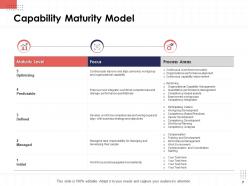
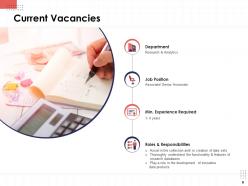
Analyze the competence of your organization with these Capacity Development PowerPoint Presentation Slides. Our readily available organizational competence PowerPoint slideshow allows you to depict your company’s background, capabilities, accreditation, vision, and mission. Highlight the current vacancies for various profiles and the qualifications required for the same by utilizing this PPT slide deck. Take the assistance of our visually appealing capability model PPT slides to showcase the five levels of capability maturity; namely initial, managed, defined, predictable, and optimizing. You can mention the job description of various profiles and the skills required in this template. Elucidate the recruitment budget components such as total recruitment expenses, no. of employees hired, salary, and complete work experience using these organizational competence PowerPoint layouts. Moreover, the capabilities required for increasing revenue, like objection handling, consultative skills, and prioritizing accounts, can also be demonstrated using this PowerPoint complete deck. Enhance your processes, functions, and systems by downloading this organizational performance PPTslideshow.
People who downloaded this PowerPoint presentation also viewed the following :
Content of this Powerpoint Presentation
Slide 1: This slide introduces Capacity Development. State your Company name and begin.
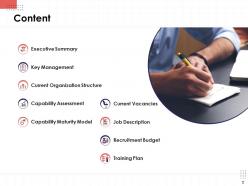
Slide 2: This slide displays Content of the presentation.
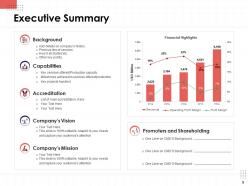
Slide 3: This slide displays Executive Summary. Add details on company’s history.
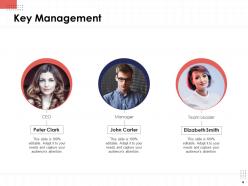
Slide 4: This slide depicts Key management.
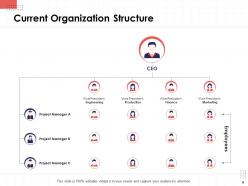
Slide 5: This slide showcases Current Organization Structure
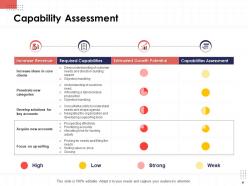
Slide 6: This slide shows Capability Assessment with- High, Low, Strong, Weak.
Slide 7: This slide showcases Capability Maturity Model
Slide 8: This slide shows Roles & Responsibilities
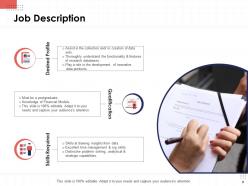
Slide 9: This slide highlights Job Description
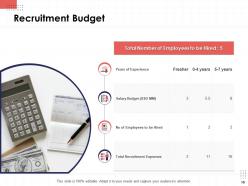
Slide 10: This slide presents Recruitment Budget
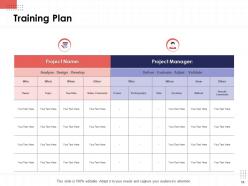
Slide 11: This slide shows Training Plan
Slide 12: This is Capacity Development Icons Slide.
Slide 13: This slide is titled as Additional Slides for moving forward.
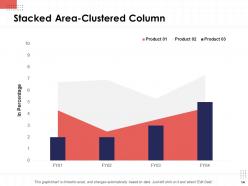
Slide 14: This slide displays Stacked Area-Clustered Column
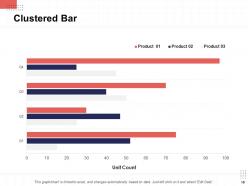
Slide 15: This slide shows Clustered Bar chart for comparison of products.
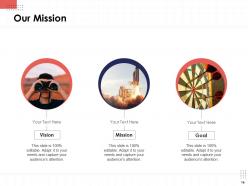
Slide 16: This slide displays Mission, Vision and Goals.
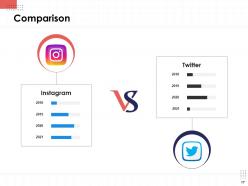
Slide 17: This slide displays Comparison
Slide 18: This is About Us slide to showcase Company specifications.
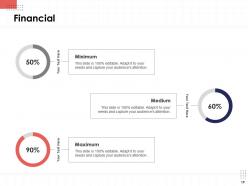
Slide 19: This is Financial slide. Showcase Finance related stuff.
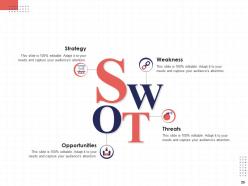
Slide 20: This slide helps to analyze strengths, weaknesses and opportunities of the company.
Slide 21: This slide display Bulb or Idea
Slide 22: This is Thank you slide with Contact details.
Capacity Development Powerpoint Presentation Slides with all 22 slides:
Use our Capacity Development Powerpoint Presentation Slides to effectively help you save your valuable time. They are readymade to fit into any presentation structure.

FAQs for Capacity Development
Effective capacity development strategies include systematic skills assessment, targeted training programs, knowledge management systems, performance measurement frameworks, and sustainable resource allocation. These components work together by identifying capability gaps, delivering customized learning solutions, and creating institutional memory, with organizations across sectors like healthcare and finance finding that strategic capacity building ultimately enhances operational efficiency and competitive advantage.
Organizations assess current capacity through comprehensive audits of existing skills, resources, infrastructure, and performance metrics across departments. This systematic evaluation includes employee competency assessments, resource allocation reviews, and gap analyses comparing current capabilities with strategic objectives, ultimately enabling targeted development programs that maximize ROI and organizational effectiveness.
Stakeholder engagement ensures capacity development initiatives align with actual needs, secure necessary resources, and achieve sustainable adoption across organizations. Through collaborative planning, feedback integration, and shared ownership, engaged stakeholders become champions rather than obstacles, with many institutions finding that early involvement significantly improves program effectiveness, reduces resistance, and ultimately delivers lasting organizational transformation.
Cultural differences significantly impact capacity development in multinational environments by creating varying learning preferences, communication styles, power dynamics, and knowledge transfer approaches across diverse teams. While these differences present initial challenges, organizations increasingly find that embracing cultural diversity enhances innovation, broadens problem-solving perspectives, and ultimately delivers more comprehensive capacity-building outcomes when managed strategically.
Capacity development program metrics include participant skill assessments, knowledge retention rates, behavioral change indicators, performance improvement measures, and organizational outcome tracking. These evaluation methods streamline program effectiveness by measuring competency gains, tracking application of new skills in workplace settings, and assessing long-term impact on productivity, ultimately delivering measurable returns on training investments.
Technology enhances capacity development through e-learning platforms, virtual reality training, AI-powered skill assessments, mobile learning applications, and data analytics tools. These solutions streamline knowledge transfer by delivering personalized learning experiences, enabling remote access to expertise, and providing real-time performance feedback, with organizations across healthcare, manufacturing, and financial services finding significantly improved training efficiency and workforce capabilities.
Organizations can ensure capacity development sustainability through strategic planning, embedding learning into organizational systems, creating mentorship programs, securing long-term funding commitments, and establishing clear performance metrics. These approaches enable institutions to build internal expertise, reduce dependency on external training, and create self-reinforcing development cycles, with many companies finding that integrated capacity building ultimately delivers improved employee retention and enhanced operational efficiency.
Capacity development aligns with organizational goals through strategic needs assessments, targeted skill-building programs, and performance measurement frameworks that directly support business objectives. Organizations streamline this alignment by mapping competency gaps to strategic priorities, implementing role-specific training initiatives, and establishing clear metrics, ultimately delivering enhanced operational efficiency and competitive advantage across departments.
Common challenges during capacity development include limited resources, resistance to change, skills gaps, inadequate leadership support, and poor assessment of current capabilities. Organizations can overcome these obstacles by securing strategic funding, implementing change management frameworks, creating targeted training programs, ensuring executive buy-in, and conducting thorough capacity audits, ultimately delivering enhanced operational efficiency and competitive advantage.
Partnerships and collaborations enhance capacity development by pooling resources, sharing expertise, expanding reach, and reducing costs for participating organizations. Through strategic alliances, institutions can access specialized knowledge, leverage complementary strengths, and deliver comprehensive training programs, with many organizations finding that collaborative approaches ultimately accelerate skill-building while maximizing operational efficiency and competitive advantage.
Best practices for designing training programs that support capacity development include needs assessment, competency mapping, blended learning approaches, mentorship integration, and continuous evaluation mechanisms. These methodologies enhance organizational capabilities by addressing skill gaps systematically, incorporating hands-on application opportunities, and measuring progress through performance metrics, with many institutions finding that strategic training design ultimately delivers improved employee retention and competitive advantage.
Capacity development addresses inequality by enhancing skills training, improving resource allocation, and creating inclusive leadership opportunities across all organizational levels. Through targeted programs, organizations can bridge knowledge gaps, establish mentorship networks, and implement equitable promotion pathways, with many institutions finding that systematic capacity building ultimately delivers more diverse leadership, reduced pay disparities, and enhanced workplace equity.
Feedback mechanisms can be integrated through regular surveys, peer evaluations, mentor assessments, performance metrics tracking, and structured reflection sessions throughout capacity development programs. These approaches enable organizations to continuously refine training content, identify skill gaps, and measure progress in real-time, with many institutions finding that systematic feedback loops ultimately enhance learning outcomes and ensure programs deliver measurable professional growth.
Capacity development and knowledge transfer work synergistically, with knowledge transfer serving as a critical mechanism for building organizational capabilities through training, mentoring, documentation, and collaborative learning initiatives. This strategic combination enables organizations to systematically enhance employee skills, preserve institutional knowledge, and accelerate professional growth, ultimately delivering improved performance and sustainable competitive advantage.
Capacity development enhances crisis management by building robust response protocols, cross-functional leadership skills, and adaptive communication systems that enable rapid decision-making during emergencies. Organizations with strong capacity development programs, particularly in healthcare and financial services, demonstrate faster recovery times, maintain stakeholder confidence, and often emerge stronger with improved operational resilience and competitive positioning.
-
Good research work and creative work done on every template.
-
Use of icon with content is very relateable, informative and appealing.
-
Unique research projects to present in meeting.
-
Use of icon with content is very relateable, informative and appealing.
-
Graphics are very appealing to eyes.
-
Best Representation of topics, really appreciable.
-
Editable templates with innovative design and color combination.